
Traditional DMA uses “stakeholder engagement” as a box-ticking exercise. We built a service to ensure their ideas are valued and they play an actual role in determining the final report.
The “Empty Engagement” Problem
The stakeholder’s frustrated perspective
Imagine spending an hour giving detailed, thoughtful feedback in a stakeholder survey or interview. You spend an hour detailing your concerns about their water usage and its environmental impact (‘E’) on local ecosystems.
Or perhaps you’re an employee, pointing out a major gap in workforce safety (‘S’). Months later, a 100-page report is published. You read it, and your feedback is nowhere to be found. It’s as if you shouted into a void.
The problem
This is ’empty engagement.’ It’s the act of contacting stakeholders to tick a compliance box, without ever valuing their input. The traditional DMA process is full of these “black boxes,” where stakeholder insights go to die.
The “truth”
A DMA report built this way isn’t just a missed opportunity; it’s a strategic risk. We built our service on a completely different principle: Your stakeholders’ value must be noted and valued during the process, because they are the ones who actually help determine and complete the final report.
The “Hard Way” — Engagement without Value
We analyzed why even well-intentioned stakeholder engagement fails. The ‘traditional method’ is not designed to value feedback; it’s designed to extract it. It’s a one-way street.
The “Traditional Method(The “Box-ticking way”)
Input: A stakeholder gives their ideas, feedback, and insights via a one-time survey or interview.
The Black Box: This data is sent to a small, internal team or consultant. It’s “processed” in private. There is no feedback loop.
Output: A final, polished report appears. The original stakeholder cannot see the “thread” that connects their specific idea to the final list of material topics.
The Problem with This (The “Truth”)
Stakeholders Feel Used: They took time to provide value but were treated as a data point. They will not participate again.
The Report is Weak: It’s not defensible.
An auditor asks, “How did you weigh this topic?”
The answer is, “It was our team’s analysis of feedback from a closed process,” not, “Our stakeholders showed us this was critical.”
Creates Distorted or Misleading Data
The “Black Box” is a translation step where stakeholder value can be lost or incorrectly noted. A small, isolated research team must interpret raw feedback without context or a feedback loop.
This forces them to guess the true priority or meaning behind a comment. As a result, urgent risks can be downplayed and critical opportunities missed, leading to a final report based on misleading information that fundamentally misrepresents what stakeholders actually value.
Our Method: The Collaborative & Transparent Solution
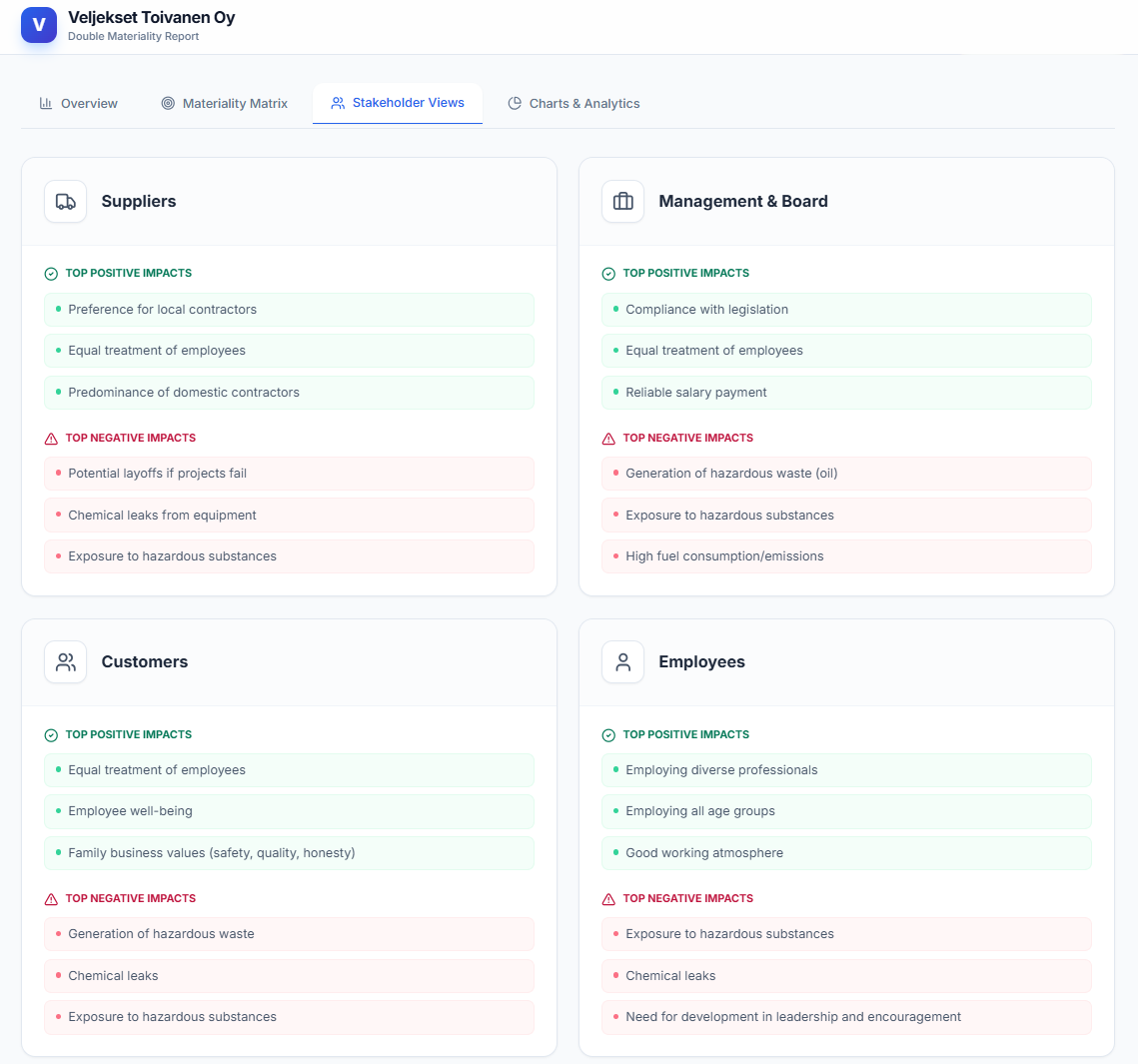
Our service is designed to be a ‘shared project room’’ not a ‘black box.’ We make stakeholder collaboration the engine of the DMA, not just a step in the process.
Benefit 1: Their Ideas, Feedback, and Insights Are Heard (and Seen).
Our service provides a clear, transparent platform where stakeholder contributions are visibly logged and tracked.
When someone submits an idea, it doesn’t vanish. It becomes a visible part of the project, allowing others to review and build upon it.
Benefit 2: They Actually Play a Role in Determining and Completing the DMA Report.
Because the process is transparent and collaborative, stakeholders become co-creators.
They can see why a topic is prioritized (or deprioritized) based on the collective feedback.
They aren’t surprised by the final report because they helped determine its outcome. They have a real, tangible role in completing the work.
Benefit 3: Integrated Communications
Our process replaces the “black box” with a transparent workflow where communication is clearly built into every step of the report’s creation.
Stakeholders receive active feedback as their contributions are processed, ensuring their insights are noted accurately rather than being lost in a secret internal analysis.
This integrated communication loop enhances data integrity and makes the final report highly valid and defensible.
Head-to-Head: The “Token” Method vs. The “Valued” Method
| Feature | Traditional “Empty Engagement” | Our “Valued Stakeholder” Service |
|---|---|---|
| Stakeholder Role | Data Point (to be extracted) | Co-Creator (to be valued) |
| Feedback Process | “Black Box” (feedback disappears) | “Glass Box” (feedback is tracked & visible) |
| Value | Ignored or assumed (invisible) | Noted, appreciated and visible throughout the process |
| Final Report | Simply a report delivered to them | An outcome they helped determine |
| Stakeholder Feel | Ignored, used, “box-ticking” | Heard, valued, and integral to success, committed to act |
Conclusion: Stop Guessing. Start Engaging.
Don’t just ‘engage’ your stakeholders. Value them. The goal isn’t to send a survey; it’s to build a consensus and better emotional climate.
A DMA created in a ‘black box’ is a document nobody trusts. A DMA created with our transparent, collaborative service is a strategy that your stakeholders, from your employees to your investors, already believe in—because they helped build it.
Stop treating your stakeholders like data points. See how our service can make them your most valuable partners in building your DMA.
Photo attributes: Image by freepik