Scope 1, 2, and 3 Emissions: The Ultimate Guide for European SMEs
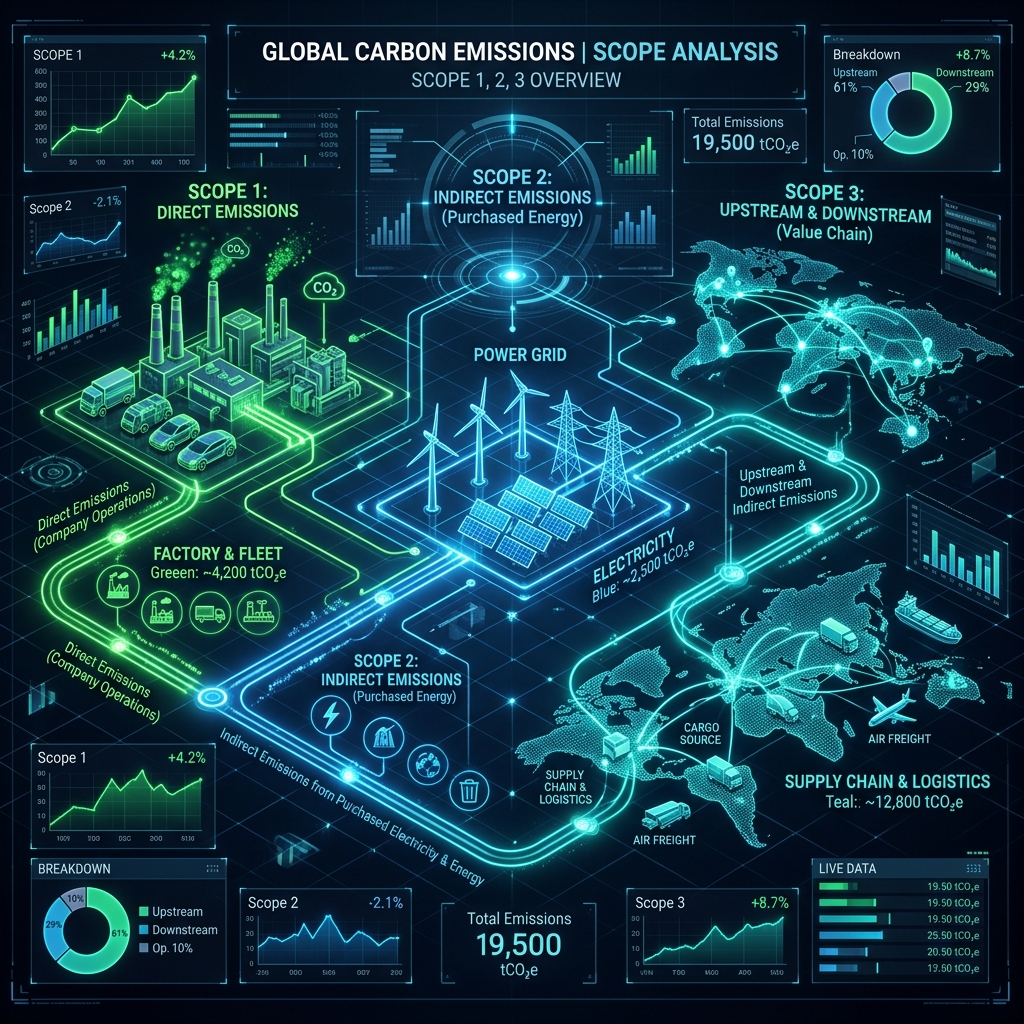
Scope 1, 2, and 3 Emissions: The Ultimate Guide for European SMEs
If you run a small or medium-sized enterprise (SME) in Europe, sustainability is no longer a corporate social responsibility footnote. It is a core business requirement. Large corporate buyers are setting net-zero targets and demanding carbon data from their suppliers. Banks are linking interest rates to sustainability performance. And standard-setters like EFRAG are rolling out the Voluntary SME (VSME) reporting standard.
To survive and thrive in this landscape, you must understand how carbon emissions are categorized and calculated.
Greenhouse gas (GHG) emissions are classified into three "scopes" based on where they originate. In this guide, we will break down what Scope 1, 2, and 3 emissions mean, how they map to modern compliance frameworks, and how your business can measure and reduce them without hiring expensive consultants.
📊 Quick Guide: Emissions Scopes at a Glance
Emissions from assets directly owned or controlled by your company.
- Boilers & heaters
- Company fleet vehicles
- On-site manufacturing
Indirect emissions from electricity, steam, heating, and cooling you buy.
- Office electricity
- District heating
- Supermarket cooling
All other indirect emissions from suppliers, shipping, and product use.
- Purchased raw materials
- Logistics & shipping
- Employee commuting
1. Introduction to Carbon Scopes & The GHG Protocol
The classification of greenhouse gas emissions into Scope 1, 2, and 3 was introduced in 2001 by the Greenhouse Gas Protocol (GHG Protocol). Developed jointly by the World Resources Institute (WRI) and the World Business Council for Sustainable Development (WBCSD), the GHG Protocol Corporate Standard is the global standard for carbon accounting.
Practically all corporate climate programs, regulatory standards (like CSRD and VSME), and ESG reporting software are anchored to the GHG Protocol.
Why Do We Use Scopes?
The main reason for dividing emissions into three scopes is to avoid double counting.
If every company reported their emissions without scopes, a power grid operator, an office using the electricity, and the supplier providing the fuel would all claim the exact same carbon footprint. Scopes establish a clear, standardized boundary of responsibility:
- Scope 1 represents your direct footprint (under your operational control).
- Scope 2 captures your shared energy burden.
- Scope 3 accounts for your upstream suppliers and downstream customers.
It is also important to note that while "carbon footprint" is the common term, GHG reporting measures several greenhouse gases, not just carbon dioxide ($CO_2$). The GHG Protocol tracks the seven main gases listed under the Kyoto Protocol, each normalized to their Carbon Dioxide Equivalent ($CO_2e$) based on their Global Warming Potential:
- Carbon Dioxide ($CO_2$): Accounts for approximately 81% of overall global emissions, primarily from burning fossil fuels.
- Methane ($CH_4$): Accounts for 10%, mostly from agriculture, landfills, and natural gas systems.
- Nitrous Oxide ($N_2O$): Accounts for 7%, primarily from fertilizers and industrial combustion.
- Fluorinated gases (HFCs, PFCs, $SF_6$, $NF_3$): Account for 2%, primarily from refrigeration leaks and electronics manufacturing. While small in volume, these gases have global warming potentials thousands of times higher than $CO_2$.
2. Direct vs. Indirect Emissions: What's the Difference?
The fundamental line dividing the scopes is the distinction between direct and indirect emissions. This is defined by ownership and operational boundaries:
- Direct emissions are greenhouse gases emitted directly from sources that your company owns or operationalizes. You have direct control over the source (e.g., turning on a gas heater or driving a company van).
- Indirect emissions occur as a consequence of your company's activities, but are emitted from sources owned or controlled by another entity. This includes the power plant generating your office electricity (Scope 2) and the cargo ship carrying your raw materials (Scope 3).
3. What is Scope 1? (Direct Emissions)
Scope 1 covers direct GHG emissions released into the atmosphere from sources owned or controlled by your company. For most SMEs, Scope 1 is the easiest starting point because you hold the invoices and activity logs.
The GHG Protocol categorizes Scope 1 emissions into five primary categories:
1. Stationary Combustion
Emissions from burning fuels in stationary equipment on your company's premises.
- SME Examples: Gas boilers heating your office, oil furnaces in workshops, diesel generators for backup power.
- SME Action: Pull your annual gas bills or utility invoices showing fuel consumption (typically in cubic meters or kWh).
2. Mobile Combustion
Emissions from burning fuel in transportation vehicles owned or leased by your company.
- SME Examples: Petrol or diesel delivery vans, sales reps' company cars, forklifts, construction machinery.
- SME Action: Tally fuel card records, mileage logs, or receipts for fuel purchases.
- Note: Electric vehicles (EVs) in your fleet do not emit tailpipe greenhouse gases. Their emissions are instead captured under Scope 2 (electricity used to charge them on-site) or Scope 3 (electricity used to charge them off-site).
3. Process Emissions
Emissions released during on-site chemical transformations or manufacturing processes.
- SME Examples: Producing $CO_2$ during cement manufacturing, metal smelting, chemical blending, or food processing.
- SME Action: Monitor chemical throughput and production logs.
4. Fugitive Emissions
Unintentional leaks of greenhouse gases from equipment or containment structures.
- SME Examples: Refrigerant gas leaks from office air conditioning systems, supermarket coolers, or food warehouse refrigeration units.
- SME Action: Review annual maintenance records from HVAC technicians showing the quantity of refrigerant gas refilled (e.g., R-134a or R-410A). Refrigerants are highly potent greenhouse gases; a small leak can equal several tonnes of $CO_2e$.
5. Agricultural Emissions
Emissions resulting from agricultural operations.
- SME Examples: Methane ($CH_4$) emissions from company-owned livestock, or nitrous oxide ($N_2O$) emissions from synthetic fertilizers on corporate land.
4. What is Scope 2? (Indirect Purchased Energy)
Scope 2 emissions are indirect emissions resulting from the generation of electricity, steam, heating, or cooling purchased and consumed by your company. These emissions physically occur at the utility provider's power plant, but are attributed to your business because your consumption drove the energy generation.
For many service-based SMEs (such as software agencies, retail stores, or consulting firms), Scope 2 represents a major portion of their operational footprint.
The Two Calculation Methods for Scope 2
Under the GHG Protocol Scope 2 Guidance, you must calculate and report your Scope 2 emissions using two distinct methodologies:
| Calculation Method | What It Measures | Best Used For |
|---|---|---|
| Location-Based Method | Reflects the average emissions intensity of the local grid where the energy is consumed. | Understanding the physical footprint of your local infrastructure. |
| Market-Based Method | Reflects the emissions intensity of the specific energy contracts you choose to buy. | Showcasing the impact of green energy purchases and certificates. |
Location-Based Example
If your German office consumes 50,000 kWh of electricity, the location-based calculation multiplies this by Germany’s national grid emission factor (reflecting the mix of coal, gas, wind, and solar feeding the grid).
Market-Based Example
If you sign a contract with a utility provider for 100% certified wind energy (backed by Guarantees of Origin), your market-based emission factor is zero. Under the market-based method, your Scope 2 electricity footprint is 0 kg $CO_2e$. However, under the location-based method, you must still report the grid-average footprint to reflect grid reality.
5. What is Scope 3? (Value Chain Emissions)
Scope 3 emissions are the "holy grail" of carbon accounting. They cover all other indirect emissions that occur up and down your value chain, originating from sources you do not own or control.
According to research by organizations like CDP and the Carbon Trust, Scope 3 accounts for an average of 88% to 92% of a company's total emissions. For B2B suppliers, understanding Scope 3 is critical because your Scope 1 and 2 emissions are your customers' Scope 3 emissions. For a deep dive into how these two scopes compare in practice, see our Scope 1 vs. Scope 3 Emissions guide.
The GHG Protocol splits Scope 3 emissions into 15 categories, divided into upstream and downstream categories:
graph TD
    classDef default fill:#f9f9f9,stroke:#333,stroke-width:1px;
    classDef highlight fill:#e1f5fe,stroke:#0288d1,stroke-width:2px;

    Sub3(Scope 3: Value Chain) --> Upstream(Upstream Activities: Categories 1-8)
    Sub3 --> Downstream(Downstream Activities: Categories 9-15)

    Upstream --> Cat1["1. Purchased Goods & Services"]
    Upstream --> Cat2["2. Capital Goods"]
    Upstream --> Cat3["3. Fuel & Energy Activities"]
    Upstream --> Cat4["4. Upstream Transport & Logistics"]
    Upstream --> Cat5["5. Waste Generated in Operations"]
    Upstream --> Cat6["6. Business Travel"]
    Upstream --> Cat7["7. Employee Commuting"]
    Upstream --> Cat8["8. Upstream Leased Assets"]

    Downstream --> Cat9["9. Downstream Transport & Logistics"]
    Downstream --> Cat10["10. Processing of Sold Products"]
    Downstream --> Cat11["11. Use of Sold Products"]
    Downstream --> Cat12["12. End-of-Life Treatment"]
    Downstream --> Cat13["13. Downstream Leased Assets"]
    Downstream --> Cat14["14. Franchises"]
    Downstream --> Cat15["15. Investments"]

    class Sub3 default;
    class Cat1,Cat4,Cat6,Cat7 highlight;
Key Upstream Categories (Supplier-Side)
- Purchased Goods & Services: The "cradle-to-gate" emissions of raw materials and software you buy (e.g., office furniture, paper, IT infrastructure, AWS hosting).
- Capital Goods: Emissions from producing long-life equipment, buildings, or vehicles you purchase. Note that unlike financial accounting, the GHG Protocol requires you to account for the entire footprint in the year of acquisition.
- Fuel- and Energy-Related Activities: Emissions from producing and transporting the energy you buy (e.g., transport losses in grid lines).
- Upstream Transportation & Distribution: Logistics, air freight, and trucking services hired to transport materials to your offices or warehouses.
- Waste Generated in Operations: Emissions from waste sent to landfill, incineration, or recycling plants.
- Business Travel: Emissions from flights, trains, rental cars, and hotel stays used by employees.
- Employee Commuting: The carbon cost of employees commuting to work, including home-office energy consumption.
- Upstream Leased Assets: Operating leased facilities not included in Scope 1 or 2.
Key Downstream Categories (Customer-Side)
- Downstream Transportation & Distribution: Shipping products to customers.
- Processing of Sold Products: Emissions from intermediate manufacturers processing your products.
- Use of Sold Products: Energy consumed by customers using your products (e.g., charging a phone you manufactured).
- End-of-Life Treatment of Sold Products: Waste treatment of your products at the end of their lifecycle (landfill vs. recycling).
- Downstream Leased Assets: Assets you lease to third parties.
- Franchises: Operations of your franchises.
- Investments: Primarily for financial services and venture funds.
Stop Guessing, Start Measuring
Calculate Your Scope 1 & 2 Emissions in Minutes
ExecutESG auto-applies country-specific emission factors to your utility data. No spreadsheets. No consultants.
Start Your Free Carbon Report →Free forever plan · No credit card · 2 minute setup
6. Beyond the Scopes: What are Scope 4 (Avoided) Emissions?
While not part of the official GHG Protocol framework, Scope 4 emissions—often called avoided emissions—are gaining significant popularity.
Scope 4 refers to the emissions reductions that occur outside of a product's lifecycle but are caused by the use of that product or service.
Examples of Scope 4:
- Energy-efficient devices: If you sell a smart thermostat that reduces a homeowner's gas usage by 20% compared to a standard model, that 20% reduction represents avoided emissions.
- Video conferencing software: Avoided travel emissions when users meet virtually instead of flying.
- Carbon accounting software: Helping companies optimize logistics, identify waste, and avoid excess carbon emissions.
Reporting Scope 4 allows progressive companies to showcase how their business model contributes to global decarbonization efforts, acting as a powerful differentiator in commercial bids.
7. Key Elements of a Compliant GHG Inventory
Before jumping into calculations, you must establish the rules of your greenhouse gas inventory. This ensures your final sustainability report is structured and auditable.
1. Boundary Setting
You must decide how to define which assets are "yours." The GHG Protocol offers two boundary models:
- Equity Share Boundary: You account for emissions in proportion to your ownership share in each joint venture or facility.
- Control Boundary (Most Common for SMEs): You account for 100% of emissions from operations where you have control. This is further split into:
- Financial Control: You direct financial policies and claim economic benefits.
- Operational Control (Recommended): You have the full authority to implement operating policies. This matches the Voluntary SME (VSME) framework.
2. Base Year Setting
To track carbon reduction, you need a starting point. Select a historical year (e.g., 2024 or 2025) with reliable data to act as your base year. All future reporting will compare progress back to this baseline.
3. Target Setting
Determine your emission reduction targets. A robust target should specify:
- The target boundary (e.g., Scopes 1 and 2).
Tip: If your organization also needs to align with ISO 14064-1 or GRI 305, see our GHG Protocol to ISO 14064 & GRI Mapping Guide for a side-by-side category mapping.
- The percentage reduction (e.g., 40% reduction by 2030).
- The target type (Absolute reduction vs. Intensity reduction, such as $tCO_2e$ per €1M revenue).
8. How to Calculate Scopes 1-3 in 4 Steps
Calculating your carbon footprint is simply a matter of converting activity metrics (like liters of fuel or kilowatt-hours of electricity) into greenhouse gas weights.
Activity Data (e.g., kWh) × Emission Factor (e.g., kg CO2e / kWh) = Emissions (kg CO2e)
Here is a step-by-step example for a typical office:
Step 1: Set Boundaries
Choose operational control. In this example, you lease an office in Helsinki and own two delivery vans.
Step 2: Collect Activity Data
Gather your activity logs for the calendar year:
- Natural gas (heating): 12,000 kWh (from utility bills).
- Diesel fuel (vans): 4,500 liters (from fuel card invoices).
- Electricity: 30,000 kWh (from building management bills).
- Office laptops purchased: €5,000 (from spend logs).
Step 3: Select Emission Factors
Acquire official, country-specific emission factors for the reporting year. Typical databases include UK DEFRA, ecoinvent, or local grid agencies.
- Diesel factor: 2.68 kg $CO_2e$ per liter.
- Finnish Grid average electricity factor: 0.089 kg $CO_2e$ per kWh.
- German Grid average electricity factor (alternative): 0.380 kg $CO_2e$ per kWh.
- Laptop spend-based factor: 0.22 kg $CO_2e$ per € spent.
Step 4: Apply the Formula
Scope 1 (Direct Fuels):
$$\text{Diesel emissions} = 4,500 \text{ liters} \times 2.68 \text{ kg/liter} = 12,060 \text{ kg } CO_2e \text{ (12.06 tonnes)}$$ $$\text{Natural Gas emissions} = 12,000 \text{ kWh} \times 0.20 \text{ kg/kWh} = 2,400 \text{ kg } CO_2e \text{ (2.40 tonnes)}$$ Total Scope 1 = 14.46 tonnes $CO_2e$.
Scope 2 (Electricity):
$$\text{Electricity emissions} = 30,000 \text{ kWh} \times 0.089 \text{ kg/kWh} = 2,670 \text{ kg } CO_2e \text{ (2.67 tonnes)}$$ Total Scope 2 = 2.67 tonnes $CO_2e$.
Scope 3 (Spend-based estimate):
$$\text{Laptop purchases} = €5,000 \text{ spend} \times 0.22 \text{ kg/€} = 1,100 \text{ kg } CO_2e \text{ (1.10 tonnes)}$$ Total Scope 3 = 1.10 tonnes $CO_2e$.
9. How to Reduce Emissions Across All Three Scopes
Measuring your footprint is only half the battle. The ultimate goal is decarbonization. Here are practical, cost-effective strategies for SMEs:
Scope 1 Reductions
- Vehicle Fleet: Shift company cars to battery electric vehicles (EVs). Replace old delivery vans with electric alternatives.
- HVAC Systems: Swap out gas boilers for air-source or geothermal heat pumps.
- Leak Prevention: Implement quarterly inspections on refrigeration systems to catch refrigerant leaks early.
Scope 2 Reductions
- Energy Efficiency: Swap office lighting to LEDs, install motion sensors, and shut down server racks when idle.
- Green Energy Contracts: Sign a market-based tariff for 100% renewable energy with your utility.
- On-Site Generation: Install rooftop solar panels to cover baseline electricity usage during work hours.
Scope 3 Reductions
- Supplier Engagement: Request carbon footprints from your top 10 suppliers. Favor suppliers who provide primary emissions data.
- Business Travel: Implement a travel policy favoring rail over short-haul flights within Europe, and use video conferencing.
- Employee Commuting: Incentivize public transit or cycling through corporate transit passes.
10. Frequently Asked Questions
Is Scope 3 reporting mandatory for SMEs? Under the European CSRD (Corporate Sustainability Reporting Directive), listing Scope 3 is mandatory for large listed corporates. For SMEs, Scope 3 reporting is currently voluntary under the VS (VSME) framework. However, large buyers are forcing their SME suppliers to report their Scope 1 & 2 emissions (which form the buyer's Scope 3), meaning Scope 3 tracking is effectively mandatory if you want to stay in corporate supply chains.
What is the difference between location-based and market-based Scope 2? Location-based calculations reflect the physical emissions of your local electricity grid. Market-based calculations reflect the energy choices you make, allowing you to claim a zero carbon footprint if you buy renewable energy certificates (like Guarantees of Origin).
What is a spend-based emission calculation method? It is a simplified Scope 3 calculation method where you multiply the monetary value of a purchase (e.g., €5,000 spent on metal parts) by an industry-average economic emission factor. For a complete comparison of how this compares to physical consumption metrics, read our guide on spend-based vs. consumption-based carbon calculations.
Ready to Calculate Your Carbon Footprint?
Import your utility bills and fuel records. ExecutESG automatically calculates Scopes 1 & 2 using verified emission factors and exports audit-ready VS (VSME) reports.
Start Your Free Report →Recommended Articles
- Scope 1 vs. Scope 3 Emissions: The B2B Supplier Guide
- How to Map GHG Protocol Scopes to ISO 14064 & GRI Standards
- How to Automate Your VS (VSME) Report (And Stop Wrestling with Spreadsheets)
- Best VS (VSME) Reporting Software Comparison
- VS (VSME) Data Collection Checklist
- VS (VSME) Standard Explained: The Complete Guide
Check Your VS (VSME) & CSRD Readiness Score
Answer 6 quick questions under the EU Voluntary Standard VS (VSME) to discover your compliance gap score, estimated time savings, and generate your free starter report.