The Business Case for Voluntary Sustainability Reporting
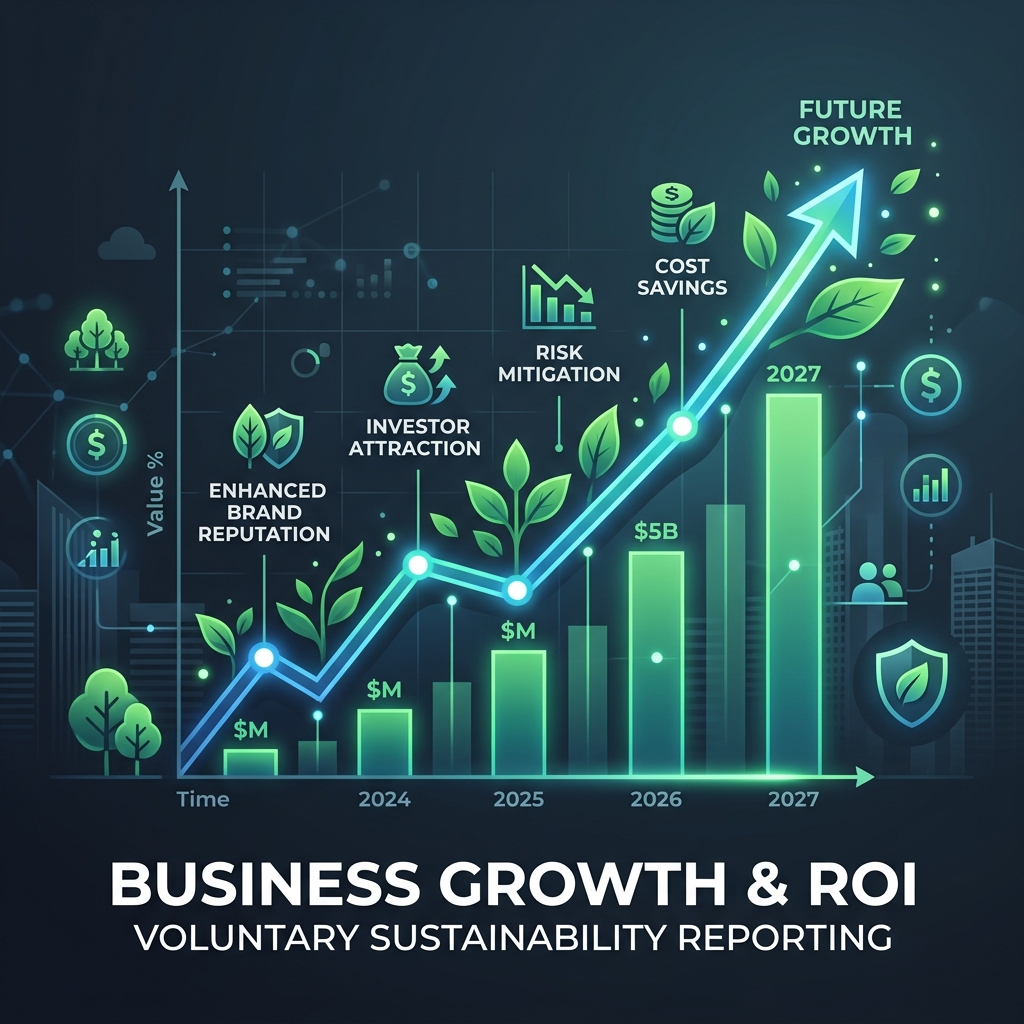
The Business Case for Voluntary Sustainability Reporting
For small and medium-sized enterprises (SMEs), sustainability reporting is often viewed as a defensive chore—a compliance task imposed by large customers or bank auditors. With limited resources, it is easy to wonder: is voluntary sustainability reporting actually worth the time and investment?
If you approach reporting as a retrospective box-ticking exercise, the return on investment will be low. However, when treated as a strategic tool, voluntary reporting becomes a powerful business driver.
In this guide, we break down the business case and ROI of voluntary sustainability reporting for SMEs, detailing how it secures capital, wins B2B contracts, and builds organizational alignment.
1. Access to Cheaper Capital and Green Financing
Banks and financial institutions face their own mandatory green asset ratio (GAR) reporting requirements under EU rules. Consequently, they must evaluate the environmental risks of their lending portfolios.
If your company has a verified ESG profile, you represent a lower risk profile to lenders:
- Under EFRAG’s voluntary VS (VSME) standard, the Lenders Module is built specifically to address bank inquiry points.
- Providing standardized carbon footprint and transition plan data enables you to qualify for sustainability-linked loans, green credit lines, and subsidized interest rates.
- Conversely, companies that cannot provide carbon baseline disclosures face higher interest premiums or restrictions on borrowing limits.
2. Sales Growth and Customer Retention
For B2B suppliers, sustainability reporting has trickled down. Large enterprises subject to the Corporate Sustainability Reporting Directive (CSRD) must disclose their Scope 3 value chain emissions, meaning they prefer suppliers that can provide verified carbon accounting data.
Furthermore, non-listed SMEs are protected by the Statutory Value Chain Cap introduced under the 2026 Omnibus simplification package:
[!IMPORTANT] The Statutory Cap: Large corporate buyers are legally prohibited from requesting sustainability data from suppliers with fewer than 1,000 employees that exceeds the voluntary VS (VSME) standard. If they request additional custom data, they must inform you of your legal right to refuse.
By compiling a standard VS (VSME) report, you pre-empt customer audits, protect your commercial accounts, and gain a competitive edge in public and private RFPs.
3. Shifting from Mandates to Leadership: The Psychological ROI
The traditional approach to corporate compliance often results in compliance detachment—where an administrator compiles data in a silo, and the leadership team has no ownership of the results.
ExecutESG resolves this by using the ExecutESG 10-Task DMA Workflow, mapped directly to our 9-Step Doctrinal Leadership Journey:
 ┌─────────────────────────────────────────────────────────────┐
  │                      THE 5-STEP ROADMAP                     │
  ├─────────────────────────────────────────────────────────────┤
  │  Step 1: Setup & Value Chain Context (Tasks 1 & 2)          │
  │  Step 2: Impact Identification & Validation (Tasks 3 & 4)   │
  │  Step 3: Stakeholder Engagement & Pairwise Voting (Task 5)  │
  │  Step 4: Financial Scoring of Risks & Opps (Tasks 6, 7 & 8) │
  │  Step 5: Consolidated Review & Declaration (Tasks 9 & 10)   │
  └─────────────────────────────────────────────────────────────┘
Instead of sending out long, confusing spreadsheets asking stakeholders to rate 50 topics from 1 to 5, ExecutESG uses forced-choice pairwise comparison surveys (Task 5). Stakeholders complete simple, binary comparisons (Topic A vs. Topic B), which Saaty's Analytic Hierarchy Process (AHP) converts into precise priority vectors.
This methodology delivers significant psychological ROI:
- Inclusion: Stakeholders feel their voice is mathematically counted, satisfying their need for Autonomy.
- Agency: Team members see their input directly shape the final materiality matrix, moving them from passive subjects to active strategic owners.
- Pride: The leadership team and employees take ownership of the final Double Materiality Matrix, transforming a top-down mandate into a collective strategic commitment.
Moving Away from Spreadsheet Chaos
To unlock the business case of sustainability reporting, you must minimize the administrative cost. ExecutESG offers a permanently free Basic Module, allowing you to transition from manual spreadsheets to automated grid calculators and triple exports (PDF, editable Word, and XBRL) without any financial commitment.
👉 Create your free account and start your report today
Recommended Articles
Check Your VS (VSME) & CSRD Readiness Score
Answer 6 quick questions under the EU Voluntary Standard VS (VSME) to discover your compliance gap score, estimated time savings, and generate your free starter report.
Stay Ahead of EU Sustainability Mandates
Get our weekly intelligence briefing on VS (VSME), CSRD compliance, buyer Scope 3 demands, and EcoVadis audits—distilled for European SMEs.