Directive (EU) 2026/470 Explained: CSRD & CSDDD Delays
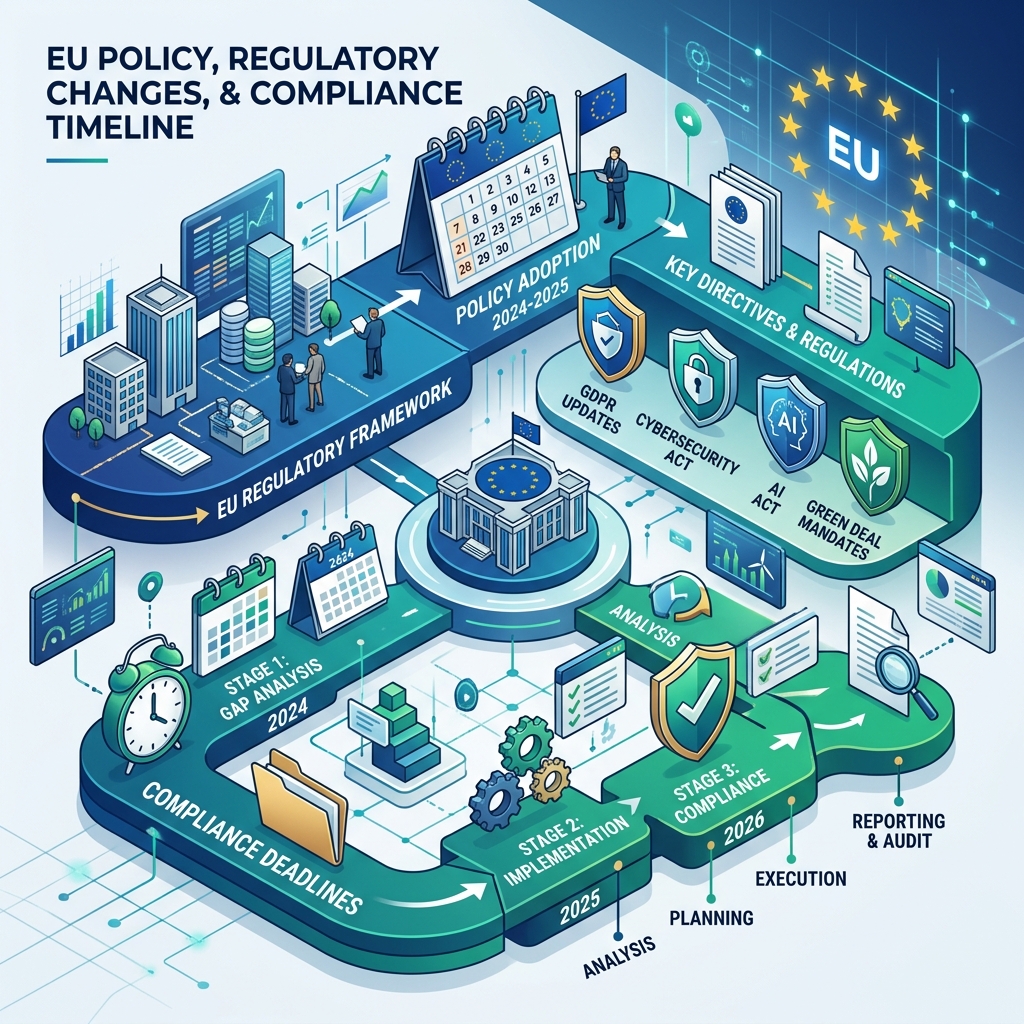
Directive (EU) 2026/470 Explained: CSRD & CSDDD Timeline Changes and Value Chain Impact
Directive (EU) 2026/470 is an EU legislative deferral that postpones Corporate Sustainability Due Diligence Directive (CSDDD) enforcement to 2028–2029 and grants CSRD value chain phase-ins. It establishes a 1,000-employee value chain cap, legally shielding mid-sized suppliers from excessive non-standardized ESG data requests.
The regulatory landscape for European corporate sustainability underwent a decisive calibration in early 2026. With the formal enactment of Directive (EU) 2026/470 of the European Parliament and of the Council (commonly referenced as the Omnibus I Deferrals Directive), EU policymakers recalibrated implementation timetables for corporate ESG disclosures and supply-chain due diligence.
While financial media characterized the measure as a broad "ESG pause," the operational reality for corporate buyers, compliance officers, and Small and Medium-sized Enterprises (SMEs) is fundamentally different. Directive (EU) 2026/470 provides relief from immediate punitive penalties for large enterprises, but it simultaneously introduces a binding 1,000-employee value chain cap that makes standardized voluntary reporting under the EFRAG VS (VSME) standard the de facto currency of commercial procurement.
This guide details what Directive (EU) 2026/470 changes, outlines the updated CSRD and CSDDD deadlines, unpacks the strategic trap of delaying compliance, and explains how suppliers can protect their enterprise contracts.
What Does Directive (EU) 2026/470 Change?
Directive (EU) 2026/470 amends the timeline and application scope across two cornerstone European sustainability frameworks:
- The Corporate Sustainability Reporting Directive (CSRD): Extends transitional value chain relief for reporting enterprises and limits the scope of mandatory ESG information buyers can demand from non-listed supply chain partners.
- The Corporate Sustainability Due Diligence Directive (CSDDD): Postpones the phased enforcement schedule by 12 to 24 months, granting member states and multinational corporations additional runway to harmonize due diligence verification systems.
The core legislative objective is eliminating "questionnaire chaos"—the practice where enterprise buyers distribute fragmented, multi-page ESG surveys to mid-market suppliers without standardized benchmarks.
Timeline & Scope Comparison: Old Rules vs. Directive (EU) 2026/470
The following table breaks down the specific deadline deferrals and scope thresholds enacted under Directive (EU) 2026/470:
| Regulatory Area | Original Directive Schedule / Scope | Directive (EU) 2026/470 Updated Schedule | Enterprise Obligation | SME Value Chain Impact |
|---|---|---|---|---|
| CSDDD Phase 1 (5,000+ employees / €1,500M turnover) | First compliance wave starting 2027 | Phased enforcement delayed to 2028 | Full human rights & environmental value-chain due diligence | Large buyers use 2026–2027 to audit and pre-qualify supply chains |
| CSDDD Phase 2 (3,000+ employees / €900M turnover) | Compliance wave scheduled for 2028 | Compliance wave deferred to 2029 | Mandatory risk mapping and adverse impact mitigation plans | Suppliers must provide standardized carbon and social metrics |
| CSRD Scope 3 Phase-In | Immediate value-chain disclosures with limited flexibility | 3-year transitional "comply-or-explain" grace period | Enterprises can explain Scope 3 data gaps if transition plans are documented | Enterprise buyers actively favor suppliers with ready Scope 1 & 2 data |
| Value Chain Data Cap (SME Shield) | Uncapped requests or 250-employee threshold | 1,000-employee statutory cap enacted | Buyers cannot legally demand full ESRS disclosures from SMEs (<1,000 staff) | SMEs gain legal right to provide simplified VS (VSME) report instead of bespoke audits |
| Standardized SME Framework | Fragmented national/private frameworks | Statutory alignment on EFRAG VS (VSME) standard | Enterprises must accept compliant VS (VSME) reports as sufficient value-chain data | One standardized report satisfies all customer procurement requests |
The 1,000-Employee Value Chain Cap: A Statutory Shield for Suppliers
The pivotal structural mechanism in Directive (EU) 2026/470 is the elevation of the value chain protection threshold to 1,000 employees.
Under initial CSRD implementations, tier-1 enterprises faced stringent Scope 3 value-chain reporting obligations. In response, enterprise procurement departments distributed lengthy, proprietary ESG questionnaires containing hundreds of bespoke indicators to suppliers regardless of headcount.
┌───────────────────────────────────────────────────────────────────────────┐
│              DIRECTIVE (EU) 2026/470 VALUE CHAIN LEGAL SHIELD             │
├───────────────────────────────────────────────────────────────────────────┤
│  PRIOR REGIME:                                                            │
│  Enterprise buyers demanded full ESRS-level datasets (hundreds of datapoints)│
│  from mid-market suppliers under threat of vendor disqualification.       │
│                                                                           │
│  DIRECTIVE (EU) 2026/470 REGIME:                                          │
│  • Suppliers under 1,000 employees are legally shielded from full ESRS.   │
│  • Enterprise buyers MUST accept the standardized EFRAG VS (VSME) report. │
│  • Reduces compliance burden from 1,000+ ESRS fields to ~50 VS (VSME) data│
│    points.                                                                │
└───────────────────────────────────────────────────────────────────────────┘
By codifying this statutory shield, Directive (EU) 2026/470 establishes the EFRAG VS (VSME) (Voluntary SME Standard) as the legally recognized maximum disclosure requirement that enterprises can impose on suppliers below 1,000 staff.
Strategic Commentary: "The Trap of Waiting"
When headlines announce regulatory deferrals, many executive teams reflexively deprioritize ESG data readiness. In the context of Directive (EU) 2026/470, delaying action is a strategic miscalculation.
The Value Chain Paradox
While large enterprises receive an enforcement delay for CSDDD penalties, their legal and compliance departments are actively using the 2026–2027 window to restructure vendor governance. Rather than waiting until 2028, enterprises are embedding mandatory sustainability data gates directly into upcoming RFP renewals and supplier contracts today.
Why? Because enterprise corporate sustainability auditors will not accept blank Scope 3 estimations once the deferral period expires. Large buyers must demonstrate verified baseline data pipelines well before audit day.
Why Deferrals Actually Accelerate Supplier Pressure
- Tier-1 Procurement Consolidation: Corporate buyers are actively consolidating vendor rosters. When choosing between two competing suppliers of comparable quality and pricing, enterprise buyers consistently award contracts to the vendor with an existing, structured VS (VSME) disclosure.
- Banking and Green Finance Screening: EU banks are subject to separate Green Asset Ratio (GAR) and ESG risk underwriting mandates unaffected by the CSDDD delay. Companies seeking credit facilities, equipment leasing, or favorable interest margins are required to submit basic carbon accounting metrics.
- Escaping "Questionnaire Hell": Suppliers without a standardized disclosure spend hundreds of internal hours answering incompatible questionnaires from different customers. Publishing a single VS (VSME) report provides an audit-defensible document that answers every buyer request at once.
Practical Action Plan: How SMEs Should Respond
To capitalize on the provisions of Directive (EU) 2026/470 and safeguard enterprise revenue:
- Verify Your Entity Scope: Confirm that your organization falls below the 1,000-employee cap to invoke the statutory value chain protection.
- Compile Core Activity Data: Aggregate trailing 12-month utility consumption (electricity, natural gas), fleet fuel receipts, and direct operational inputs for Scope 1 and Scope 2 calculations.
- Adopt the EFRAG VS (VSME) Framework: Standardize your disclosures using the VS (VSME) Basic Module (focusing on ~50 core metrics) instead of attempting burdensome ESRS disclosures.
- Distribute Proactively to Enterprise Accounts: Provide your completed VS (VSME) report during annual contract reviews and procurement renewals before buyers issue bespoke questionnaires.
simplify Your VS (VSME) Compliance with ExecutESG
Navigating Directive (EU) 2026/470 does not require costly sustainability consultants or months of manual spreadsheet tracking.
ExecutESG is purpose-built to help European businesses and suppliers generate audit-ready VS (VSME) sustainability reports in under 15 minutes:
- 100% EFRAG VS (VSME) Compliant: Aligned with the latest Directive (EU) 2026/470 provisions and EFRAG voluntary standards.
- Automated Scope 1 & Scope 2 Accounting: Convert energy and fuel bills into verified emission figures automatically.
- Statutory Value Chain Shield: Produce a standardized, professional disclosure packet that corporate buyers and banks are legally obligated to accept.
- Instant Export: Generate presentation-ready PDFs and digital structured data packages with one click.
Protect Your Enterprise Contracts Today
Don't wait for enterprise customers to send emergency ESG questionnaires under tight RFP deadlines. Build your verified VS (VSME) report today and turn sustainability compliance into a competitive commercial advantage.
Frequently Asked Questions
What does Directive (EU) 2026/470 change?
Directive (EU) 2026/470 adjusts European sustainability reporting timelines by postponing Corporate Sustainability Due Diligence Directive (CSDDD) enforcement to 2028–2029 and providing a 3-year transitional period for CSRD value chain reporting. It also raises the statutory value-chain reporting cap to 1,000 employees, legally protecting suppliers from excessive ESRS data demands.
Does Directive 2026/470 exempt SMEs from sustainability reporting?
No. While non-listed SMEs are not directly mandated to publish full CSRD reports, they remain subject to indirect value-chain requirements from large corporate customers and commercial lenders. Directive (EU) 2026/470 restricts corporate buyers from asking for full ESRS disclosures, ensuring that a simplified EFRAG VS (VSME) report fulfills enterprise supplier due diligence.
What is the 1,000-employee value chain cap?
The 1,000-employee value chain cap is a legal boundary established under Directive (EU) 2026/470. Under this rule, large corporate buyers subject to CSRD cannot legally require suppliers with fewer than 1,000 employees to provide disclosures beyond the standardized EFRAG VS (VSME) standard.
Why should SMEs report under VS (VSME) now if CSRD is delayed?
Corporate buyers are currently overhauling their procurement criteria during the deferral window to prepare for future CSDDD enforcement. SMEs that have a verified VS (VSME) report ready can pass enterprise supplier screenings immediately, avoiding RFP disqualification and replacing dozens of ad-hoc questionnaires with a single standardized document.
Check Your VS (VSME) & CSRD Readiness Score
Answer 6 quick questions under the EU Voluntary Standard VS (VSME) to discover your compliance gap score, estimated time savings, and generate your free starter report.
Stay Ahead of EU Sustainability Mandates
Get our weekly intelligence briefing on VS (VSME), CSRD compliance, buyer Scope 3 demands, and EcoVadis audits—distilled for European SMEs.