The CFO’s Guide to VS (VSME) and CSRD: Internal Controls Over Sustainability Reporting (ICSR)
The CFO’s Guide to VS (VSME) and CSRD: Internal Controls Over Sustainability Reporting (ICSR)
For years, corporate sustainability reporting lived inside marketing, public relations, or human resources departments. Reports featured glossy brochures filled with narrative commitments, nature photography, and selective environmental milestones.
In 2026, that era has ended.
Under the Corporate Sustainability Reporting Directive (CSRD), the emergence of EFRAG's voluntary VS (VSME) standard, and stringent European Banking Authority (EBA) lending mandates, sustainability metrics carry the same legal, audit, and financial consequences as standard balance sheets. A misstatement in greenhouse gas intensity can disqualify a supplier from a €10 million tender, trigger penalty interest rates on bank facilities, or result in a qualified audit opinion from statutory assurance providers.
Consequently, Chief Financial Officers (CFOs) and financial controllers are stepping in to take ownership. To ensure sustainability numbers withstand external scrutiny, finance leaders are deploying Internal Controls over Sustainability Reporting (ICSR).
This guide provides CFOs and senior finance executives with a practical blueprint for establishing audit-grade internal controls over non-financial data, structuring data governance, and aligning EFRAG VS (VSME) reporting with standard financial closing cycles.
What Is Internal Controls over Sustainability Reporting (ICSR)?
Internal Controls over Sustainability Reporting (ICSR) is the adaptation of traditional internal financial controls (such as the COSO Internal Control Framework or Sarbanes-Oxley principles) to non-financial environmental, social, and governance disclosures.
┌────────────────────────────────────────────────────────────────────────┐
│             THE COSO ICSR FRAMEWORK FOR SUSTAINABILITY DATA            │
├──────────────────────────┬─────────────────────────────────────────────┤
│ 1. Control Environment   │ Formal board oversight and CFO sign-off on  │
│                          │ all EFRAG VS (VSME) data submissions.       │
├──────────────────────────┼─────────────────────────────────────────────┤
│ 2. Risk Assessment       │ Identifying where greenhouse gas or workforce│
│                          │ metrics are prone to misstatement or error. │
├──────────────────────────┼─────────────────────────────────────────────┤
│ 3. Control Activities    │ Automated invoice line validation, dual     │
│                          │ approvals on meter logs, and CoA mapping.   │
├──────────────────────────┼─────────────────────────────────────────────┤
│ 4. Information & Comm.   │ Unbroken digital lineage from general ledger│
│                          │ vouchers to final disclosure tables.        │
├──────────────────────────┼─────────────────────────────────────────────┤
│ 5. Monitoring Activities │ Quarterly reconciliation between financial  │
│                          │ energy spend and physical activity volumes. │
└──────────────────────────┴─────────────────────────────────────────────┘
The objective of ICSR is straightforward: ensure that every number published in a corporate sustainability report is complete, accurate, authorized, and reproducible by an independent auditor.
Why the CFO Must Own Sustainability Data Governance
When sustainability reporting is decentralized across disparate departments, data governance predictably breaks down:
- The Facilities Silo: Utility bills are collected manually from local plant managers, often resulting in missed estimated bills or missing months.
- The HR Silo: Headcount, gender pay ratios, and health and safety metrics are compiled in standalone spreadsheets without clear version history.
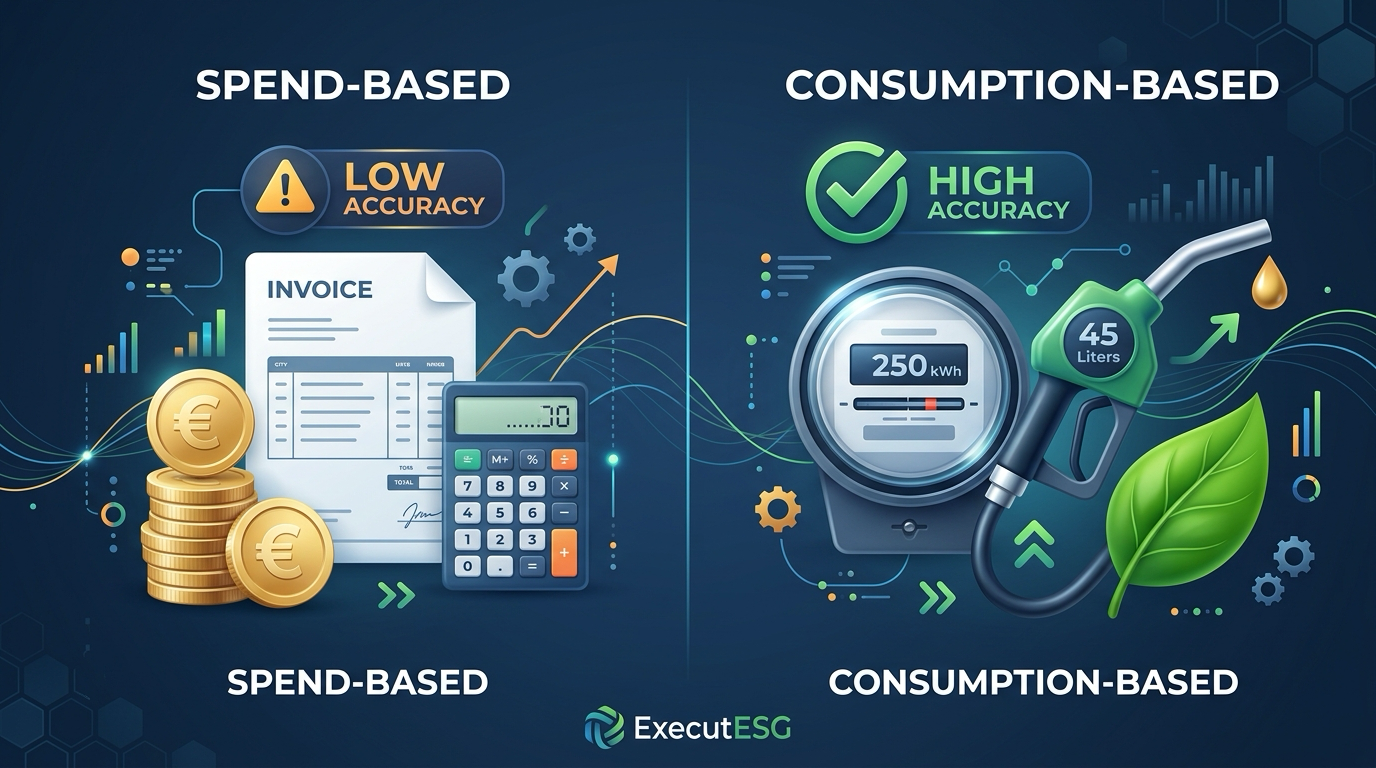
- The Procurement Silo: Supplier Scope 3 emissions are guessed using crude spend averages, exposing the business to the spend-based inflation trap.
The Three Financial Risks of Poor Sustainability Controls
1. Bank Loan Covenants & Capital Access
Major European commercial banks (including Nordea, OP Financial Group, SEB, Swedbank, and BNP Paribas) now evaluate corporate borrower creditworthiness through environmental scorecards. Many commercial credit facilities incorporate sustainability-linked covenants: achieve verified carbon reductions to receive an interest rate discount of 15 to 35 basis points.
If your sustainability data lacks internal controls and fails bank validation, your company faces immediate margin penalties and increased borrowing costs.
2. Enterprise Customer Disqualification
Enterprise corporations operating under mandatory CSRD face statutory liability for their Scope 3 supply chain disclosures. If an SME supplier provides inconsistent or unverifiable emissions data, enterprise procurement teams will replace them with certified suppliers to protect their own audit posture.
3. Statutory Assurance Liability
Under European standards, external assurance over sustainability reporting is transitioning from limited assurance toward reasonable assurance. Statutory auditors will test internal controls over sustainability reporting with the same rigor applied to revenue recognition and inventory valuation.
5 Practical ICSR Controls Every CFO Should Implement
Finance leaders do not need to invent new administrative processes from scratch. By integrating sustainability data into existing financial control workflows, companies can establish an audit-ready ICSR system:
Control 1: Integrate Sustainability into the Monthly Financial Close
Do not leave ESG data collection to an annual year-end scramble. During the standard monthly financial close, require accounts payable to reconcile utility electricity bills and fuel statements. Reconciling physical energy volumes (kWh, liters) alongside financial debits ensures complete 12-month coverage without missing vouchers.
Control 2: Segregation of Duties (Maker-Checker Workflow)
Establish clear role boundaries:
- Preparer (Maker): Accounts payable or the environmental coordinator inputs or ingests invoice line items and maps general ledger accounts.
- Reviewer (Checker): The financial controller or accounting manager reviews the mapped classifications, verifies physical unit conversions, and confirms that abnormal consumption spikes are investigated.
- Approver: The CFO or Managing Director conducts the final review and formally authorizes the EFRAG VS (VSME) disclosure package.
Control 3: Automated Ledger and Line-Item Ingestion
Manual spreadsheet transcription is the leading cause of audit failure. Eliminate manual data entry by connecting your accounting software (such as Xero, QuickBooks Online, Visma Netvisor, or Fortnox) via API or using the Universal CSV Migration Module. Automated ingestion preserves the exact digital voucher ID and timestamp for every transaction.
Control 4: Establish an Emission Factor Inventory & Vintage Policy
A common finding in sustainability audits is the inconsistent use of emission factors—such as using a 2021 electricity grid factor for a 2026 reporting year. Formalize an annual policy governing your emission factor sources:
- Scope 1 direct fuels: Standardize on official government conversion tables (e.g., DEFRA / DESNZ).
- Scope 2 location-based: International Energy Agency (IEA) national grid averages.
- Scope 2 market-based: Association of Issuing Bodies (AIB) European Residual Mix factors or supplier contractual instruments (Guarantees of Origin).
Control 5: Reconcile Physical Consumption with Bank and Meter Logs
Quarterly, cross-reference total fuel liters reported across fuel card accounts against fleet odometer readings, and reconcile utility kilowatt-hours against main facility meter data. Document this reconciliation in your internal control dossier.
Structuring the CFO’s EFRAG VS (VSME) Audit Binder
When external auditors or enterprise customer procurement teams request proof of your sustainability disclosures, the finance team should be prepared to hand over an organized Audit Binder:
┌────────────────────────────────────────────────────────────────────────┐
│                   THE CFO'S VS (VSME) AUDIT BINDER                     │
├───────┬──────────────────────────┬─────────────────────────────────────┤
│ Tab 1 │ Governance & Sign-off    │ Signed board approval, ICSR policy, │
│       │                          │ and organizational boundary doc.    │
├───────┼──────────────────────────┼─────────────────────────────────────┤
│ Tab 2 │ Chart of Accounts Crosswalk│ Itemized trial balance mapping OpEx│
│       │                          │ accounts to GHG Scopes 1, 2, and 3. │
├───────┼──────────────────────────┼─────────────────────────────────────┤
│ Tab 3 │ Primary Activity Records │ Reconciled utility invoices, fuel   │
│       │                          │ receipts, and meter confirmation.   │
├───────┼──────────────────────────┼─────────────────────────────────────┤
│ Tab 4 │ Emission Factor Register │ Documentation of factor sources,    │
│       │                          │ vintages, and calculation formulas. │
├───────┼──────────────────────────┼─────────────────────────────────────┤
│ Tab 5 │ Lineage Reconciliation   │ Transaction-level audit trail       │
│       │                          │ connecting vouchers to VS (VSME).   │
└───────┴──────────────────────────┴─────────────────────────────────────┘
Using a dedicated platform like ExecutESG automates the compilation of this audit binder. With a single click, finance teams can export the complete reconciliation file, saving weeks of audit preparation.
Comparison: Ad-Hoc Sustainability Reporting vs. ICSR Governance
The table below contrasts informal, decentralized sustainability data collection against formal ICSR financial governance:
| Process Dimension | Traditional Ad-Hoc Reporting | ICSR-Controlled Financial Governance |
|---|---|---|
| Executive Ownership | Marketing, HR, or external consultant | Chief Financial Officer & Financial Controller |
| Data Source | Disconnected emails and annual staff estimates | General ledger transaction journals & purchase invoices |
| Data Collection Cadence | Annual retrospective scramble | Reconciled during standard monthly financial close |
| Voucher Traceability | None; static totals in spreadsheets | Immutable digital audit trail linked to GL vouchers |
| Audit Verification | High risk of errors and qualification | Clean limited or reasonable assurance verification |
| Bank Credit Assessment | Ineligible for green margin discounts | Satisfies commercial bank ESG lending covenants |
Frequently Asked Questions
What is the difference between ICFR and ICSR?
ICFR (Internal Controls over Financial Reporting) focuses on ensuring the accuracy of financial statements, balance sheets, and earnings reports. ICSR (Internal Controls over Sustainability Reporting) applies the same principles of documentation, authorization, and reproducibility to non-financial metrics, including greenhouse gas emissions, energy consumption, and workforce data.
Does our company need an external audit for EFRAG VS (VSME)?
EFRAG's VS (VSME) is a voluntary standard designed for non-listed SMEs. While the standard does not legally mandate an independent assurance audit, corporate supply chain customers, bank lenders, and public tender authorities increasingly require third-party verification or proof of audit-readiness before accepting supplier disclosures.
How much internal time does establishing ICSR require?
When sustainability data is collected through spreadsheets, ICSR can demand hundreds of staff hours. However, when finance teams connect existing accounting ledgers and automated line-item ingestion through ExecutESG, establishing audit-ready controls takes fewer than ten hours of initial configuration.
Align Your Sustainability Data with Financial Standards
Sustainability disclosures can no longer be treated as marketing collateral. By applying financial rigor and internal controls to your EFRAG VS (VSME) reporting, CFOs can de-risk corporate audits, protect key enterprise customer relationships, and secure competitive financing terms.
Create your free account on ExecutESG to connect your accounting ledger and establish an audit-defensible sustainability reporting framework today.
Check Your VS (VSME) & CSRD Readiness Score
Answer 6 quick questions under the EU Voluntary Standard VS (VSME) to discover your compliance gap score, estimated time savings, and generate your free starter report.
Stay Ahead of EU Sustainability Mandates
Get our weekly intelligence briefing on VS (VSME), CSRD compliance, buyer Scope 3 demands, and EcoVadis audits—distilled for European SMEs.