ESG Reporting Tool RFP Template: 50 Evaluation Questions for Buyers
⚡ Evaluating Sustainability Reporting Tools for Your Business?
Avoid multi-month procurement cycles and hidden integration fees. ExecutESG provides an audit-ready, EFRAG VS (VSME) reporting platform with automated carbon calculations and a permanently free basic tier.
ESG Reporting Tool RFP Template: 50 Evaluation Questions for Buyers
Selecting an enterprise or mid-market ESG reporting tool represents a major strategic decision. With dozens of software vendors marketing overlapping feature lists, procurement teams and Chief Sustainability Officers face a confusing market.
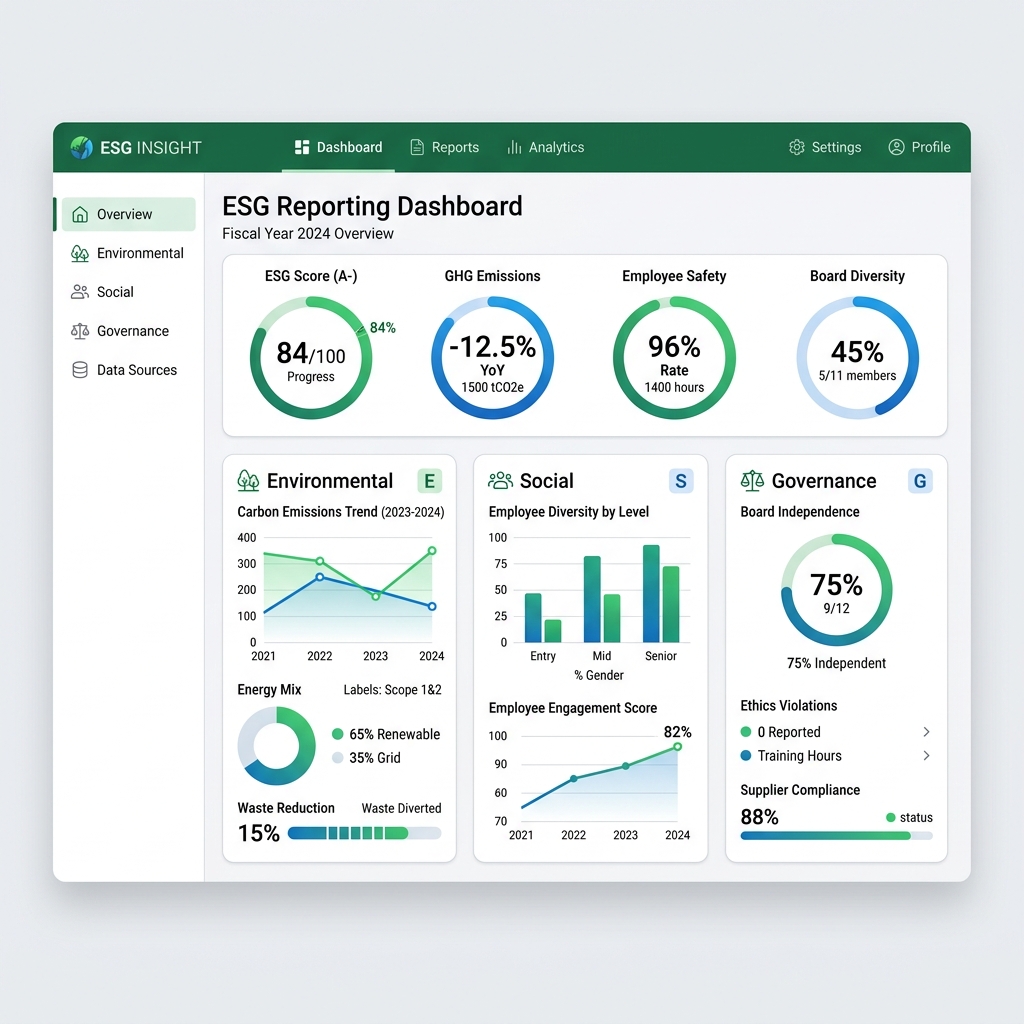
Many vendors demonstrate polished marketing dashboards during sales demos, only for buyers to discover post-contract that the software cannot calculate location-based versus market-based Scope 2 emissions, lacks native EFRAG templates, or charges tens of thousands of euros for basic data exports.
To protect your organization against vendor lock-in, compliance failures, and budget overruns, we have assembled the definitive 50-point ESG Reporting Tool Request for Proposal (RFP) Template.
Organized into seven critical technical domains, these questions will help your procurement team separate true compliance engines from superficial survey tools.
The 7 Core Domains of ESG Software Evaluation
┌────────────────────────────────────────────────────────────────────────┐
│                   THE 7 ESSENTIAL RFP EVALUATION DOMAINS               │
├────────────────────────────────────────────────────────────────────────┤
│  1. REGULATORY COMPLIANCE & FRAMEWORK ALIGNMENT (Q1–Q8)                │
│  2. GREENHOUSE GAS ACCOUNTING & EMISSION FACTORS (Q9–Q16)              │
│  3. DOUBLE MATERIALITY ASSESSMENT CAPABILITIES (Q17–Q22)               │
│  4. DATA GOVERNANCE, LINEAGE & AUDIT DEFENSE (Q23–Q29)                 │
│  5. VALUE CHAIN & SUPPLIER DATA ENGAGEMENT (Q30–Q35)                   │
│  6. SECURITY, ARCHITECTURE & TECHNICAL INTEGRATION (Q36–Q42)           │
│  7. COMMERCIAL TERMS, PRICING TRANSPARENCY & SLA (Q43–Q50)             │
└────────────────────────────────────────────────────────────────────────┘
Domain 1: Regulatory Compliance & Framework Alignment (Questions 1–8)
- Does the platform provide native, pre-configured disclosure modules for the EFRAG Voluntary Standard VS (VSME) (Basic, Narrative, and Business Partner modules)?
- How does the system handle the 2026 EU Statutory Value Chain Cap to prevent over-reporting for non-listed suppliers?
- Which additional standards are natively supported (CSRD ESRS, GRI, ISSB, CDP, EcoVadis)?
- How quickly does your engineering team update disclosure templates when standard-setters (EFRAG, ISSB) release technical errata or revisions?
- Does the software generate digital machine-readable outputs, including XBRL taxonomies or structured JSON?
- Can the platform produce formatted, human-readable exports in editable Word (.docx) and audit-ready PDF formats?
- Are multi-entity parent-subsidiary consolidation rules supported for mid-market corporate groups?
- Does the system permit dual-reporting across multiple regulatory jurisdictions simultaneously?
Domain 2: Greenhouse Gas Accounting & Emission Factor Databases (Questions 9–16)
- Does the platform automate greenhouse gas calculations across Scope 1, Scope 2, and all 15 categories of Scope 3?
- Which international emission factor databases are natively integrated (DEFRA, IEA, eGRID, Agribalyse, Exiobase)?
- How frequently are emission factor datasets refreshed, and does the software maintain historical factor versions for prior-year audits?
- Does the tool support both Location-Based and Market-Based accounting for Scope 2 electricity disclosures?
- Can the software convert operational activity data (kilowatt-hours, litres of diesel, cubic meters of natural gas) directly into $tCO_2e$?
- Does the system flag statistical anomalies, missing utility months, or billing duplicate entries?
- How does the software handle biogenic emissions and carbon removal credits relative to gross corporate emissions?
- Can emissions intensities be automatically normalized by revenue, production units, and full-time employee headcount?
Domain 3: Double Materiality Assessment Capabilities (Questions 17–22)
- Does the platform support a structured Double Materiality Assessment incorporating both Impact Materiality (inside-out) and Financial Materiality (outside-in)?
- What methodology is used to score topics—subjective 1-to-5 Likert scales, or algorithmic pairwise duels (such as the Analytic Hierarchy Process or Bradley-Terry model)?
- How are external stakeholders (suppliers, customers, employees, lenders) invited to participate in voting?
- Does the platform calculate mathematical consistency ratios to identify contradictory stakeholder votes?
- Can materiality assessment results be visualized as an interactive 2D materiality matrix with customizable threshold lines?
- Does the software generate an audit-ready methodology report documenting stakeholder selection, scoring formulas, and rationale?
Domain 4: Data Governance, Lineage & Audit Defense (Questions 23–29)
- Does every reported metric maintain a strict audit trail and document control linking numbers to uploaded source files (utility bills, payroll sheets)?
- Can external financial auditors be granted read-only verification access with dedicated assurance workspaces?
- Does the platform record immutable timestamps, user IDs, and version change logs for all modified data points?
- How does the system handle sign-offs, approvals, and multi-tier internal controls before report publication?
- Are qualitative narrative responses accompanied by evidence attachments and internal policy citations?
- Can users lock historic reporting years to prevent retroactive modification during assurance reviews?
- Does the platform support automated recalculation flags if base-year data requires structural adjustment?
Domain 5: Value Chain & Supplier Data Engagement (Questions 30–35)
- How does the tool collect primary activity data from supply chain partners without requiring expensive individual licenses?
- Can the platform ingest standardized EFRAG VS (VSME) supplier reports to populate Scope 3 Category 1 calculations?
- What mechanisms protect suppliers' proprietary commercial data when submitting emissions metrics?
- Does the platform provide automated reminder workflows for external suppliers with upcoming submission deadlines?
- Can suppliers reuse their compliance data across multiple buyer requests to eliminate survey duplication?
- How does the software benchmark supplier emission intensity against regional industry averages?
Domain 6: Technical Integration, Security & Infrastructure (Questions 36–42)
- Where is customer data physically hosted (EU-based servers with strict GDPR compliance)?
- Does the software maintain SOC 2 Type II or ISO 27001 security certifications?
- Which ERP and accounting systems can the software integrate with via REST API or flat-file CSV pipelines?
- Does the platform support Single Sign-On (SSO) via SAML 2.0, Microsoft Azure AD, or Google Workspace?
- What is your historical platform uptime SLA (e.g., 99.9%), and where is status tracked publicly?
- What disaster recovery and encrypted database backup protocols are maintained?
- If we terminate our subscription, what format is our complete historical data exported in, and is there an exit fee?
Domain 7: Commercial Terms, Pricing & Total Cost of Ownership (Questions 43–50)
- What is the comprehensive annual software subscription fee, and what tier limits apply (user seats, entities, suppliers)?
- Are there mandatory onboarding, implementation, or setup consulting fees?
- Does the software vendor require multi-year contracts, or are annual and monthly terms available?
- What customer support is included (dedicated account manager, live chat, ticketing SLAs)?
- Are framework updates and new regulatory templates included in the standard subscription, or sold as add-on modules?
- What are the seat license costs for read-only viewers, contributors, and external auditors?
- What is the typical implementation timeline from contract execution to first published report?
- Does the vendor offer a free trial, pilot program, or permanently free basic tier to evaluate the platform?
Review our detailed ESG software pricing guide for transparent market averages across leading vendors.
Vendor Scoring Matrix
When scoring RFP responses, assign weightings aligned with your operational priorities:
| RFP Domain | Recommended Weighting (SMEs) | Recommended Weighting (Enterprises) |
|---|---|---|
| 1. Framework Alignment (VS (VSME) / CSRD) | 30% | 25% |
| 2. Carbon Accounting & Emission Factors | 25% | 20% |
| 3. Double Materiality Capabilities | 15% | 15% |
| 4. Data Lineage & Audit Trails | 15% | 20% |
| 5. Technical Architecture & Security | 5% | 10% |
| 6. Commercial Terms & Implementation Speed | 10% | 10% |
| Total | 100% | 100% |
Why ExecutESG Excels on the RFP Scorecard
When evaluating vendors against this 50-point rubric, ExecutESG stands apart as the purpose-built choice for European small-to-mid-sized enterprises:
- 100% Native EFRAG VS (VSME) Alignment: Built directly on European disclosure standards.
- Automated Triple-Scope Calculator: Instant activity-to-carbon conversions with zero manual configuration.
- Bradley-Terry Materiality Engine: Eliminates biased 1-to-5 rating grids in favor of mathematically proven pairwise ranking.
- Frictionless Self-Service: Zero mandatory onboarding retainers; produces audit-ready disclosures in under 30 minutes.
- Transparent Commercials: Free Basic tier with Professional plans starting at €99/month.
Compare ExecutESG against other market leaders in our best ESG reporting tools review, or test the workflow yourself by launching a free report on the ExecutESG platform.
Frequently Asked Questions
What is the most critical question in an ESG tool RFP?
Question 1 and Question 23: verifying native alignment with your required standard (such as EFRAG VS (VSME)) and inspecting data lineage. If a tool cannot link reported figures back to verified source bills or requires expensive custom configuration to produce compliant tables, your audit costs will soar.
How long should an ESG software procurement cycle take?
For large public enterprises, RFP evaluations typically take 3 to 6 months. For SMEs and mid-market suppliers, prolonged RFPs waste critical compliance time. Modern self-service platforms like ExecutESG allow companies to test the software immediately and produce verified reports within days.
Should we issue an RFP for a small company?
If you have fewer than 250 employees, a formal 50-page RFP process creates unnecessary administrative burden. Instead, use this 50-point questionnaire as an internal vetting checklist during vendor software demos and free trial evaluations.
Check Your VS (VSME) & CSRD Readiness Score
Answer 6 quick questions under the EU Voluntary Standard VS (VSME) to discover your compliance gap score, estimated time savings, and generate your free starter report.
Stay Ahead of EU Sustainability Mandates
Get our weekly intelligence briefing on VS (VSME), CSRD compliance, buyer Scope 3 demands, and EcoVadis audits—distilled for European SMEs.