Financial Sustainability Reporting: How to Connect Your General Ledger to EFRAG VS (VSME)
Financial Sustainability Reporting: How to Connect Your General Ledger to EFRAG VS (VSME)
When European small and medium enterprises (SMEs) receive their first corporate sustainability questionnaire from a tier-1 customer or a commercial bank, the immediate reaction is often panic. Companies assume they must recruit specialized sustainability consultants, install complex environmental sensors, or spend weeks re-entering data into spreadsheets.
The truth is much simpler: over 80% of the primary data required for greenhouse gas (GHG) accounting and European sustainability disclosures already exists in your accounting software.
Every liter of diesel pumped into company vans, every kilowatt-hour of electricity powering your production facility, every flight booked for client meetings, and every invoice paid for raw materials passes through your Accounts Payable (AP) and General Ledger (GL).
Financial sustainability reporting bridges double-entry bookkeeping with sustainability standards. By mapping your existing chart of accounts to the European Financial Reporting Advisory Group's VS (VSME) voluntary standard, finance teams can turn everyday bookkeeping into an audit-ready sustainability disclosure in days rather than months.
Why Accounting Systems Are the Foundation of Defensible ESG
For decades, financial accounting has operated under strict governance frameworks: double-entry ledgers, internal controls, segregation of duties, and statutory audit verification. Corporate sustainability reporting, by contrast, has suffered from messy spreadsheets, subjective self-assessments, and unverifiable estimates.
This divide is no longer acceptable. Commercial lenders such as Nordea, OP Financial Group, SEB, and Deutsche Bank now factor sustainability disclosures into corporate credit ratings and loan covenants. Simultaneously, enterprise buyers operating under the Corporate Sustainability Reporting Directive (CSRD) face legal liability for inaccurate Scope 3 emissions across their supply chain.
Connecting your sustainability reporting directly to your accounting ledger provides three decisive advantages:
┌─────────────────────────────────┐
│     Your Accounting Ledger      │
│  (Xero, QuickBooks, Netvisor,   │
│   Fortnox, SAP, or CSV Export)  │
└────────────────┬────────────────┘
                 │
                 ▼
┌─────────────────────────────────┐
│   ExecutESG Ingestion Engine    │
│  1. Chart of Accounts Mapping   │
│  2. Line-Item Quantity Scans    │
│  3. Multi-Currency Normalization│
└────────────────┬────────────────┘
                 │
                 ▼
┌─────────────────────────────────┐
│  Audited EFRAG VS (VSME) Report │
│  • Scope 1, 2, and 3 Disclosures│
│  • Digital Lineage to Vouchers  │
│  • XBRL-Ready Tagged Output     │
└─────────────────────────────────┘
1. Inherent Audit Trail and Immutability
In a standard financial audit, an auditor samples a transaction from the income statement, traces it back to the general ledger journal entry, inspects the underlying purchase invoice voucher, and checks bank reconciliation. When your sustainability report shares this exact data lineage, assurance providers can verify energy, fuel, and waste metrics using standard financial audit procedures.
2. Elimination of Duplicate Data Collection
Asking operations managers to record monthly meter readings in manual forms creates operational friction and human error. Your accounting team already receives and approves utility bills, fuel credit card statements, and contractor invoices every month. Ingesting this data programmatically removes hundreds of hours of redundant administrative work.
3. Financial Materiality Integration
The European sustainability framework requires understanding financial materiality—how climate risks, energy price volatility, and regulatory penalties affect your company’s cash flows, balance sheet, and operating margins. When carbon metrics live alongside your income statement, identifying high-carbon cost drivers becomes straightforward.
Spend-Based vs. Activity-Based Accounting: The Inflation Trap
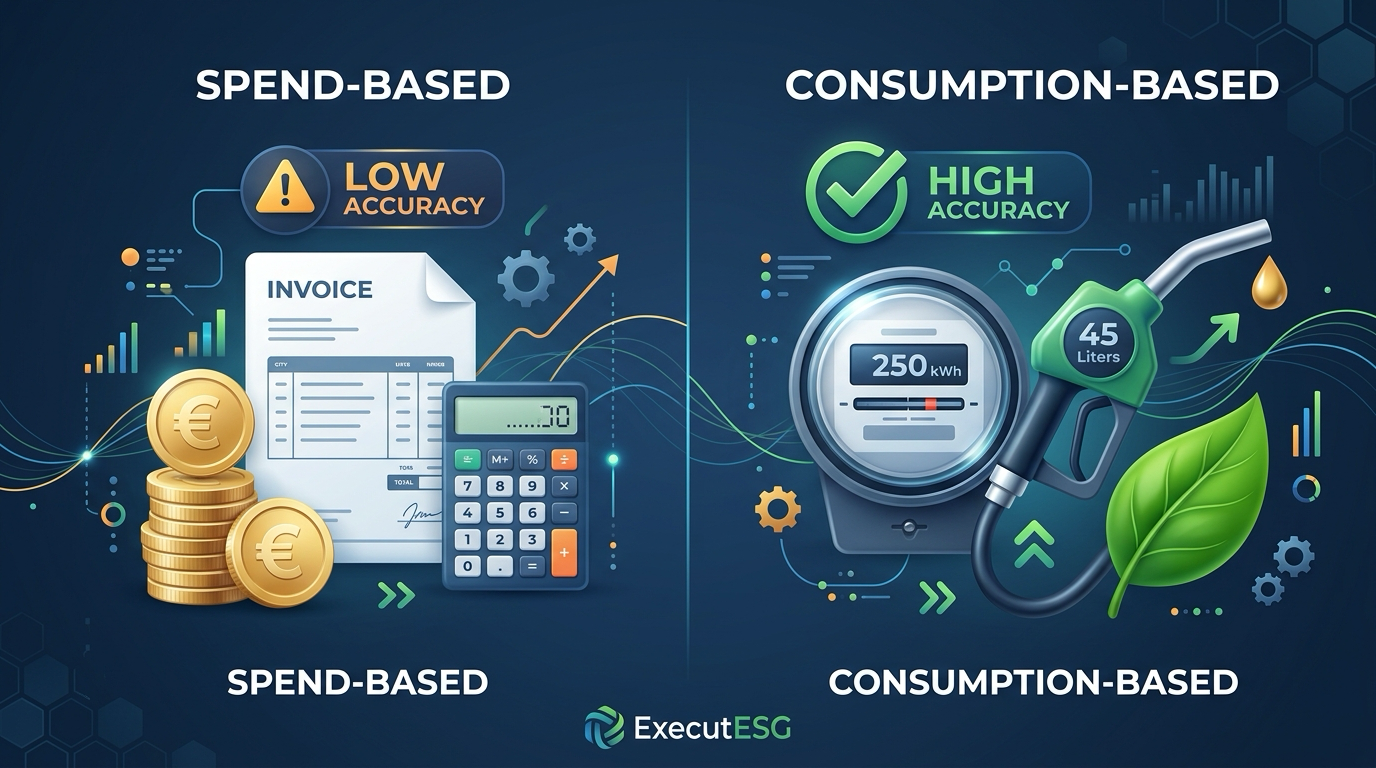
When connecting accounting data to greenhouse gas calculations, software platforms handle transactions in two fundamentally different ways: spend-based calculation and activity-based calculation.
The Dangerous Flaw of Spend-Based Multipliers
Most basic carbon tools rely exclusively on Environmentally Extended Input-Output (EEIO) models. These models multiply total currency spent by an industry-average emissions factor:
$$\text{Emissions } (\text{kg CO}_2\text{e}) = \text{Spend } (€) \times \text{Sector Emission Factor } \left(\frac{\text{kg CO}_2\text{e}}{€}\right)$$
While spend-based calculations require minimal effort, they create severe distortions during periods of inflation or commodity volatility:
| Scenario | Physical Reality | Spend-Based Calculation Result | What Actually Happened |
|---|---|---|---|
| Fuel Price Surge | Company diesel consumption drops by 10% through route optimization. | Fuel price rises 35%; spend increases 21.5%. Reported Scope 1 emissions increase by 21.5%. | False penalty: The company improved efficiency, but the report shows higher emissions. |
| Green Power Premium | Company switches from fossil grid power to 100% verified renewable wind electricity at a 15% price premium. | Electricity spend increases by 15%. Reported emissions increase by 15%. | Severe distortion: Real market-based emissions dropped to near zero, but spend models report higher pollution. |
| Purchasing Recycled Metals | Manufacturer buys low-carbon recycled aluminum costing 10% more than virgin scrap. | Total raw materials spend increases by 10%. Reported Scope 3 emissions increase by 10%. | Decarbonization blindspot: Low-carbon investments appear as environmental setbacks. |
How Modern Platforms Solve the Trap: Line-Item Quantity Extraction
To produce defensible metrics under EFRAG's VS (VSME) standard, modern sustainability software does not simply multiply totals. Instead, the ingestion engine inspects invoice line items to extract physical quantities:
- Fuel Invoices: Extracts exact liters of diesel, gasoline, or biodiesel alongside fuel card supplier data (e.g., Neste, Shell, Circle K).
- Utility Statements: Extracts kilowatt-hours (kWh) or megawatt-hours (MWh) of grid electricity, district heating, and natural gas.
- Logistics & Freight: Extracts metric tons transported and shipment kilometers from freight forwarder invoices.
Where physical quantities are temporarily unavailable, the system applies conservative spend-based benchmarks as a secondary fallback, flagging the entry for future refinement.
How to Map Your Chart of Accounts to GHG Protocol Scopes
Mapping your Chart of Accounts (CoA) to greenhouse gas scopes requires grouping general ledger expense codes into their corresponding greenhouse gas emission categories.
The table below outlines a standard general ledger mapping structure applicable across international chart of accounts (such as US GAAP, UK GAAP, German SKR03/SKR04, Swedish BAS, and Finnish Liikekirjuri):
| General Ledger Account Type | Typical Account Range / Name | Target GHG Scope | EFRAG VS (VSME) Section | Required Extraction Data |
|---|---|---|---|---|
| Vehicle Fleet Fuel | 6400–6420 (Motor Vehicle Expenses / Fuels) |
Scope 1 (Direct) | Basic Module: Energy & GHG (B3) | Liters of fuel, fuel type (Diesel, Petrol, HVO100) |
| On-Site Heating / Gas | 6310 (Building Heating / Natural Gas / Oil) |
Scope 1 (Direct) | Basic Module: Energy & GHG (B3) | Liters of light fuel oil, cubic meters of gas, or kWh |
| Facility Electricity | 6300 (Purchased Electricity) |
Scope 2 (Indirect) | Basic Module: Energy & GHG (B3) | Total kWh/MWh, grid location, Guarantees of Origin |
| District Heating & Cooling | 6320 (District Heating Services) |
Scope 2 (Indirect) | Basic Module: Energy & GHG (B3) | MWh consumed, local municipal supplier grid emission factor |
| Freight & Outbound Logistics | 6050–6070 (Transport & Shipping Costs) |
Scope 3: Category 4 | Business Partners Module (BP1) | Weight shipped (tons), transport mode (road, rail, sea, air), distance |
| Business Travel (Flights & Rail) | 6600–6650 (Travel & Subsistence) |
Scope 3: Category 6 | Business Partners Module (BP1) | Flight routes (short-haul, long-haul), passenger count |
| Waste Disposal & Recycling | 6350 (Waste Management & Sanitation) |
Scope 3: Category 5 | Basic Module: Pollution & Waste (B7) | Metric tons of waste, disposal method (landfill, incineration, recycled) |
| Raw Material Procurement | 4000–4200 (Materials & Supplies) |
Scope 3: Category 1 | Business Partners Module (BP1) | Material weight (kg), supplier emission declarations |
Universal Data Ingestion: API Connectors vs. The Universal CSV Importer
A common concern among finance leaders is software lock-in: "What if our company uses an accounting tool that lacks a direct API connector?"
To solve this, modern ESG data architecture supports two parallel connection paths:
                           ┌──────────────────────────────────────────────┐
                           │      Accounting Software Ingestion Paths     │
                           └──────────────────────┬───────────────────────┘
                                                  │
                  ┌───────────────────────────────┴───────────────────────────────┐
                  ▼                                                               ▼
   ┌─────────────────────────────┐                                 ┌─────────────────────────────┐
   │     Native API Sync         │                                 │   Universal CSV / Excel     │
   │  • Xero                     │                                 │      Migration Module       │
   │  • QuickBooks Online        │                                 ├─────────────────────────────┤
   │  • Visma Netvisor           │                                 │  • Drag & drop general      │
   │  • Procountor               │                                 │    ledger export            │
   │  • Fortnox                  │                                 │  • Auto-detects columns     │
   │  • Exact Online             │                                 │  • Instant CoA mapping      │
   └──────────────┬──────────────┘                                 └──────────────┬──────────────┘
                  │                                                               │
                  └───────────────────────────────┬───────────────────────────────┘
                                                  ▼
                                   ┌─────────────────────────────┐
                                   │  Reconciled VS (VSME) Data  │
                                   └─────────────────────────────┘
1. Direct API Synchronization
For organizations running cloud-native accounting platforms like Xero, QuickBooks Online, Visma Netvisor, Procountor, Fortnox, or Exact Online, direct API authorization connects the systems in under five minutes. The API pulls purchase ledger journals, invoice line items, and vendor metadata on a scheduled daily or monthly cadence.
2. The Universal Drag-and-Drop CSV Migration Module
For companies operating on-premise ERPs (such as older SAP R/3 versions, Sage 50, Microsoft Dynamics NAV) or regional accounting tools, the Universal CSV Importer provides an immediate alternative:
- Export your standard transaction detail or general ledger report from your accounting software as a
.csvor.xlsxfile. - Drag and drop the file into the platform.
- The platform's machine learning parser automatically identifies transaction dates, account codes, vendor names, descriptions, net amounts, and tax codes.
- Account codes are matched to predefined GHG Protocol categories, allowing finance teams to review, adjust, and confirm mappings within a visual interface.
This flexibility ensures that any business, anywhere in the world, can transition their general ledger into an audited sustainability disclosure without waiting for complex enterprise software deployments.
5 Steps to Implement Financial Sustainability Reporting
Setting up an automated bridge between your financial records and sustainability disclosures follows five structured steps:
Step 1: Export or Connect Your Chart of Accounts
Connect your accounting system via API or export your chart of accounts trial balance. Confirm that account descriptions clearly distinguish energy-intensive categories (e.g., separating facility heating fuel from machinery fuel).
Step 2: Establish Boundary and Reporting Entities
Determine whether your sustainability report covers a single legal entity or a consolidated corporate group. In multi-entity organizations, ensure that inter-company transactions (such as management fees or inter-company logistics billing) are eliminated to prevent double-counting of greenhouse gas emissions.
Step 3: Run the Automated Line-Item Scan
Allow the extraction engine to process purchase invoices from utility providers, fuel vendors, and freight companies. The system identifies physical units and converts them into standardized metrics ($MWh$, liters, metric tons).
Step 4: Apply Standardized Emission Factors
The platform maps verified physical activity metrics to internationally recognized emission factor databases, including:
- DEFRA / DESNZ: Comprehensive conversion factors for transport, fuels, and freight.
- IEA (International Energy Agency): National electricity grid average factors for Scope 2 location-based reporting.
- AIB (Association of Issuing Bodies): European Residual Mix factors for Scope 2 market-based accounting.
- ecoinvent: Life-cycle inventory factors for raw materials and industrial components.
Step 5: Generate the EFRAG VS (VSME) Disclosure Package
With all accounts mapped and transactions verified, export your formal disclosure package. Under the EFRAG VS (VSME) standard, the report includes:
- The Basic Module: Energy consumption, direct Scope 1 emissions, indirect Scope 2 emissions, and workforce metrics.
- The Business Partners Module: Material Scope 3 supply chain metrics required by enterprise customers and corporate banks.
- Digital Lineage Audit Log: An itemized ledger cross-referencing every reported number directly to specific accounting vouchers and invoice IDs.
Comparison: Financial Carbon Accounting vs. Traditional Consulting
| Feature / Metric | Traditional ESG Consulting Firm | Manual Spreadsheets (Excel) | ExecutESG Ledger-First Architecture |
|---|---|---|---|
| Typical Cost | €15,000 – €45,000 per year | Low software cost; €10,000+ in internal labor | €1,200 – €4,800 per year |
| Time to Completion | 3 to 6 months | 40 to 80 manual staff hours | Under 48 hours |
| Data Source | Ad-hoc questionnaires & email threads | Disconnected copy-pasting from invoices | Direct General Ledger & API / CSV ingestion |
| Audit Readiness | Variable; often static PDF summaries | Extremely poor; prone to broken cell formulas | Complete digital audit trail tied to financial vouchers |
| Update Frequency | Once per year (lagging data) | Once per year | Continuous monthly or quarterly sync |
| Standard Alignment | Often proprietary frameworks | Unstructured | Official EFRAG VS (VSME) & CSRD interoperable |
Frequently Asked Questions
Can our accounting firm (tilitoimisto or CPA) prepare this report for us?
Yes. Many progressive accounting firms now offer sustainability reporting as an extension of their regular financial closing and advisory services. Because the data originates in the general ledger that the accountant already reconciles, accounting firms can package VS (VSME) reporting as a high-value advisory retainer without needing specialized environmental scientists.
Does our company need to report Scope 3 emissions under VS (VSME)?
Under the EFRAG VS (VSME) standard, the Basic Module only requires Scope 1 and Scope 2 energy emissions. Scope 3 reporting is part of the Business Partners Module, which is voluntary unless specifically mandated by your key commercial customers or financing banks. Connecting your general ledger makes compiling the Business Partners Module simple, because supply chain spend categories are already organized in your accounts payable.
What happens if an invoice lacks physical units (like liters or kWh)?
When an invoice only shows total monetary spend without unit breakdowns, modern platforms apply a secondary spend-based factor based on the supplier’s specific industry code. The platform highlights these transactions in a data-quality dashboard, enabling your procurement team to request itemized electronic invoicing from key vendors in subsequent billing cycles.
Is our financial data kept confidential?
Yes. System integrations operate under strict SOC 2 and GDPR-compliant protocols with read-only permissions. Financial amounts are used strictly for category classification, unit extraction, and reconciliation. Sensitive employee payroll data or proprietary pricing terms are never exposed or shared with third parties.
Connect Your Ledger to Audit-Ready Sustainability Disclosures
Sustainability reporting should not be an expensive, disconnected administrative burden. By leveraging the financial records your company already produces, you can deliver defensible, auditor-grade sustainability metrics that protect key client accounts and unlock favorable green financing.
Whether you operate Xero, QuickBooks, Visma Netvisor, Fortnox, or prefer to drag and drop your standard general ledger CSV export, ExecutESG transforms routine bookkeeping into an EFRAG-compliant disclosure in under 48 hours.
Create your free account on ExecutESG to connect your accounting ledger and generate your baseline EFRAG VS (VSME) sustainability report today.
Check Your VS (VSME) & CSRD Readiness Score
Answer 6 quick questions under the EU Voluntary Standard VS (VSME) to discover your compliance gap score, estimated time savings, and generate your free starter report.
Stay Ahead of EU Sustainability Mandates
Get our weekly intelligence briefing on VS (VSME), CSRD compliance, buyer Scope 3 demands, and EcoVadis audits—distilled for European SMEs.