Beyond Spend-Based Carbon Accounting: Why Purchase Invoice Line Items Matter
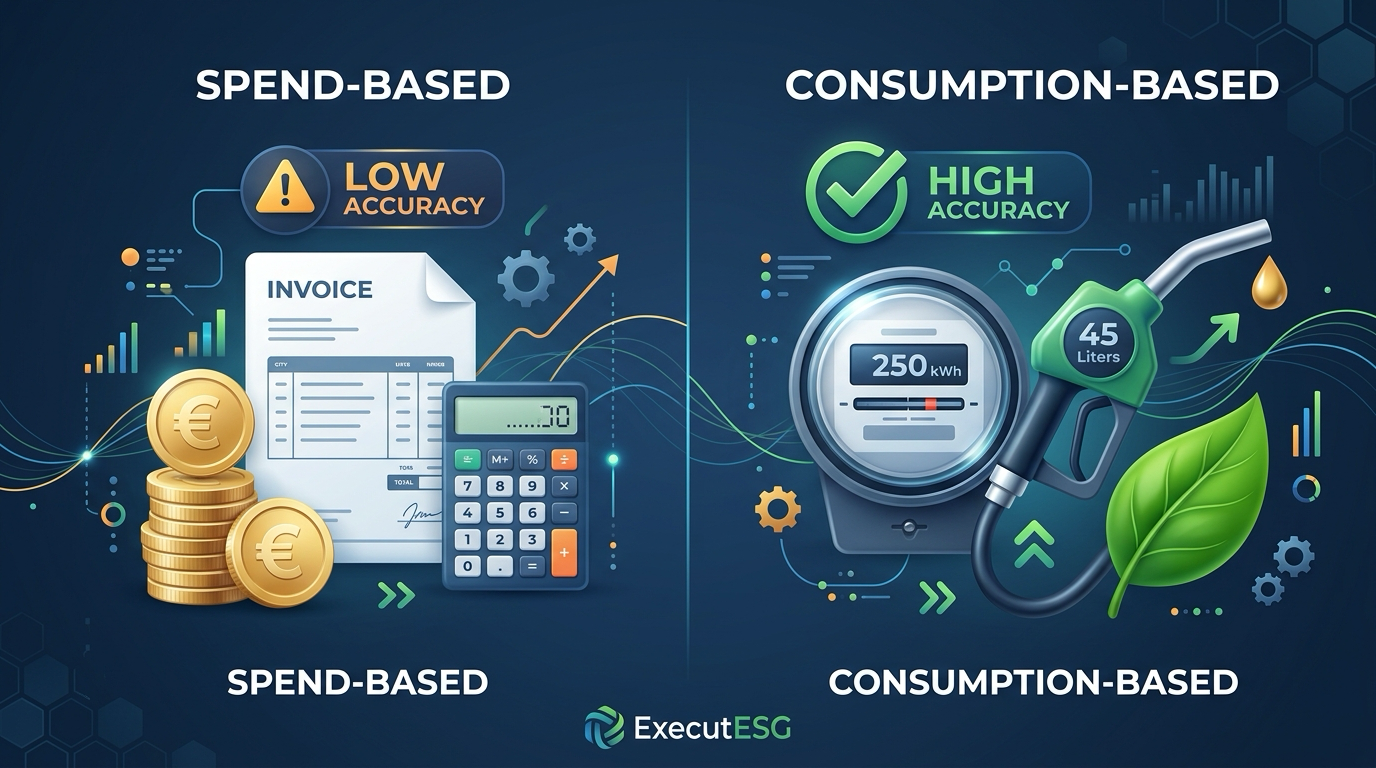
Beyond Spend-Based Carbon Accounting: Why Purchase Invoice Line Items Matter
When corporate sustainability teams began calculating greenhouse gas emissions a decade ago, data collection was difficult. Because gathering physical utility readings and fuel logbooks from dozens of operational sites took months, carbon accounting software popularized a convenient shortcut: the spend-based calculation method.
By taking financial expenditure from accounts payable and multiplying each euro or dollar by an industry-average emissions factor, companies could produce a comprehensive carbon footprint in minutes.
In 2026, the economic and regulatory reality has changed. Inflationary price shocks, energy volatility, and strict corporate supply chain audits have exposed the structural flaws of spend-based accounting. When energy or fuel prices rise, companies that successfully cut physical consumption find their reported carbon footprint increasing on paper.
To compile a defensible report under EFRAG's voluntary VS (VSME) standard or satisfy corporate buyer audits, finance departments must look beyond total invoice amounts and inspect purchase invoice line items.
How the Spend-Based Method Works (and Where It Fails)
The spend-based calculation method relies on Environmentally Extended Input-Output (EEIO) models. These models calculate emissions by linking macroeconomic transaction data with national industrial emissions averages:
$$\text{Emissions } (\text{kg CO}_2\text{e}) = \text{Monetary Spend } (€) \times \text{Sector EEIO Factor } \left(\frac{\text{kg CO}_2\text{e}}{€}\right)$$
While spend-based calculations provide a fast initial screening tool, they rely on a fundamentally flawed premise: that price and physical environmental impact move in locked tandem.
                           THE SPEND-BASED INFLATION TRAP

   PHYSICAL REALITY:                                 SPEND-BASED MODEL:
   Company burns 10% LESS fuel                       Fuel price spikes 35%
   (Routes optimized, idle time cut)                 (Geopolitical oil shock)
            │                                                 │
            ▼                                                 ▼
   Real Scope 1: -10% REDUCTION                      Reported Scope 1: +21.5% INCREASE
   ✓ Real Environmental Progress                     ❌ False Greenwashing Penalty
The Three Structural Failures of Spend-Based Models
1. The Inflation Distortion Penalty
If your company purchased 50,000 liters of diesel in 2024 at €1.60 per liter, your fuel spend was €80,000. In 2026, you invested in telematics and driver coaching, reducing physical fuel consumption by 10% to 45,000 liters. However, due to fuel price increases, the price rose to €2.15 per liter, resulting in a total spend of €96,750 (+20.9%).
- Real Physical Outcome: Direct Scope 1 emissions fell by 10.0%.
- Spend-Based Calculation: Because total spending increased by 20.9%, a spend-based calculator reports a 20.9% increase in your carbon emissions.
2. The Green Premium Blindspot
When companies actively decarbonize by purchasing sustainable alternatives—such as low-carbon hydrotreated vegetable oil (HVO100) instead of fossil diesel, or recycled certified aluminum instead of virgin ingots—the sustainable material often carries a 10% to 25% price premium.
Under spend-based accounting, paying a premium for low-carbon materials falsely inflates your calculated emissions, punishing your business for proactive environmental stewardship.
3. Auditor Rejection
Statutory auditors operating under European assurance guidelines and procurement officers evaluating high-value tenders reject pure spend-based estimates for high-impact emission categories. They demand primary data verified against commercial documentation.
The Solution: Automated Invoice Line-Item Extraction
Rather than multiplying total invoice balances by generic industry averages, modern carbon platforms extract granular activity data from purchase invoice line items.
┌────────────────────────────────────────────────────────────────────────┐
│                        PURCHASE INVOICE SAMPLE                         │
│  Supplier: Neste Retail Oy                   Invoice #: INV-2026-8891  │
│  Date: 2026-03-15                            Currency: EUR             │
├──────┬──────────────────────┬──────────┬───────────┬───────────────────┤
│ Line │ Description          │ Quantity │ Unit Price│ Line Total (Net)  │
├──────┼──────────────────────┼──────────┼───────────┼───────────────────┤
│ 1    │ Neste MY Renewable   │ 1,450 L  │ €2.10 / L │ €3,045.00         │
│      │ Diesel (HVO100)      │          │           │                   │
│ 2    │ Premium Car Wash     │ 2 pcs    │ €25.00 ea │ €50.00            │
│ 3    │ Windshield Fluid 5L  │ 4 pcs    │ €12.50 ea │ €50.00            │
└──────┴──────────────────────┴──────────┴───────────┴───────────────────┘
When an ingestion engine analyzes this invoice, it treats each line item according to its true environmental property:
- Line 1 (Renewable Diesel): Extracts the exact physical quantity (
1,450 Liters) and fuel grade (HVO100). It applies the verified physical emission factor for renewable diesel ($\approx 0.35\text{ kg CO}_2\text{e/L}$) rather than the standard fossil diesel factor ($\approx 2.68\text{ kg CO}_2\text{e/L}$). This captures an 87% real emissions reduction. - Line 2 (Car Wash): Classifies the service into operational services, isolating water usage without distorting fuel accounts.
- Line 3 (Windshield Fluid): Classifies supplies into consumable maintenance goods under Scope 3, keeping Scope 1 fleet combustion metrics unpolluted.
Comparison: Spend-Based vs. Invoice Line-Item Extraction
| Feature / Dimension | Spend-Based Model (EEIO) | Invoice Line-Item Extraction |
|---|---|---|
| Primary Input | Net total monetary spend (€, $, £) | Physical quantities (liters, kWh, MWh, kg) |
| Accuracy | Low (sector-wide industry estimates) | High (verified physical operational units) |
| Sensitivity to Price Volatility | Vulnerable (price spikes falsely increase footprint) | Immune (carbon calculated on physical units) |
| Decarbonization Recognition | Blind to low-carbon material premiums | Fully recognizes material substitutions and efficiency |
| Administrative Burden | Minimal (total spend only) | Automated via OCR & API line parsing |
| EFRAG VS (VSME) Audit Acceptance | Restricted to minor Scope 3 categories | Accepted across Basic and Business Partners modules |
| Audit Verification | Inability to prove physical unit volumes | Direct voucher cross-referencing and invoice line logs |
How to Transition from Spend-Based to Line-Item Extraction
Finance and operations teams can transition from crude spend estimations to verified activity-based accounting in four practical stages:
┌─────────────────┐     ┌─────────────────┐     ┌─────────────────┐     ┌─────────────────┐
│     STAGE 1     │ ──> │     STAGE 2     │ ──> │     STAGE 3     │ ──> │     STAGE 4     │
│ Quick Spend     │     │ Isolate Energy  │     │ Automated OCR   │     │ Unified Hybrid  │
│ Screening       │     │ & Fuel Accounts │     │ Line-Item Sync  │     │ Ledger & XBRL   │
└─────────────────┘     └─────────────────┘     └─────────────────┘     └─────────────────┘
Stage 1: Initial Spend Screening (Scoping Hotspots)
Begin with a complete accounts payable export. Apply spend-based multipliers to identify your emission hotspots. In most manufacturing, logistics, and trade businesses, 85% of total operational emissions originate from fewer than six vendor accounts: electricity, vehicle fuel, facility heating, and primary freight carriers.
Stage 2: Target High-Impact Accounts for Line-Item Extraction
Rather than attempting to parse every petty-cash coffee receipt, focus line-item extraction where it matters most:
- Utility electricity bills (extracting kWh and location vs. market tariffs).
- Fuel card statements and bulk fuel deliveries (extracting liters and fuel types).
- Natural gas and district heating invoices (extracting MWh or cubic meters).
- Primary freight forwarder statements (extracting metric tons and transport modes).
Stage 3: Enable Automated Ingestion via API or Universal CSV
Connect your accounting software (such as Xero, QuickBooks Online, Visma Netvisor, or Fortnox) via API, or drag and drop your general ledger export into ExecutESG's Universal CSV Migration Module. The parsing engine scans invoice line items and receipt PDFs attached to transaction journals, automatically extracting physical units.
Stage 4: Apply the Hybrid Fallback Protocol
For low-materiality categories—such as office supplies, software subscriptions, or legal services—retain spend-based calculations. The hybrid approach gives you complete coverage across the entire income statement while ensuring that 90%+ of your reported footprint rests on auditor-grade physical data.
Meeting EFRAG VS (VSME) Requirements
Under the EFRAG VS (VSME) standard, reporting requirements are structured into distinct modules:
- The Basic Module (Disclosures B3 & B7): Requires energy consumption in MWh and direct greenhouse gas emissions in metric tons. Reporting pure monetary spend does not satisfy the disclosure mandate; physical energy data is explicitly required.
- The Business Partners Module (Disclosure BP1): Requests primary greenhouse gas intensity data from key suppliers. When enterprise buyers ask for your carbon metrics, providing uninflated, activity-backed figures protects your supplier rating and ensures contract renewal.
Frequently Asked Questions
What happens when an invoice is handwritten or formatted as a scanned image?
Modern optical character recognition (OCR) engines analyze scanned receipts and PDF invoices to detect numerical quantities, unit symbols (L, ltr, kWh, MWh, kg), and fuel product codes. If an invoice cannot be parsed with high statistical confidence, the platform flags the transaction for one-click manual confirmation by your accounting team.
Is spend-based carbon accounting completely prohibited?
No. Standard-setters, including the GHG Protocol and EFRAG, permit spend-based calculations for screening purposes and for minor, non-material Scope 3 categories (such as purchased office equipment or travel hotel stays). However, for Scope 1 direct fuels and Scope 2 electricity, physical activity data is mandatory for credible reporting.
How does line-item parsing affect our existing bookkeeping workflows?
Line-item extraction requires zero changes to your core financial workflows. Your accounts payable team continues processing and approving bills in your standard accounting software as usual. ExecutESG runs silently in the background, reading invoice data via read-only API sync or scheduled CSV ledger uploads.
Protect Your Sustainability Data from Price Volatility
Your company's sustainability report should reflect real operational improvements, not market inflation or commodity price spikes. By moving from crude spend multipliers to automated purchase invoice line-item extraction, you ensure that every fuel efficiency gain and renewable energy investment is recognized.
Create your free account on ExecutESG to connect your purchase ledger or upload your general ledger CSV, and compile your verified EFRAG VS (VSME) sustainability report today.
Check Your VS (VSME) & CSRD Readiness Score
Answer 6 quick questions under the EU Voluntary Standard VS (VSME) to discover your compliance gap score, estimated time savings, and generate your free starter report.
Stay Ahead of EU Sustainability Mandates
Get our weekly intelligence briefing on VS (VSME), CSRD compliance, buyer Scope 3 demands, and EcoVadis audits—distilled for European SMEs.