ISO 14064 and GHG Protocol Mapping
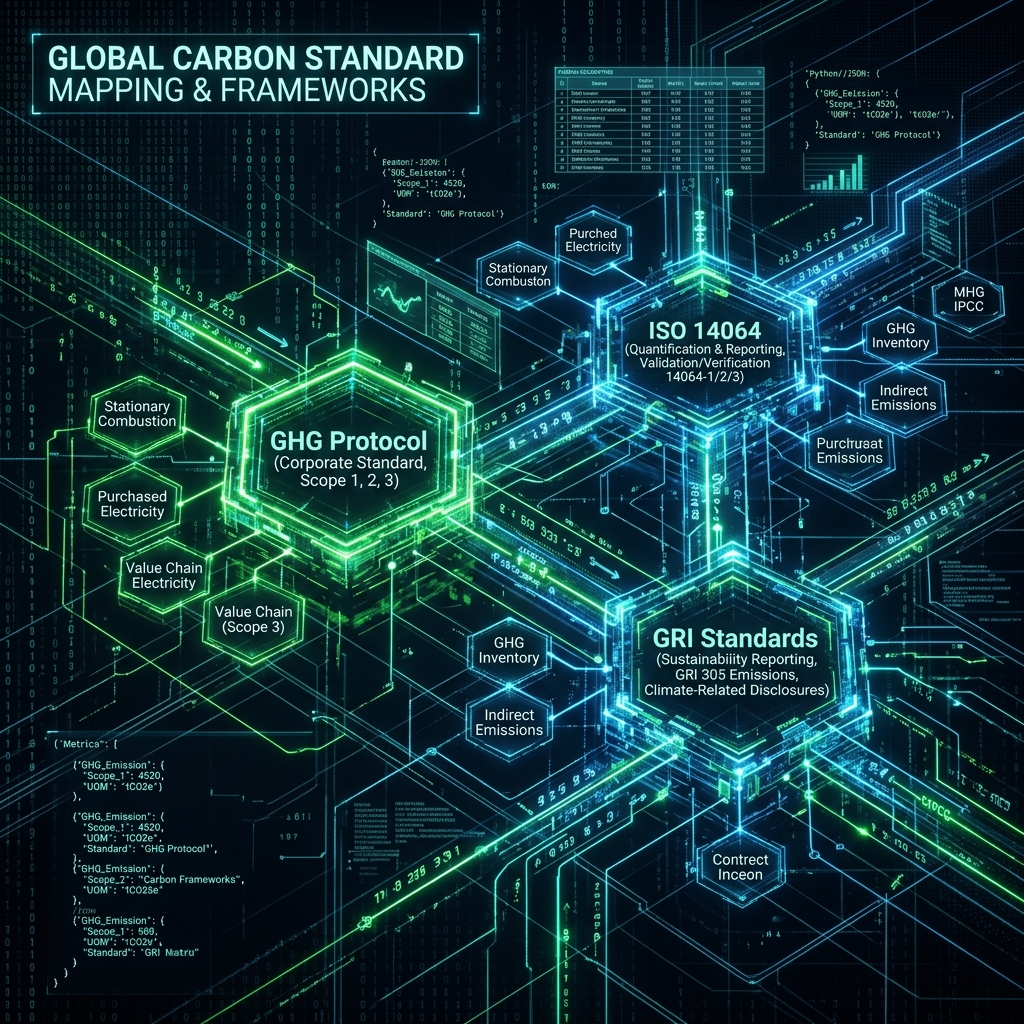
How to Map GHG Protocol Scopes 1-3 to ISO 14064 and GRI Standards
As corporate carbon accounting transitions from a voluntary marketing exercise to a regulated, audited compliance process, businesses find themselves navigating a complex web of standards.
While the Greenhouse Gas Protocol (GHG Protocol) is the most common starting point for measuring a carbon footprint, international regulations and professional auditors often require alignment with other major frameworks, specifically ISO 14064 and the Global Reporting Initiative (GRI).
If your company compiles data under the GHG Protocol, how do you map your Scope 1, 2, and 3 emissions to satisfy an ISO 14064 audit or a GRI-compliant sustainability report?
In this guide, we provide a complete cross-reference mapping matrix between these three leading standards, outline the critical differences in categories, and present a checklist to prepare your carbon inventory for third-party auditing.
🧭 Framework Mapping Matrix
Collect your activity data once. Use this matrix to map and report it across all three major sustainability reporting standards.
| GHG Protocol Scope | ISO 14064-1:2018 Category | GRI Standard Indicator |
|---|---|---|
| Scope 1 (Direct) | Category 1: Direct GHG emissions and removals | GRI 305-1: Direct (Scope 1) GHG emissions |
| Scope 2 (Indirect Energy) | Category 2: Indirect GHG emissions from imported energy | GRI 305-2: Energy indirect (Scope 2) GHG emissions |
| Scope 3 (Indirect Value Chain) | Category 3: Indirect GHG emissions from transportation | GRI 305-3: Other indirect (Scope 3) GHG emissions |
| Category 4: Indirect GHG emissions from products used by organization | ||
| Category 5: Indirect GHG emissions associated with the use of products from organization | ||
| Category 6: Indirect GHG emissions from other sources |
Why Harmonize Your Carbon Accounting Frameworks?
Many ESG leads and financial officers view frameworks like ISO 14064 and GRI as competing standards. In reality, they are highly complementary. Harmonizing your data collection under a single, unified pipeline delivers several key advantages:
- Eliminate Redundant Work: Collecting data from utility bills, shipping invoices, and employee commuting surveys is the most time-consuming part of carbon accounting. When you align your categories, you extract the raw data once and simply format the outputs differently.
- Ensure Audit Readiness: ISO 14064-1 establishes a rigid data management standard. Aligning your GHG Protocol report with ISO structure forces you to compile the exact chain of evidence that financial auditors expect.
- XBRL Standard Compliance: Voluntary and regulatory reporting frameworks are standardizing around machine-readable XBRL formats. By structuring your mapping correctly, you can export reports that integrate seamlessly with digital taxonomy systems.
GHG Protocol vs. ISO 14064-1: The Category Mapping
The ISO 14064-1 standard specifies principles and requirements for quantifying and reporting greenhouse gas emissions at the organization level. In its 2018 major update, ISO moved away from the traditional three "scopes" of the GHG Protocol, replacing them with six categories to provide a more detailed breakdown of indirect value chain emissions.
Here is how the mapping works:
1. Scope 1 maps to ISO Category 1
- GHG Protocol Scope 1 (Direct Emissions): Direct fuel combustion, process emissions, fleet fuel, and fugitive leaks.
- ISO 14064 Category 1 (Direct GHG emissions and removals): Covers direct emissions from owned/controlled stationary combustion, mobile combustion, processes, fugitive leaks, and agricultural activities. It also explicitly requires you to calculate direct carbon removals (e.g., carbon captured by on-site forestry).
2. Scope 2 maps to ISO Category 2
- GHG Protocol Scope 2 (Indirect Energy): Purchased electricity, heat, steam, and cooling.
- ISO 14064 Category 2 (Indirect GHG emissions from imported energy): Captures emissions associated with the generation of purchased electricity, steam, heating, and cooling consumed by the organization.
3. Scope 3 maps to ISO Categories 3, 4, 5, and 6
Because Scope 3 represents a broad mix of activities, ISO splits it into four distinct categories:
- ISO Category 3 (Indirect GHG emissions from transportation): Upstream and downstream logistics, employee commuting, business travel, and customer transport.
- ISO Category 4 (Indirect GHG emissions from products used by organization): Upstream value chain emissions, including purchased raw materials, capital goods, waste disposal, and leased assets.
- ISO Category 5 (Indirect GHG emissions associated with the use of products from organization): Downstream value chain emissions, specifically the emissions emitted by customers when processing or using your sold products.
- ISO Category 6 (Indirect GHG emissions from other sources): A capture-all category for unique, sector-specific emissions that do not fit into Categories 3, 4, or 5.
Mapping Scopes 1-3 to GRI 305 (Emissions)
The Global Reporting Initiative (GRI) is the most widely used voluntary standard for sustainability reporting worldwide. GRI 305: Emissions is the specific module dedicated to emissions.
Unlike ISO, GRI maintains the exact "Scope 1, 2, and 3" terminology of the GHG Protocol. This makes mapping straightforward:
- GRI 305-1 (Direct GHG emissions): Matches Scope 1 definitions. You must report total gross Scope 1 emissions, biogenic emissions, base years, and calculation methodologies.
- GRI 305-2 (Energy indirect GHG emissions): Matches Scope 2 definitions. You must report both the location-based and market-based totals.
- GRI 305-3 (Other indirect GHG emissions): Matches Scope 3 definitions. You are encouraged to list which of the 15 GHG Protocol categories are included in your calculations.
Additional GRI 305 Disclosures
To be fully GRI-compliant, you must also report two performance metrics:
- GRI 305-4 (GHG emissions intensity): Expresses your footprint relative to a business metric (e.g., tonnes of $CO_2e$ per full-time employee, or per €1M in revenue). This helps track relative efficiency independent of business growth.
- GRI 305-5 (Reduction of GHG emissions): Showcases direct reductions achieved due to sustainability initiatives (e.g., switching to LEDs or buying green tariffs), compared to your chosen baseline.
The ISO 14064-3 Audit Preparation Checklist
To get your carbon inventory certified (whether for an ISO 14064-1 certificate or a CSRD/VS (VSME) audit), an independent third-party auditor must review your data under the ISO 14064-3 verification standard.
Prepare your team using this checklist:
- Boundaries Documentation: Provide a written statement explaining your consolidation approach (e.g., Operational control boundary) and listing all physical sites included in the reporting.
- Raw Activity Evidence: Gather the primary source data for every entry. This includes:
- Electricity, gas, and district heating bills.
- Fuel card statements and vehicle mileage logs.
- Contractor invoices showing refrigerant gas replenishment.
- Expense receipts for flight and rail business travel.
- Emission Factors Log: Compile a log of all emission factors used, including their database source (e.g., DEFRA 2025, ecoinvent v3.10, or grid operator factors) and publication year.
- Calculation Methodology: Write down the formulas and unit conversions used. Keep spreadsheet formulas transparent—avoid hardcoded numbers.
- Exclusions Statement: List any operations or sources that were excluded from the report (e.g., "remote warehouse accounting for less than 1% of total energy footprint") and provide a justification.
- Data Management Procedures: Document how the data was gathered, who is responsible for data quality, and how units were cross-checked for accuracy.
Skip the Spreadsheets
Collect Once, Export to Any Standard
ExecutESG maps your data to GHG Protocol, ISO 14064, and GRI 305 automatically. Enter your activity data once and generate compliant reports for every framework.
Start Your Free Report →Free forever plan · No credit card · 2 minute setup
Automating Multi-Framework Exports with ExecutESG
Managing carbon reporting across three standards using traditional spreadsheets is a recipe for manual error and high compliance costs.
ExecutESG was designed to act as your single source of truth:
- Collect Once, Export Anywhere: Enter your basic energy, fleet, and spend data into our guided dashboard.
- Auto-Calculation Engine: Our calculator automatically applies GHG Protocol methodologies, converts values to $CO_2e$, and maps them to ISO Categories and GRI indicators.
- One-Click Compliance Reporting: Export structured PDFs for internal auditors or machine-readable XBRL formats for financial institutions.
Establishing a compliant carbon inventory does not have to be an audit nightmare. By understanding how the GHG scopes map to ISO and GRI frameworks, you can future-proof your sustainability reporting and focus on driving real, measurable decarbonization.
Recommended Articles
Check Your VS (VSME) & CSRD Readiness Score
Answer 6 quick questions under the EU Voluntary Standard VS (VSME) to discover your compliance gap score, estimated time savings, and generate your free starter report.
Stay Ahead of EU Sustainability Mandates
Get our weekly intelligence briefing on VS (VSME), CSRD compliance, buyer Scope 3 demands, and EcoVadis audits—distilled for European SMEs.