Which ESG Framework Should You Report Under? The Ultimate Decision Flowchart & Guide (2026)

⚖️ Global ESG Frameworks at a Glance
Legally binding rules based on geography, company size, and listing status.
- EU: CSRD / ESRS (Mandatory) & VS (VSME) (Voluntary SME)
- US: California SB 253 & SEC Climate Rules
- India: SEBI BRSR & BRSR Core (Listed Top 1000)
- UK / APAC: TCFD-aligned SDS & ISSB integrations
Global standards chosen to satisfy investors, buyers, or community stakeholders.
- GRI: Broad impact materiality for all stakeholders
- ISSB (IFRS S1/S2): Financial materiality for investors
- SASB: Sector-specific quantitative metrics
- CDP: Carbon, water, and forest disclosure portal
For many corporate sustainability officers, compliance leads, and CFOs, the ESG reporting landscape is often described as an "alphabet soup" of overlapping abbreviations: GRI, SASB, TCFD, CSRD, ISSB, BRSR, and California's SB 253. Historically, companies selected a framework based on marketing goals or investor preferences, creating static, isolated spreadsheets that had to be reconstructed from scratch every year.
However, as we move through 2026, corporate sustainability has entered a new era. The voluntary "disclosure checklist" has evolved into a structured, legally binding accounting discipline. With major regulations like the EU's Corporate Sustainability Reporting Directive (CSRD), India’s BRSR, and California’s climate legislation coming into full force, choosing the right framework is no longer just a branding exercise—it is a critical compliance decision.
Moreover, the focus is shifting away from selecting a single framework toward establishing a unified ESG data baseline. Instead of running duplicate data collection projects for different questionnaires, leading organizations build an asset-level data architecture that feeds multiple reporting formats dynamically.
This comprehensive guide serves as your strategic decision manual. We outline the core concepts of the modern ESG landscape, present a practical global flowchart to guide your choice, break down how different frameworks stack together, and show how you can use software to automate disclosures.
Table of Contents
- Introduction: The Interconnected ESG Reporting Ecosystem
- The Materiality Landscape: GRI, ISSB, and CSRD
- The Decision Flowchart: 6 Paths to Your Reporting Framework
- The Sustainability Reporting Architecture: How Frameworks Stack Together
- Choosing the Right Module: Basic vs. Comprehensive VS (VSME)
- How ExecutESG Solves the Multi-Framework Challenge
- Frequently Asked Questions
- Recommended Articles
Introduction: The Interconnected ESG Reporting Ecosystem
The fundamental problem with traditional ESG reporting is reporting fatigue. In the past, a mid-market manufacturing company might receive a TCFD-aligned questionnaire from an institutional investor, a GRI-based request from a major European customer, and a CDP disclosure invitation from a supply chain partner. Because the company managed these requests using manual spreadsheets, the sustainability team spent hundreds of hours recalculating emissions, collecting HR statistics, and reformulating policies for each format.
In 2026, this fragmented approach is no longer viable. Global regulatory bodies and standard-setters have made significant progress toward interoperability. The International Sustainability Standards Board (ISSB) has consolidated the SASB and TCFD frameworks under the IFRS Foundation. EFRAG (the European body drafting the CSRD's standards) and the GRI have signed formal agreements mapping their mutual alignment.
This means that instead of viewing these frameworks as competing silos, businesses must view them as different lenses extracting data from a single, underlying sustainability dataset. When you build a clean, activity-based data baseline—capturing asset-level utility usage, procurement spend, travel records, and workforce demographics—you can map that baseline to any regional or global framework without duplicate work.
Understanding which framework to report under involves mapping your regulatory obligations, identifying your key audience, and establishing an agile data architecture that can scale as your business grows.
The Materiality Landscape: GRI, ISSB, and CSRD
Before choosing a reporting path, you must understand the concept of materiality. Materiality determines which ESG topics are relevant to your business and must be disclosed. Today, the global standards landscape is divided into three distinct approaches to materiality:
- Financial Materiality (The "Outside-In" Lens): Structured for capital markets. This approach examines how sustainability risks and climate change affect the company’s financial health, asset values, cash flows, and access to capital. The core question is: How does the environment impact our business? This is the foundation of the ISSB (IFRS S1 and S2) and SASB standards.
- Impact Materiality (The "Inside-Out" Lens): Structured for a multi-stakeholder audience. This approach evaluates how the company’s operations, products, and supply chains affect the environment, economy, and society (e.g., carbon emissions, labor exploitation, water pollution). The core question is: How does our business impact the world? This is the foundation of the GRI Standards.
- Double Materiality (The Integrated Lens): The combination of both financial and impact materiality. A topic is considered material if it meets either criteria. This is the legal foundation of the EU's CSRD and ESRS.
| Framework | Materiality Lens | Primary Target Audience | Legal Status |
|---|---|---|---|
| ISSB (IFRS S1 & S2) | Financial Materiality | Investors, lenders, creditors | Mandated by national jurisdictions (e.g., UK, Australia) |
| GRI Standards | Impact Materiality | Broad stakeholders (employees, buyers, NGOs, communities) | Voluntary (Global standard for corporate transparency) |
| CSRD / ESRS | Double Materiality | Investors, regulators, buyers, general public | Mandatory statutory requirement under EU law |
By identifying which materiality standard your stakeholders expect, you can eliminate unnecessary metrics and focus your resources on the disclosures that carry regulatory or commercial value.
The Decision Flowchart: 6 Paths to Your Reporting Framework
To help compliance leads and executives navigate their reporting requirements, we have mapped the global regulatory landscape into a practical, step-by-step decision flowchart. This flowchart evaluates your company's geographic location, listing status, size, and supply chain relationships to identify your primary reporting pathway.

Below, we walk through each of the six paths in detail, explaining the specific thresholds, mandatory timelines, and voluntary opportunities available.
Path 1: European Union (EU)
The European Union has established the most comprehensive and legally binding ESG framework in the world under the Corporate Sustainability Reporting Directive (CSRD), which uses the detailed European Sustainability Reporting Standards (ESRS).
- Large / Listed Corporations: If your company is listed on an EU regulated market, or if it is a large private entity meeting at least two of the three following criteria, you must report under the full CSRD/ESRS framework:
- Over 250 employees
- More than €50 million in net turnover
- More than €25 million in total assets
- Note: Timelines are phased, with the largest entities reporting on FY 2024 data, and all large companies subject by FY 2025.
- Listed SMEs (LSME): Small and medium-sized public companies face simplified mandatory reporting under the LSME standard starting in FY 2026, with an option to opt-out until FY 2028.
- Non-Listed SMEs (VSME): If you are a private SME operating in the EU (fewer than 250 employees and below the large company financial thresholds), you have no legal obligation to report under the CSRD. However, you will face significant indirect pressure. Large corporate buyers subject to the CSRD must report on their supply chain's carbon footprints (Scope 3) and environmental policies.
- The Solution for SMEs: To prevent large buyers from sending overwhelming 200-question spreadsheets downstream, EFRAG developed the voluntary VS (VSME) standard. Under the 2026 Omnibus simplification package, the VS (VSME) serves as a statutory value chain cap. Large EU buyers are legally prohibited from requesting sustainability data from suppliers with fewer than 1,000 employees that exceeds the scope of the VS (VSME) standard. If a buyer requests extra data, they must explicitly inform you of your legal right to refuse. Non-listed SMEs should default to the VS (VSME) standard to protect themselves and satisfy buyers efficiently. Read our VS (VSME) Standard Explained Guide for a deep dive into the requirements.
Path 2: United Kingdom (UK)
Following its departure from the EU, the United Kingdom has developed its own domestic sustainability reporting framework, heavily aligned with international climate disclosures.
- Listed and Financial Institutions: Large listed companies, banks, and insurance firms must report under the UK Sustainability Disclosure Requirements (SDR), which incorporate the recommendations of the Task Force on Climate-related Financial Disclosures (TCFD).
- Private Companies and SMEs: For unlisted UK firms, there is currently no broad statutory ESG mandate. However, the UK government is developing UK Sustainability Disclosure Standards (UK SDS), which will integrate the ISSB's IFRS S1 and S2 standards.
- The Strategy: UK private companies seeking investor funding or green loans should adopt IFRS S1 and S2 to demonstrate financial climate resilience. If your primary goal is supply chain transparency and responding to corporate buyer questionnaires, you should use the GRI Standards alongside a voluntary VS (VSME) report for European trade.
Path 3: United States (US)
The regulatory landscape in the United States is highly fragmented, characterized by federal litigation, state-level mandates, and voluntary investor-led disclosures.
- SEC Climate Disclosures: The Securities and Exchange Commission (SEC) finalized its climate-related disclosure rules for public companies. While these rules have faced ongoing legal challenges and political debate, large listed corporations are actively preparing data infrastructure to report Scope 1 and Scope 2 emissions, alongside material physical and transition climate risks.
- California’s Historic Mandates (SB 253 & SB 254): California has bypassed federal gridlock by enacting two major climate laws that apply to both public and private entities:
- SB 253 (Climate Corporate Data Accountability Act): Applies to any partnership, corporation, or business entity doing business in California with annual revenues exceeding $1 billion. Subject companies must publicly disclose their Scope 1 and Scope 2 emissions starting in 2026, and their Scope 3 value chain emissions starting in 2027, subject to independent assurance.
- SB 254 (Climate-Related Financial Risk Act): Applies to companies doing business in California with annual revenues exceeding $500 million, requiring biennial reporting on climate-related financial risks and mitigation strategies.
- Trickle-Down Effect on US SMEs: If you are a mid-market private supplier to a company operating in California that exceeds the $1B threshold, you will be forced to calculate your carbon footprint. Large buyers must collect Scope 3 data from their suppliers to satisfy SB 253. US SMEs should build a standardized Scope 1, 2, and 3 baseline using the GHG Protocol to secure their positions as preferred vendors.
Path 4: Australia, Singapore, and Canada
These jurisdictions are leading the global adoption of the ISSB standards, integrating financial sustainability disclosures directly into corporate law.
- Australia: The Australian government has introduced mandatory climate-related reporting laws based on the Australian Sustainability Reporting Standards (ASRS), which align closely with IFRS S2. The mandate applies to large entities (phased from Group 1 in 2025 to Group 3 by 2027) based on revenue, assets, and employee counts.
- Singapore: The Singapore Exchange (SGX) and the Accounting and Corporate Regulatory Authority (ACRA) mandate climate reporting aligned with the ISSB standards. The requirement applies to listed companies, and is being phased in for large non-listed companies (revenues ≥ $100M).
- Canada: The Canadian Sustainability Standards Board (CSSB) has developed CSDS 1 and CSDS 2, which are Canadian modifications of IFRS S1 and S2.
- The Strategy: For public and large private firms in these regions, ISSB alignment is mandatory. Smaller, unlisted suppliers should implement the GRI Standards for stakeholder communication, backed by a reliable carbon calculator to provide the Scope 3 metrics required by their large, listed buyers.
Path 5: India
The Securities and Exchange Board of India (SEBI) has established one of the world's most progressive and quantitatively demanding ESG reporting frameworks: the Business Responsibility and Sustainability Reporting (BRSR) framework.
- Mandatory Listed Threshold: Filing an annual BRSR report is mandatory for the top 1,000 listed entities by market capitalization on the NSE and BSE.
- BRSR Core and Reasonable Assurance: In 2023, SEBI introduced "BRSR Core," a subset of 9 critical ESG attributes. The top 150 listed companies were required to obtain third-party "reasonable assurance" (audit verification) for these metrics. This requirement scales to the top 1,000 listed companies by FY 2026-27.
- Supply Chain Disclosures: Top listed entities must also disclose the ESG performance of their value chain partners representing the top 75% of purchases/sales by value.
- The Strategy: Any Indian supplier, SME, or subsidiary serving a top listed entity must calculate its carbon footprint and basic ESG metrics immediately. Failing to provide this data is a direct commercial risk. Implementing a digital compliance platform is essential to establish the strict audit trail required by BRSR Core. Learn more in our BRSR India SEBI Compliance Guide.
Path 6: Other Global Regions
If your company operates in a country or sector without mandatory ESG reporting regulations (such as parts of Latin America, the Middle East, or non-mandated Asian markets), you should choose your framework based on your primary business objective:
- Attracting Capital / Pleasing Investors: If your goal is to secure venture capital, private equity, or bank loans, align with ISSB (IFRS S1 and S2). This framework speaks the language of financial risk and enterprise value.
- Satisfying Corporate Buyers / Public Tenders: If you sell to large multinational buyers, public entities, or trade with Europe, align with the GRI Standards and complete a voluntary VS (VSME) report.
- Purely Carbon / Climate Focus: If your primary pressure is carbon accounting (e.g., carbon taxes, net-zero commitments), adopt the GHG Protocol and report through the CDP portal.
The Sustainability Reporting Architecture: How Frameworks Stack Together
Understanding how these different acronyms relate to one another is key to ending framework fatigue. Rather than viewing them as competing standards, think of them as an interconnected sustainability reporting stack.
The diagram below visualizes how data flows from the foundational risk management principles up to the final disclosure channels.
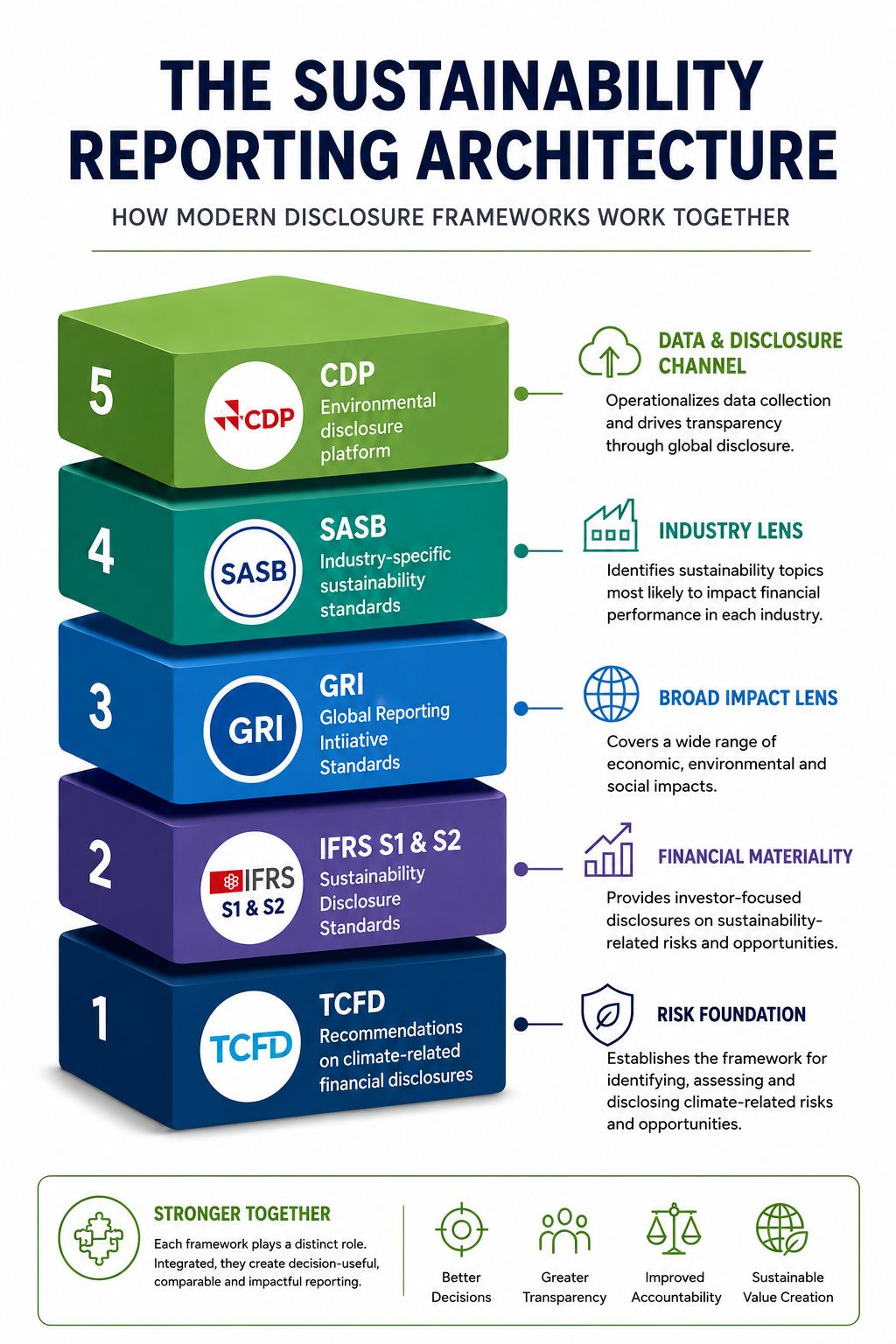
Here is how the five layers of the reporting architecture stack together, from bottom to top:
Layer 1: TCFD (The Risk Foundation)
The Task Force on Climate-related Financial Disclosures (TCFD) established the core operational methodology for ESG. TCFD introduced the four-pillar management structure: Governance, Strategy, Risk Management, and Metrics & Targets. Almost every modern ESG standard—including CSRD, ISSB, and California SB 253—uses this exact four-pillar structure to organize its disclosures. TCFD provides the operational blueprint for how a board should manage climate risk.
Layer 2: IFRS S1 & S2 (Financial Materiality Baseline)
Building directly on top of TCFD, the International Sustainability Standards Board (ISSB) released IFRS S1 and S2. These standards translate TCFD’s qualitative risk principles into formal, quantitative financial accounting disclosures. They represent the global baseline for financial materiality, helping investors evaluate how climate-related transition and physical risks impact a company’s future enterprise value.
Layer 3: GRI (Broad Impact Lens)
While IFRS S1 & S2 cover the financial risks to the company, the Global Reporting Initiative (GRI) provides the standard for impact materiality. GRI measures the company’s outward impact on the environment and society. By combining the investor-focused metrics of IFRS S1 & S2 with the stakeholder-focused impact metrics of GRI, an organization satisfies the requirements of double materiality, making it fully aligned with the EU's CSRD.
Layer 4: SASB (Sector-Specific Materiality)
Sustainability risks vary wildly by industry. A software firm faces material risks in data privacy and server energy use; a mining company faces risks in water extraction, occupational safety, and waste management. The Sustainability Accounting Standards Board (SASB) provides industry-specific quantitative metrics across 77 distinct sectors. IFRS S1 explicitly directs companies to use the SASB metrics to identify relevant risks and select appropriate indicators.
Layer 5: CDP (Data Collection & Disclosure)
Once you have structured your TCFD risk processes, calculated your IFRS financial metrics, compiled your GRI impact indicators, and selected your SASB sector metrics, you need a channel to distribute this data. CDP (formerly the Carbon Disclosure Project) is the world’s largest voluntary environmental database. Over 23,000 companies submit detailed annual questionnaires on climate change, forests, and water security through the CDP portal, which distributes the data to global institutional investors.
By organizing your data collection around this 5-layer architecture, you can build a unified ESG data baseline that captures the raw inputs once and outputs them to any disclosure standard.
Choosing the Right Module: Basic vs. Comprehensive VS (VSME)
If you are a non-listed European SME, or a global supplier to an EU firm, EFRAG's voluntary VS (VSME) standard is the most proportionate and strategic entry point. The VS (VSME) uses a modular structure designed to scale with your company's capabilities and business goals.
There are two primary modules to choose from:
- The Basic Module (B1–B11): The entry-level baseline. It contains 11 disclosures covering approximately 50 quantitative and qualitative data points (such as energy consumption, Scope 1 and Scope 2 emissions, employee headcount, contract types, average wages, and anti-corruption policies). There is no requirement for a double materiality assessment or an external audit. This module acts as the statutory "value chain cap" under EU law.
- The Comprehensive Module (C1–C9): The advanced extension. It adds 9 additional disclosures (approximately 42 more data points, totaling ~100). It requires the company to document its sustainability strategy, establish formal greenhouse gas reduction targets (including Scope 3 value chain emissions where material), assess climate-related physical and transition risks, and detail supplier practices.
| Requirement | Basic Module (B1-B11) | Comprehensive Module (C1-C9) | Business Objective |
|---|---|---|---|
| Scope 1 & 2 Carbon Footprint | Mandatory (B3) | Mandatory (B3 + C3 targets) | Core carbon accounting baseline |
| Scope 3 (Value Chain) Emissions | Not Required | Mandatory if material (C5) | Addressing supply chain pressure |
| Double Materiality Assessment (DMA) | Not Required | Strategy Disclosure (C1-C2) | Identifying strategic risks & opportunities |
| Climate Risk Assessment | Not Required | Mandatory (C4) | Satisfying bank financing and loan requests |
Which should you choose?
- Select the Basic Module if this is your first year of reporting, if you are a micro-enterprise, or if you are responding to a single corporate customer request.
- Select the Comprehensive Module if you are applying for a green loan or bank financing (banks require risk assessments and targets), if you have multiple corporate buyers requesting detailed Scope 3 metrics, or if you want to prepare for future compliance.
How ExecutESG Solves the Multi-Framework Challenge
Choosing the correct ESG framework is only half the battle. The real challenge is establishing a data collection system that doesn't collapse under the weight of manual admin, broken formulas, and missing document records.
ExecutESG is a strategic sustainability operating system designed specifically to simplify this process for SMEs and compliance teams.
- Unified Asset-Level Database: Move away from static spreadsheets. Input your utility bills, fuel invoices, travel logs, and HR demographics once. The platform automatically calculates your Scope 1, 2, and 3 emissions using localized emission factors (DEFRA, IEA, EPA).
- Automated Multi-Framework Mapping: Enter your activity data, and export it into a voluntary VS (VSME) report for EU buyers, a GRI-aligned content index for public transparency, or structured climate metrics to satisfy ISSB and BRSR demands.
- Audit-Ready Document Storage: Protect your reports from compliance risks. ExecutESG acts as a single source of truth, allowing you to attach primary verification documents directly to metrics, creating a transparent audit trail for third-party certifiers or bank lenders.
- Guided Materiality & Compliance Wizards: Walk through double materiality assessments and localized disclosures step-by-step with interactive software that translates dense regulatory requirements into clear, plain-language actions.
Start Your Free VS (VSME) Report →
Create your account in 2 minutes. The Basic Module is permanently free.
Frequently Asked Questions
Is GRI compatible with CSRD/ESRS?
Yes. EFRAG and GRI have designed their frameworks to be highly interoperable. In May 2024, they issued joint guidance confirming that companies reporting under the ESRS are considered to be reporting "with reference" to the GRI Standards on shared topics. This means that a GRI-aligned dataset can serve as the direct foundation for your mandatory CSRD compliance.
What is the difference between ISSB and TCFD?
The ISSB standards (IFRS S1 and S2) build directly upon and incorporate the TCFD recommendations. In late 2023, the Financial Stability Board officially disbanded the TCFD and handed its monitoring responsibilities over to the IFRS Foundation. Practically, IFRS S2 represents the next, more detailed and quantitative evolution of the TCFD framework, integrating climate risks directly into financial reporting.
Do private companies have to report under CSRD?
It depends on their size. Large private companies operating in the EU must report under the CSRD if they exceed at least two of the three key thresholds (250 employees, €50M turnover, €25M assets). However, non-listed SMEs (fewer than 250 employees) are legally exempt from the CSRD. They face indirect pressure because their large customers are required to collect data on value chain emissions. These private SMEs should adopt the voluntary VS (VSME) standard to satisfy these requests efficiently.
How does California SB 253 affect companies outside of California?
California SB 253 applies to any public or private business entity doing business in California with annual revenues exceeding $1 billion. Because the law requires these companies to report on their Scope 3 value chain emissions, any business—regardless of its location or size—that acts as a supplier to these large California-linked entities will be required to calculate and submit their carbon footprint data.
Can a company report under both GRI and ISSB?
Yes. Many leading organizations report under both frameworks to satisfy different audiences. They use ISSB (IFRS S1 & S2) for investor-focused, financial materiality disclosures in their annual reports, and publish a separate or integrated GRI report to demonstrate impact materiality to employees, customers, NGOs, and the local community.
Recommended Articles
- VS (VSME) Standard Explained: The Complete Guide for European SMEs
- BRSR Reporting in India: The SEBI Sustainability Compliance Guide
- IFRS S1 and S2: The New Global Baseline for ESG Financial Disclosures
- The GRI Standards Framework: A Complete Sustainability Reporting Guide
- Understanding Scope 1, 2, and 3 Emissions: A Complete Guide
- Scope 1 vs. Scope 3 Emissions: Key Differences for Businesses
- How to Automate Your VS (VSME) Report and Save Hours
- Best VS (VSME) Reporting Software Comparison
- Free ESG Reporting Software Guide
- EU Taxonomy: What SMEs Actually Need to Know
- SFDR: Why Your Bank Is Asking for ESG Data
- ExecutESG Pricing and Plans
Check Your VS (VSME) & CSRD Readiness Score
Answer 6 quick questions under the EU Voluntary Standard VS (VSME) to discover your compliance gap score, estimated time savings, and generate your free starter report.
Stay Ahead of EU Sustainability Mandates
Get our weekly intelligence briefing on VS (VSME), CSRD compliance, buyer Scope 3 demands, and EcoVadis audits—distilled for European SMEs.