Best Accounting Software for Sustainability Reporting in 2026: The Complete Market Benchmark
Best Accounting Software for Sustainability Reporting in 2026: The Complete Market Benchmark
For decades, accounting software had one job: track financial debits and credits to satisfy tax authorities and evaluate profitability. In 2026, the mandate has expanded. Under the European Union’s Corporate Sustainability Reporting Directive (CSRD) and supply chain mandates from corporate buyers, small and mid-sized enterprises (SMEs) must now track carbon debits and credits with the same rigor applied to cash.
Because over 80% of greenhouse gas activity data resides in purchase invoices and general ledgers, your accounting software choice dictates whether sustainability compliance takes two days or three months.
In this market benchmark, we evaluate the leading global, mid-market, and European regional accounting platforms on their sustainability reporting capabilities, integration architectures, and compliance with EFRAG's voluntary VS (VSME) standard.
5 Evaluation Criteria for ESG-Ready Accounting Software
Not all accounting systems handle sustainability data equally. When assessing an accounting platform for corporate carbon accounting and sustainability disclosures, finance leaders should evaluate five core capabilities:
┌────────────────────────────────────────────────────────────────────────┐
│                   5 ESG Accounting Evaluation Criteria                 │
├───────────────────────────────┬────────────────────────────────────────┤
│ 1. API Line-Item Access       │ Can external tools read invoice lines, │
│                               │ physical quantities, and vendor names? │
├───────────────────────────────┼────────────────────────────────────────┤
│ 2. Chart of Accounts Support  │ Does the platform support sub-accounts │
│                               │ for energy, fuels, and travel?         │
├───────────────────────────────┼────────────────────────────────────────┤
│ 3. Multi-Currency Normalization│ Are foreign currency expenses handled  │
│                               │ without corrupting spend-based math?   │
├───────────────────────────────┼────────────────────────────────────────┤
│ 4. Digital Audit Trails       │ Can each transaction be verified back  │
│                               │ to an immutable voucher and invoice ID?│
├───────────────────────────────┼────────────────────────────────────────┤
│ 5. EFRAG VS (VSME) Alignment  │ Can the ledger output be mapped to     │
│                               │ official European disclosure modules?  │
└───────────────────────────────┴────────────────────────────────────────┘
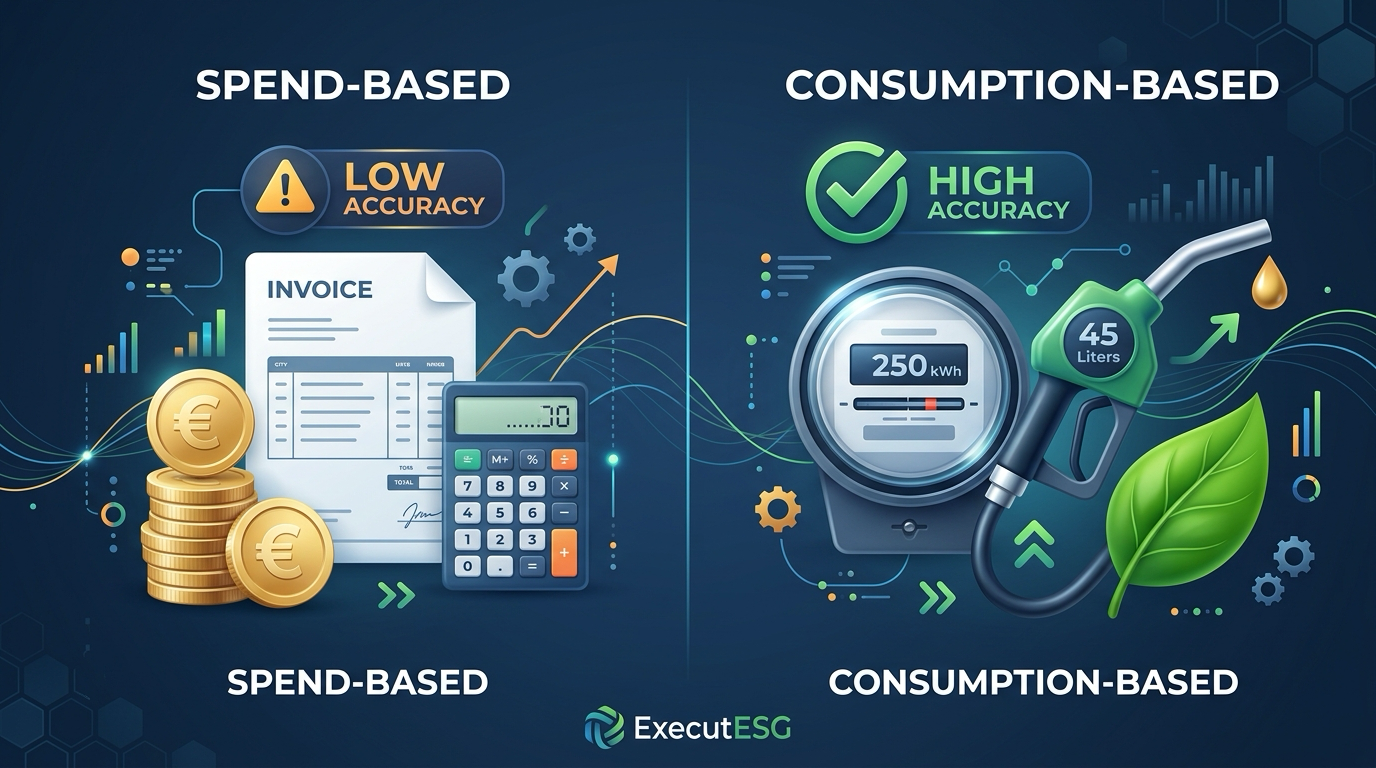
- API Line-Item Access: Does the software expose detailed purchase invoice line items via API, or only high-level account balances? Access to line items is essential for extracting physical units (liters of fuel, kilowatt-hours of power) instead of crude spend multipliers.
- Chart of Accounts Flexibility: Can finance teams establish dedicated sub-accounts for environmental cost drivers (e.g., separating stationary facility diesel from mobile transport diesel)?
- Multi-Currency Normalization: Does the platform convert foreign expenditures into reporting currency using historical exchange rates to prevent inflation-driven carbon estimation errors?
- Digital Voucher Auditability: Can an external auditor click through from a reported greenhouse gas metric directly to the underlying receipt or invoice PDF stored in the document archive?
- Universal Portability: If an organization operates legacy desktop software, can the system export structured General Ledger files that can be processed via a universal CSV migration module?
The 2026 Accounting Software Benchmark Matrix
The comparison table below summarizes how major cloud and enterprise accounting platforms support corporate sustainability and carbon reporting:
| Platform | Target Business Size | Primary ESG Integration Method | Physical Unit Extraction (Liters/kWh) | EFRAG VS (VSME) Readiness | Typical Implementation Overhead |
|---|---|---|---|---|---|
| Xero | Small Businesses (1–50 employees) | Cloud REST API & Marketplace | High (via connected apps) | Full (via ExecutESG sync) | 1–2 hours |
| QuickBooks Online | Small Businesses (1–100 employees) | Intuit Developer REST API | High (via connected apps) | Full (via ExecutESG sync) | 1–2 hours |
| Visma Netvisor | Nordic SMEs (20–500 employees) | Direct Netvisor Web Service API | Very High (direct e-invoice line data) | Full (native VS (VSME) mapping) | Under 1 hour |
| Fortnox | Swedish SMEs (5–250 employees) | Fortnox Partner REST API | High (electronic invoice vouchers) | Full (BAS Chart of Accounts sync) | 1–2 hours |
| Procountor | Finnish & Nordic SMEs | Finago REST API / API v2 | High (purchase ledger parsing) | Full (native VS (VSME) mapping) | 1–2 hours |
| DATEV | German Mid-Market & Tax Advisors | DATEV Data Services / Export | Moderate (requires SKR03/04 mapping) | Full (via CSV / partner API) | 1–2 days |
| Oracle NetSuite | Mid-Market & Scale-ups | SuiteTalk REST Web Services | Moderate to High (CarbonSuite module) | Partial (requires custom config) | 4–8 weeks |
| SAP S/4HANA | Enterprise (1,000+ employees) | SAP Green Ledger / OData API | Very High (transactional material flows) | Full (enterprise CSRD / ESRS) | 6–18 months |
In-Depth Platform Analysis
1. Xero: The Best Cloud Platform for Small International Teams
Best for: International micro-enterprises, digital agencies, and professional services firms.
Xero’s cloud architecture and extensive App Store make it one of the easiest accounting platforms to connect to external sustainability software.
- Key Strengths: Xero’s standard chart of accounts structure provides clear categorization for travel, utilities, and office supplies. Its REST API allows external systems like ExecutESG to pull transaction line items with minimal configuration.
- Limitations: Xero does not have a native carbon accounting module. Without an external integration, users cannot calculate greenhouse gas emissions directly inside the software. Furthermore, standard receipt capture often records total price rather than fuel volume.
- Verdict: Excellent when paired with a specialized reporting engine. Connecting Xero to ExecutESG takes under 15 minutes and enables full financial sustainability reporting.
2. QuickBooks Online: Best for Trade and Contracting SMBs
Best for: Small contractors, specialty trade businesses, and logistics operators with intensive vendor spending.
Intuit’s QuickBooks Online (QBO) handles high transaction volumes and detailed purchase orders across diverse vendor categories.
- Key Strengths: QuickBooks provides granular vendor profiling, allowing businesses to tag recurring fuel suppliers (e.g., BP, Shell, ExxonMobil) and regional energy utilities. This vendor tagging simplifies the automated categorization of Scope 1 and Scope 2 transactions.
- Limitations: Intuit’s built-in reporting tools do not include greenhouse gas metrics. If users rely strictly on third-party spend-based add-ons that multiply currency values by industry averages, commodity price spikes will falsely inflate reported emissions.
- Verdict: Highly effective for small commercial suppliers, provided your integration engine parses invoice lines for physical quantities rather than relying purely on spend.
3. Visma Netvisor: The Nordic Benchmark for Automated Compliance
Best for: Finnish and Nordic SMEs requiring turnkey EFRAG VS (VSME) compliance for bank loans and supply chain tenders.
Visma Netvisor is widely used among Finnish businesses and accounting offices (tilitoimistot). Because Finnish B2B commerce runs almost entirely on structured electronic invoices (Finvoice), Netvisor contains exceptional data granularity.
- Key Strengths: Through its
getpurchaseinvoice.nvandaccountingledger.nvendpoints, Netvisor exposes raw electronic invoice XML. This allows ExecutESG to extract exact physical metrics—such as liters of diesel from fuel distributors (Neste, St1, ABC) and megawatt-hours of district heating—directly from line items. - Limitations: Netvisor is localized primarily for the Nordic market and Finnish business practices.
- Verdict: The gold standard for automated Nordic SME sustainability reporting. Zero manual data entry is required to generate an audit-ready VS (VSME) baseline.
4. Fortnox: The Swedish Market Leader
Best for: Swedish enterprises and manufacturing suppliers operating under the Swedish BAS Chart of Accounts.
Fortnox is the dominant cloud ERP for Swedish mid-market businesses. Its structured account numbering aligns cleanly with environmental data extraction.
- Key Strengths: Because Swedish businesses use the standardized BAS chart of accounts (e.g., account
5611for passenger car fuel,5612for truck diesel, and5310for electricity), automated mapping to the Greenhouse Gas Protocol is straightforward and consistent. - Limitations: Native sustainability features within Fortnox are limited to basic organizational footprints; formal EFRAG VS (VSME) disclosure assembly requires an external connector.
- Verdict: Outstanding candidate for automated compliance. Connecting Fortnox via API enables rapid assembly of both Basic and Business Partners modules.
5. Oracle NetSuite & SAP: Enterprise Powerhouses vs. Cost Reality
Best for: Large mid-market enterprises and multinational corporations.
For enterprises with revenues exceeding €50 million, Oracle NetSuite (with SuiteClimate / CarbonSuite) and SAP (with SAP Green Ledger and SAP Sustainability Footprint Management) offer native ledger capabilities.
- The Enterprise Trade-off: While SAP Green Ledger embeds carbon directly alongside financial general ledger postings, implementation costs often exceed €150,000 to €500,000, accompanied by months of enterprise systems integration.
- The Agile Hybrid Alternative: Growing mid-market companies frequently choose to keep their core financial records in NetSuite or SAP while using an agile platform like ExecutESG to pull ledger journals via API or CSV exports. This hybrid approach delivers compliant VS (VSME) reports at a fraction of the cost.
What If Your Accounting Software Has No API? The Universal CSV Migration Module
A major obstacle for many SMEs is operating legacy on-premise accounting software (such as older Sage installations, Microsoft Dynamics NAV, or regional desktop software) that lack modern API connectors.
To eliminate this barrier, finance teams can use a Universal CSV Migration Module:
┌─────────────────────────────────┐
│     Any Accounting Software     │
│   (Sage, Dynamics, Desktop ERP) │
└────────────────┬────────────────┘
                 │
                 ▼ Export Transaction Journal (.csv / .xlsx)
┌─────────────────────────────────┐
│  ExecutESG Universal CSV Engine │
│  • Auto-Detects Column Headers  │
│  • Normalizes Dates & Currencies│
│  • Matches Account Codes to GHG │
└────────────────┬────────────────┘
                 │
                 ▼
┌─────────────────────────────────┐
│  Verified EFRAG VS (VSME) Output│
└─────────────────────────────────┘
- One-Click Export: Export your general ledger transaction journal or accounts payable report from your software as a standard
.csvor.xlsxfile. - Intelligent Column Mapping: The platform’s ingestion engine automatically recognizes columns for transaction date, voucher ID, account code, vendor name, line description, net amount, and currency.
- Automated Account Grouping: The engine maps account codes to greenhouse gas categories, allowing your finance team to review and confirm account classifications in a clear, visual interface.
- Immediate Calculation: Scope 1, Scope 2, and material Scope 3 emissions are computed immediately, eliminating software migration lock-in.
How Accounting Firms (Tilitoimistot) Choose Software for Client Portals
For accounting and advisory firms managing multi-tenant client portfolios, software selection is governed by practice economics. Traditional bookkeeping margins are shrinking; accounting firms need platforms that turn routine client accounting files into new advisory revenue.
Key criteria for accounting firm partner portals include:
- Multi-Client Dashboard: Managing dozens of SME clients from a single administrative login.
- Automated Data Quality Flags: Highlighting client invoices that lack unit metrics or vendor classifications before audits take place.
- White-Label Reporting: Exporting EFRAG-compliant VS (VSME) reports complete with the accounting firm’s branding and professional sign-off.
Frequently Asked Questions
Which accounting software is best for an SME reporting under VS (VSME)?
If your business operates in the Nordics, Visma Netvisor and Fortnox offer the highest data granularity due to structured electronic invoicing. For international companies, Xero and QuickBooks Online provide rapid setup when connected to a specialized platform like ExecutESG.
Can accounting software calculate Scope 3 supply chain emissions accurately?
Core accounting systems cannot calculate Scope 3 emissions on their own because they lack integrated emission factor databases and life-cycle assessment models. However, because your accounts payable ledger tracks every supplier and purchase invoice, connecting your accounting data to ExecutESG enables automated Scope 3 calculation across categories like freight, business travel, waste, and purchased goods.
Does our company need to switch accounting software to do carbon accounting?
No. You do not need to replace your existing accounting system. Modern sustainability operating systems connect via secure, read-only APIs or ingest standard general ledger CSV exports, preserving your existing financial workflows while automating compliance.
Automate Your Sustainability Disclosures from Any Accounting Ledger
Evaluating accounting software for sustainability is no longer a theoretical exercise—it is a practical operational decision. Whether you run Xero, QuickBooks, Visma Netvisor, Fortnox, or an enterprise ERP, you can turn existing financial records into verified, auditor-grade sustainability reports.
Create your free account on ExecutESG to connect your accounting system or upload your general ledger CSV, and generate your audit-ready EFRAG VS (VSME) report in under 48 hours.
Check Your VS (VSME) & CSRD Readiness Score
Answer 6 quick questions under the EU Voluntary Standard VS (VSME) to discover your compliance gap score, estimated time savings, and generate your free starter report.
Stay Ahead of EU Sustainability Mandates
Get our weekly intelligence briefing on VS (VSME), CSRD compliance, buyer Scope 3 demands, and EcoVadis audits—distilled for European SMEs.