Carbon Accounting Software vs. Spreadsheets: The SME Guide
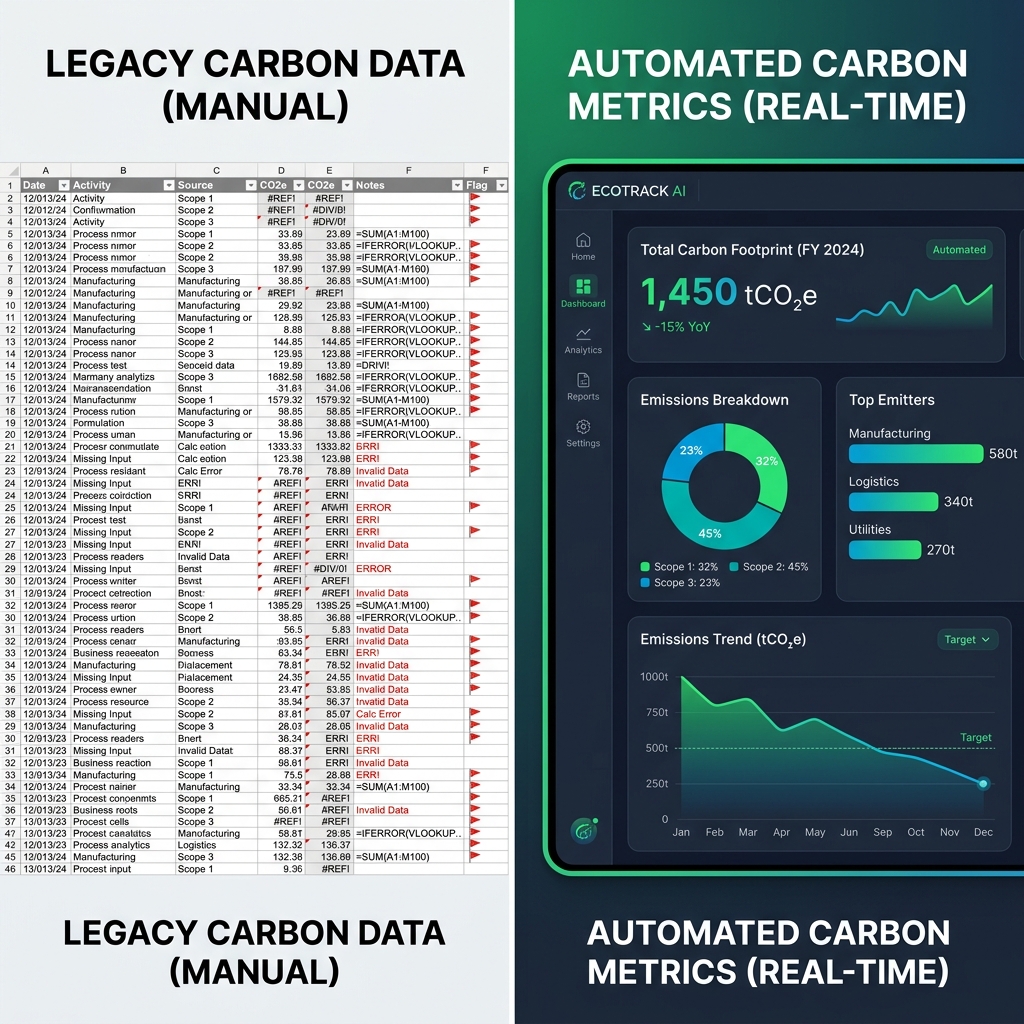
Carbon Accounting Software vs. Spreadsheets: The SME Guide
When small and medium-sized enterprises (SMEs) begin their sustainability journeys, the default starting point is almost always Microsoft Excel or Google Sheets. It makes sense: spreadsheets are free, familiar, and highly customizable.
However, as sustainability reporting shifts from a voluntary PR exercise to a regulated compliance requirement under EFRAG’s voluntary VS (VSME) standard and the Corporate Sustainability Reporting Directive (CSRD), the limitations of manual spreadsheets are becoming clear.
In this guide, we compare carbon accounting software vs. spreadsheets, detailing where Excel falls short, how software-based calculators operate, and how this decision affects your compliance under the latest EU regulations.
The Comparison: Spreadsheets vs. Software
To evaluate whether your company should stick to spreadsheets or upgrade to dedicated software, let’s compare them across key operational workflows:
| Feature / Metric | Spreadsheet-Based Accounting | Specialized Carbon Software (ExecutESG) |
|---|---|---|
| Upfront Cost | €0 (Using internal resources) | Free basic tier / €49/mo Pro |
| Calculations | Manual formulas (Subject to math errors) | Automated dropdown calculators |
| Emission Factors | Manually sourced (Vulnerable to outdated data) | Automatically updated databases (Fingrid, Vattenfall, etc.) |
| Data Verification | None (Version control is difficult) | Read-only audit trails for assurance providers |
| Double Materiality (DMA) | Questionnaire sheets (High response bias) | Native AHP pairwise consensus voting |
| Regulatory Guardrails | None | Enforces the Statutory Value Chain Cap |
| Format Outputs | Flat sheets or static PDF | PDF, editable Word (.docx), and digital XBRL |
1. Automated Calculations vs. Manual Formulas
The most significant bottleneck in carbon accounting is converting raw utility activity data (kWh of electricity, litres of diesel, tonnes of waste) into carbon dioxide equivalents ($CO_2e$).
- The Spreadsheet Approach: You must search online databases for the correct emission factors, paste them into your cells, and write formulas. If you use a grid emission factor from a previous year or confuse electricity transmission losses with generation factors, your calculations will be incorrect.
- The Software Approach: ExecutESG uses automated dropdown calculators. You select your utility provider (e.g., Vattenfall or Fingrid for Nordic businesses), input your raw consumption values from your invoices, and the platform calculates Scope 1 and Scope 2 emissions instantly. The emission factor database is updated in the background, ensuring compliance without manual research.
2. Spreadsheet Error Rates: A Real Audit Risk
In financial accounting, spreadsheets are notorious for containing hidden errors. In carbon accounting, the risk is even higher because the metrics are non-financial and multidisciplinary.
Common spreadsheet errors that fail audits include:
- Unit Conversion Issues: Accidental entry of gigajoules ($GJ$) instead of kilowatt-hours ($kWh$) or megawatt-hours ($MWh$), inflating footprints by orders of magnitude.
- Lack of Version Control: Multiple team members editing the same file, resulting in broken links and overwritten data blocks.
- No Data Lineage: External auditors cannot verify where a specific figure came from, forcing you to pay for extra audit hours to trace your numbers back to raw invoices.
Dedicated software resolves this by utilizing read-only audit trails. When a sustainability manager uploads a utility bill, the platform locks the data point and links it directly to the corresponding disclosure, providing a transparent trace for assurance providers.
3. Double Materiality: Beyond the Carbon Tunnel
Sustainability reporting involves more than just carbon footprinting. Under the VS (VSME) Business Partners Module and the CSRD, companies must evaluate their social and governance impacts using a Double Materiality Assessment (DMA).
Attempting to run a DMA in spreadsheets is difficult:
- Spreadsheet-based surveys ask stakeholders to rate 50 topics from 1 to 5. This causes survey fatigue, and respondents often rate everything as a "4" or "5," rendering the results useless.
- ExecutESG runs on the ExecutESG 10-Task DMA Workflow, mapped to our 9-Step Doctrinal Leadership Journey:
 ┌─────────────────────────────────────────────────────────────┐
  │                      THE 5-STEP ROADMAP                     │
  ├─────────────────────────────────────────────────────────────┤
  │  Step 1: Setup & Value Chain Context (Tasks 1 & 2)          │
  │  Step 2: Impact Identification & Validation (Tasks 3 & 4)   │
  │  Step 3: Stakeholder Engagement & Pairwise Voting (Task 5)  │
  │  Step 4: Financial Scoring of Risks & Opps (Tasks 6, 7 & 8) │
  │  Step 5: Consolidated Review & Declaration (Tasks 9 & 10)   │
  └─────────────────────────────────────────────────────────────┘
By replacing flat 1-5 ratings with forced-choice pairwise comparison surveys (Task 5), the software asks stakeholders to choose between Topic A and Topic B. The platform then uses Saaty's Analytic Hierarchy Process (AHP) to calculate mathematically precise priority vectors, reducing scoring variance and ensuring a statistically sound materiality matrix.
4. The Value Chain Shield: Enforcing the Statutory Cap
If your company has fewer than 1,000 employees, you are protected by the Statutory Value Chain Cap introduced under the 2026 Omnibus simplification package:
[!IMPORTANT] The Statutory Cap: Large corporate buyers subject to the CSRD are legally prohibited from requesting sustainability data from suppliers with fewer than 1,000 employees that exceeds the voluntary VS (VSME) standard. If they request additional data, they must inform you of your legal right to refuse.
If you use spreadsheets, you have no guardrails to prevent your sales or compliance teams from over-reporting. A dedicated SME ESG tool enforces this cap natively, ensuring you report only what is legally required and shielding your operations from unnecessary administrative burden.
Conclusion: When to Upgrade?
If you are a micro-business with basic energy data, EFRAG's free Excel sheet is a solid starting point.
However, if you are under pressure from multiple corporate customers, need to complete a Double Materiality Assessment for your buyers, or want to avoid audit risks, manual spreadsheets quickly become a liability.
ExecutESG offers a permanently free Basic Module featuring automated GHG calculations, allowing you to move away from spreadsheet chaos without an upfront financial commitment.
👉 Create your free account and calculate your emissions today
Recommended Articles
Check Your VS (VSME) & CSRD Readiness Score
Answer 6 quick questions under the EU Voluntary Standard VS (VSME) to discover your compliance gap score, estimated time savings, and generate your free starter report.