How to Disclose CDP Scope 1, 2, and 3 Emissions
How to Disclose CDP Scope 1, 2, and 3 Emissions
The CDP (formerly Carbon Disclosure Project) runs the global disclosure system for companies, cities, and states to manage their environmental impacts. For small and medium-sized enterprises (SMEs), receiving a request to disclose emissions to the CDP is a major milestone—and a significant administrative challenge.
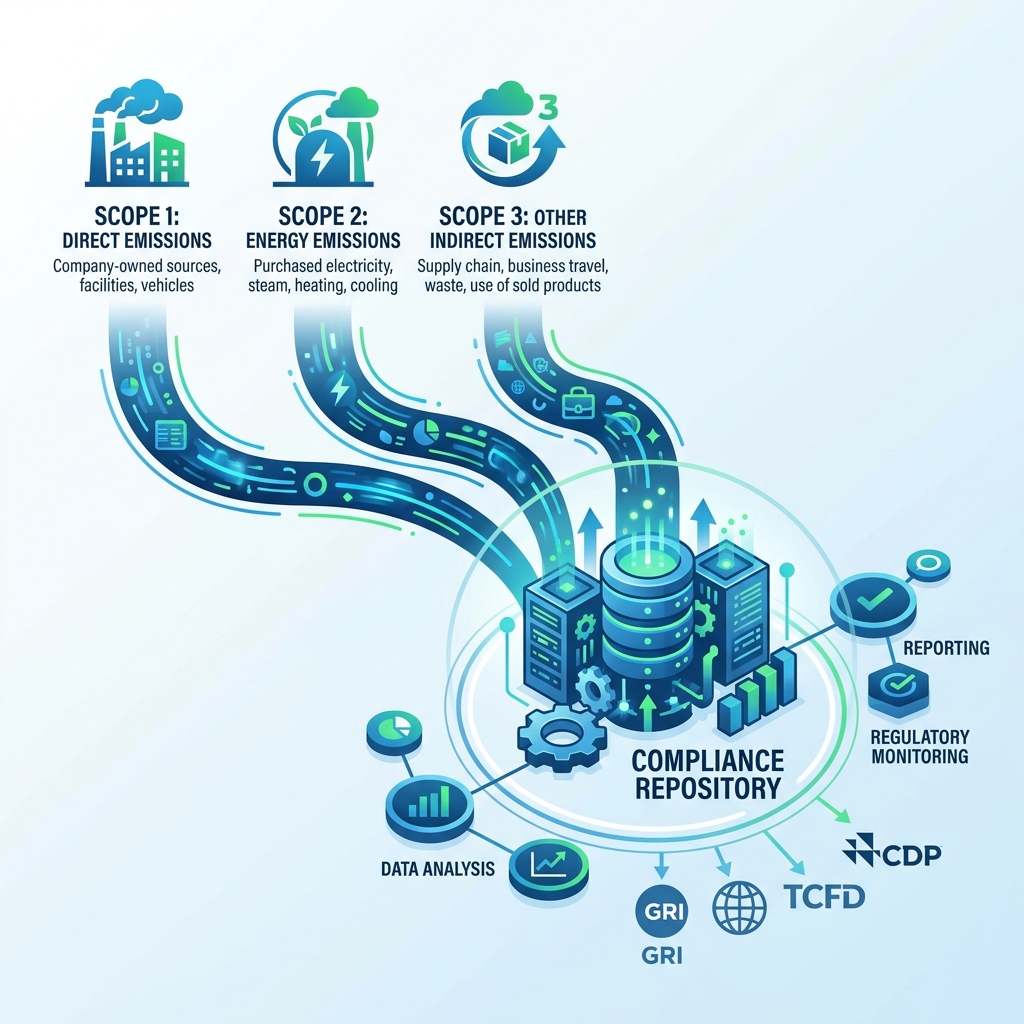
To satisfy investors and large corporate buyers, you must disclose your greenhouse gas (GHG) footprint across three distinct categories: Scope 1 (direct operational emissions), Scope 2 (indirect energy emissions), and Scope 3 (value chain emissions).
In this guide, we break down how to calculate and disclose these emissions for the CDP, share a CDP-to-VS (VSME) Data Reuse Table, and outline how to simplify your reporting workflows.
Understanding the Disclosures: Scope 1, 2, and 3
Before submitting data to the CDP, you must categorize your emissions according to the GHG Protocol:
- Scope 1 (Direct Emissions): Emissions from sources that your company owns or controls directly. This includes gas boilers in your offices, company-owned petrol or diesel delivery vans, and industrial processes.
- Scope 2 (Indirect Energy Emissions): Emissions from the generation of electricity, heating, or cooling that your company purchases and consumes. For example, the electricity powering your office laptops or warehouse lighting.
- Scope 3 (Value Chain Emissions): Emissions that occur because of your business activities, but from sources you do not own or control. This includes employee commuting, business travel, raw material transport, and the end-of-life disposal of products you sell.
🔁 The CDP-to-VS (VSME) Data Reuse Table
One of the most common mistakes SMEs make is framework duplication—calculating carbon footprints separately for different questionnaires (e.g., one for CDP, one for EcoVadis, and another for EFRAG’s VSME).
Because these frameworks all reference the GHG Protocol, you can calculate your data once and reuse it. The table below maps how your CDP carbon disclosures map directly to EFRAG’s voluntary VS (VSME) disclosures:
| GHG Category | CDP Questionnaire Section | VS (VSME) Standard Module / Disclosure | Actionable Calculation |
|---|---|---|---|
| Scope 1 | C5.2 / C6.1 (Direct emissions breakdown) | Basic Module - Disclosure B3 (Greenhouse gas emissions) | Calculate total gas/fuel consumption in liters or cubic meters and apply GHG Protocol factors. |
| Scope 2 | C6.2 / C6.3 (Indirect emissions breakdown) | Basic Module - Disclosure B3 (Greenhouse gas emissions) | Input total electricity/heat usage in kWh. Apply location-based and market-based grid factors. |
| Scope 3 | C6.5 (Value chain emissions categories) | Comprehensive Module - Disclosure C5 (Scope 3 emissions) | Estimate emissions from key categories, such as inbound shipping and employee business travel. |
| Targets | C4.1 / C4.2 (Emissions reduction targets) | Comprehensive Module - Disclosure C3 (GHG emission reduction targets) | Define carbon reduction targets (e.g., 50% reduction in Scope 1 and 2 by 2030). |
The Value Chain Shield: The Statutory Cap
If you are disclosing to the CDP because a large corporate customer requested it, keep in mind your legal protections. Under the 2026 Omnibus simplification package, non-listed SMEs (companies with fewer than 1,000 employees) are protected by a statutory value chain ceiling:
[!IMPORTANT] The Statutory Cap: Large EU buyers are legally prohibited from requesting sustainability data from suppliers with fewer than 1,000 employees that exceeds the voluntary VS (VSME) standard. If they request additional custom data, they must inform you of your legal right to refuse.
Because the VS (VSME) standard aligns with the CDP's core requirements, completing a VS (VSME)-aligned report is sufficient to answer most CDP supply chain requests, preventing you from filling out custom questionnaires.
The Operational Path: Generating Audit-Ready Disclosures
To ensure your CDP submission passes customer audits without issues, your carbon accounting must follow a structured process. ExecutESG runs on the ExecutESG 10-Task DMA Workflow, mapped directly to our 9-Step Doctrinal Leadership Journey:
  ┌─────────────────────────────────────────────────────────────┐
  │                      THE 5-STEP ROADMAP                     │
  ├─────────────────────────────────────────────────────────────┤
  │  Step 1: Setup & Value Chain Context (Tasks 1 & 2)          │
  │  Step 2: Impact Identification & Validation (Tasks 3 & 4)   │
  │  Step 3: Stakeholder Engagement & Pairwise Voting (Task 5)  │
  │  Step 4: Financial Scoring of Risks & Opps (Tasks 6, 7 & 8) │
  │  Step 5: Consolidated Review & Declaration (Tasks 9 & 10)   │
  └─────────────────────────────────────────────────────────────┘
By using a structured engine to calculate and lock your data:
- Automated Grid Factors (Step 1): The software automatically applies regional grid emission factors (such as Fingrid in Finland or Vattenfall in Sweden) to your Scope 2 energy data, eliminating manual research errors.
- Pairwise Stakeholder Consensus (Step 3): Under Task 5, stakeholders complete binary comparison surveys (A vs. B) to rank ESG topics. Using the Analytic Hierarchy Process (AHP), the tool resolves scoring variance, providing a clear consensus on whether climate change is a material risk.
- Audit-Ready Verification (Step 5): The system generates a read-only audit trail and exports digital files (XBRL and Word), enabling you to share verified figures with CDP and other assurance providers.
Conclusion & Next Steps
Disclosing to the CDP does not require hiring external consultants or spending months building spreadsheets. By using standardized calculations and reusing your carbon metrics across frameworks, you can satisfy multiple compliance requirements at once.
ExecutESG offers a permanently free Basic Module featuring automated GHG calculations, helping you build your first Scope 1 and 2 footprint in under 15 minutes.
👉 Create your free account and start your carbon baseline today
Recommended Articles
Check Your VS (VSME) & CSRD Readiness Score
Answer 6 quick questions under the EU Voluntary Standard VS (VSME) to discover your compliance gap score, estimated time savings, and generate your free starter report.
Stay Ahead of EU Sustainability Mandates
Get our weekly intelligence briefing on VS (VSME), CSRD compliance, buyer Scope 3 demands, and EcoVadis audits—distilled for European SMEs.