GHG Calculation Models: Consumption-Based vs. Spend-Based
GHG Calculation Models: Consumption-Based vs. Spend-Based
As small and medium-sized enterprises (SMEs) face growing pressure to report their carbon footprints, they quickly encounter the technical realities of carbon accounting. Whether trying to satisfy a supply chain request from a corporate buyer, preparing an EcoVadis scorecard (facilitated by the EcoVadis platform), or aligning with the European Union’s voluntary VS (VSME) reporting standard, you must decide how to calculate your greenhouse gas (GHG) emissions.
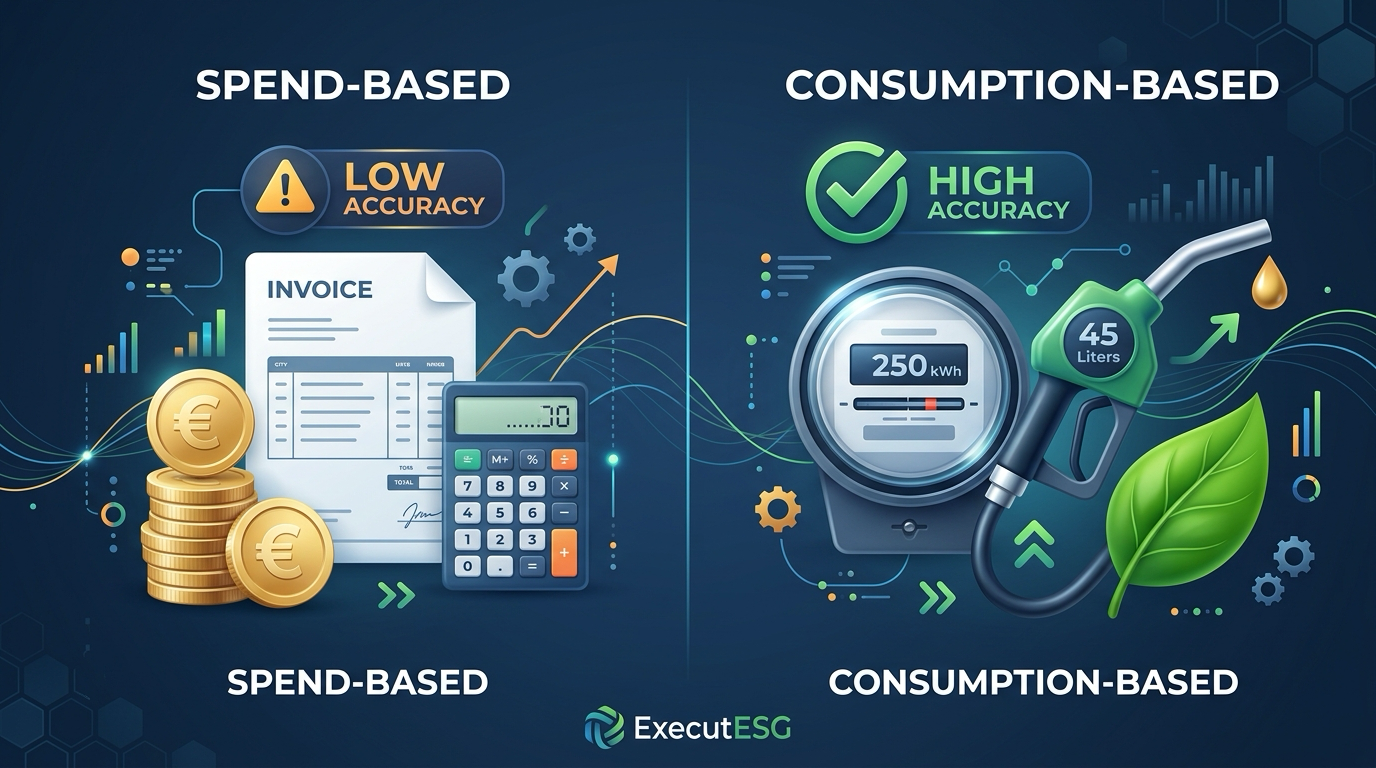
Under the GHG Protocol, companies generally rely on two core calculation models: the spend-based calculation method and the consumption-based (activity-based) method.
In this guide, we compare these two models in detail. We will look at how they work, how price volatility and inflation distort carbon data, and how standard-setters like EFRAG view them. Finally, we provide a practical roadmap to help you transition from simple estimates to audit-ready primary data.
The Comparison: Spend-Based vs. Consumption-Based
Before diving into the technical mechanics, let’s look at how the two models compare side-by-side:
| Metric / Feature | Spend-Based Model | Consumption-Based (Activity-Based) Model |
|---|---|---|
| Primary Data Input | Financial spend (e.g., Euros spent on steel, fuel, or flights) | Physical consumption (e.g., kg of steel, liters of diesel, kWh of power) |
| Database Source | EEIO (Environmentally Extended Input-Output) sector averages | Physical emission factors (e.g., DEFRA, ecoinvent, utility-specific grid factors) |
| Accuracy Level | Low (sector-wide average estimates) | High (reflects real operational realities) |
| Administrative Effort | Very low (uses existing general ledger/invoice data) | Moderate to high (requires utility bills and supplier tracking) |
| Sensitivity to Decarbonization | Insensitive (reducing carbon does not show unless spend drops) | Highly sensitive (directly reflects material substitutions and efficiency gains) |
| Inflation Vulnerability | Highly vulnerable (price spikes falsely inflate your footprint) | Invulnerable (carbon calculations are independent of cost fluctuations) |
| Audit Readiness | Limited (best for initial screening) | Audit-ready (preferred for compliance audits) |
1. What Is the Spend-Based Method?
The spend-based method calculates emissions by multiplying the monetary value of a purchased good or service by an industry-average economic emission factor.
These factors are derived from Environmentally Extended Input-Output (EEIO) models, which map national economic transactions to national environmental data. For example, an EEIO database might determine that for every Euro spent in the "logistics and trucking services" sector, an average of $0.45\text{ kg } CO_2e$ is released.
Advantages of the Spend-Based Model
- Minimal Data friction: You do not need to hunt down utility meters or ask suppliers for environmental reports. You only need access to your bookkeeping software or general ledger.
- Complete Coverage: It is impossible to have "data gaps." If you have spent money on an item, you can assign an emission estimate to it, ensuring a comprehensive initial scope.
- Ideal for Hotspot Analysis: It is an excellent tool for a quick "screening" phase to identify which spend categories (e.g., logistics, IT equipment, raw materials) contribute the most to your footprint.
Limitations of the Spend-Based Model
- The Decarbonization Blindspot: If you buy recycled steel that costs the same as standard steel but has a 70% lower carbon footprint, your spend-based calculation will show no carbon reduction.
- Inflation Distortion: If energy prices or material costs rise due to market inflation, your calculated emissions will increase artificially, even if your physical consumption remains identical.
2. What Is the Consumption-Based Method?
The consumption-based (or activity-based) method calculates emissions by multiplying a physical unit of activity data by a corresponding physical emission factor.
Instead of looking at the invoice amount, this model looks at the physical quantity. It uses verified databases (like UK DEFRA, ecoinvent, or local utility grid records) to calculate direct operational impacts.
Advantages of the Consumption-Based Model
- Accurate Decarbonization Tracking: If you switch your corporate vehicle fleet to electric vehicles, transition to renewable energy tariffs (like Guarantees of Origin), or swap to energy-efficient lighting, your physical consumption data decreases, reflecting a real-world carbon reduction.
- Audit Readiness: External assurance providers and corporate auditors can easily trace activity-based numbers back to physical primary evidence, such as electricity bills, fuel card statements, and weight receipts.
- Corporate Buyer Preference: Large enterprise customers who are subject to the CSRD are legally required to report their Scope 3 emissions. To do this accurately, they want to replace generic industry averages with primary supplier-specific data.
Limitations of the Consumption-Based Model
- High Administrative Burden: Collecting actual consumption data requires setting up manual or API tracking systems to read utility bills, waste logs, and travel records.
- Supplier Engagement Barriers: Gathering Scope 3 supplier data requires active collaboration with your supply chain partners, who may not have calculated their own footprints yet.
3. Practical Example: How Price Volatility Distorts Carbon Data
To understand why the distinction between these two models matters for business decision-making, let's look at a practical example: purchasing 10 tonnes of structural steel.
   ┌─────────────────────────────────────────────────────────────┐
   │             CASE STUDY: STEEL PROCUREMENT (10 TONNES)       │
   ├─────────────────────────────────────────────────────────────┤
   │  Year 2024: Steel costs €10,000                             │
   │  Year 2026: Steel costs €15,000 (purely due to inflation)   │
   ├─────────────────────────────────────────────────────────────┤
   │  SPEND-BASED FOOTPRINT:                                     │
   │  • 2024: €10,000 x 1.5 kg/€ = 15.0 tonnes CO2e              │
   │  • 2026: €15,000 x 1.5 kg/€ = 22.5 tonnes CO2e (Falsified!) │
   ├─────────────────────────────────────────────────────────────┤
   │  CONSUMPTION-BASED FOOTPRINT:                               │
   │  • 2024: 10 tonnes x 1.85 t/t = 18.5 tonnes CO2e            │
   │  • 2026: 10 tonnes x 1.85 t/t = 18.5 tonnes CO2e (Accurate!)│
   └─────────────────────────────────────────────────────────────┘
Case A: Using the Spend-Based Model
- 2024: Your company buys 10 tonnes of standard structural steel for €10,000. Using an economic sector factor of $1.5\text{ kg } CO_2e / €$ spent, your calculated footprint is:
* **2026:** Due to global supply chain constraints and energy price spikes, the exact same 10 tonnes of structural steel now costs **€15,000**. If you continue using the spend-based model, your calculation shows:
Emissions = €10,000 × 1.5 kg/€ = 15,000 kg CO2e (15 tonnes)
Emissions = €15,000 × 1.5 kg/€ = 22,500 kg CO2e (22.5 tonnes)The Distortion: Your physical steel consumption is identical, but your reported carbon footprint has increased by 50% purely due to market inflation.
Case B: Using the Consumption-Based Model
- 2024: You record the physical quantity (10 tonnes of steel) and apply a physical emission factor for standard primary steel ($1.85\text{ tonnes } CO_2e$ per tonne of steel):
* **2026:** Even though the invoice price has risen to €15,000, your physical activity data remains 10 tonnes of steel. The calculated footprint is still exactly **$18.5\text{ tonnes } CO_2e$**. * **The Decarbonization Benefit:** If your procurement team decides to swap standard primary steel for recycled electric-arc furnace (EAF) steel (which has a factor of only $0.6\text{ tonnes } CO_2e$ per tonne of steel), your calculated footprint drops instantly:
Emissions = 10 tonnes × 1.85 t/t = 18.5 tonnes CO2e
Emissions = 10 tonnes × 0.6 t/t = 6.0 tonnes CO2eThis represents a real-world carbon reduction of 67.5%, which would be completely invisible in a spend-based model if the recycled steel had a similar or slightly higher price tag.
4. Regulatory Alignment: EFRAG VS (VSME) & CSRD
How do modern reporting standards view these calculation models?
The GHG Protocol Corporate Value Chain (Scope 3) Standard establishes a clear data hierarchy. While spend-based calculations are accepted, the standard prioritizes higher-accuracy primary data methods:
- Supplier-Specific Method (Highest Accuracy): Collecting product-level carbon footprints directly from your specific suppliers.
- Average-Data Method (Consumption-Based): Multiplying physical quantities (kWh, kg) by generic physical industry averages.
- Spend-Based Method (Lowest Accuracy): Multiplying monetary spend by economic sector factors.
Under EFRAG’s voluntary VS (VSME) (Voluntary SME) standard, which is designed to help European SMEs satisfy customer requests without complex overhead, the Basic Module focuses heavily on consumption-based activity data (Scope 1 direct fuel invoices and Scope 2 electricity bills). Because these direct metrics are readily available through your operational utility bills, starting with physical consumption is highly recommended.
Furthermore, if your company has fewer than 1,000 employees, you are protected by the Statutory Value Chain Cap introduced under the 2026 Omnibus simplification package. This cap legally prohibits large corporate buyers from requesting Scope 3 supply chain data from you that exceeds the voluntary VS (VSME) standard. Providing verified consumption data for your own Scope 1 and Scope 2 footprints is the absolute best way to satisfy these requests while shielding your company from excessive reporting burdens.
5. SME Strategy: How to Build a Hybrid Approach
For most small and medium-sized businesses, going 100% consumption-based on day one is financially and administratively unrealistic. Instead, we recommend a hybrid approach:
┌─────────────────────────────────────────────────────────────┐ │ THE HYBRID ROADMAP │ ├─────────────────────────────────────────────────────────────┤ │ Phase 1: Spend-Based Screening (General ledger audit) │ │ Phase 2: Consumption-Based Transition (Direct utilities) │ │ Phase 3: Supplier-Specific Decarbonization (Scope 3) │ └─────────────────────────────────────────────────────────────┘- Phase 1: Run a Spend-Based Screening: Export your annual general ledger and run a broad spend-based calculation. This will take very little time and will immediately show you where your carbon hotspots lie.
- Phase 2: Target Direct Utilities with Consumption Data: Focus on the hotspots you actually control. Transition your Scope 1 (company fleet fuel cards) and Scope 2 (office and factory electricity meter bills) to consumption-based activity calculations.
- Phase 3: Engaged Supplier Partnerships: For your largest purchased materials (e.g. steel, concrete, freight transport), engage with your top suppliers. Request their primary carbon metrics to replace your generic spend-based estimates over time.
Moving Beyond Spreadsheet Calculations
Running a hybrid carbon accounting model using manual spreadsheets is an audit risk. Unit conversion issues, outdated emission factors, and a lack of version control can quickly corrupt your reporting files.
ExecutESG is built specifically to bridge this gap. Our permanently free Basic Module features automated dropdown calculators. You select your utility provider (such as Vattenfall or Fingrid for Nordic businesses), input your raw billing numbers, and the platform handles the conversion to $CO_2e$ automatically in the background using updated, verified databases.
By replacing inaccurate spend-based estimates with physical consumption data, you generate audit-ready, EFRAG-compliant VS (VSME) reports that satisfy corporate buyers in under 15 minutes.
👉 Create your free account and start calculating your carbon footprint today
Recommended Articles
- 2024: You record the physical quantity (10 tonnes of steel) and apply a physical emission factor for standard primary steel ($1.85\text{ tonnes } CO_2e$ per tonne of steel):
Check Your VS (VSME) & CSRD Readiness Score
Answer 6 quick questions under the EU Voluntary Standard VS (VSME) to discover your compliance gap score, estimated time savings, and generate your free starter report.
Stay Ahead of EU Sustainability Mandates
Get our weekly intelligence briefing on VS (VSME), CSRD compliance, buyer Scope 3 demands, and EcoVadis audits—distilled for European SMEs.