The CSRD Limited Assurance Playbook: What Financial Auditors Look for in SME ESG Data
The CSRD Limited Assurance Playbook: What Financial Auditors Look for in SME ESG Data
When European CFOs and financial controllers hear the phrase "sustainability assurance," two questions immediately come up: Are we legally required to pay a statutory auditor for our sustainability report? And if our largest corporate customer is audited under CSRD, what exact evidence will their auditor demand from us as a supplier?
Following the European Union's 2026 Omnibus reform (see the updated EU SME size thresholds), non-listed companies with fewer than 1,000 employees have zero statutory obligation to hire an external assurance firm when reporting under the voluntary EFRAG VS (VSME) standard. However, large enterprise buyers (>1,000 employees) do undergo mandatory Limited Assurance on their CSRD filings—meaning their auditors sample upstream supplier figures for traceability, physical units, and arithmetic accuracy.
This playbook breaks down how Limited Assurance differs from Reasonable Assurance, the five red flags auditors flag first, and how controllers build a clean evidence vault without Big-4 consulting bills.
Limited Assurance vs. Reasonable Assurance: What Is the Difference?
Under EU CSRD (ISSA 5000 / ISAE 3000) rules, obligated large enterprises start with Limited Assurance (with the European Commission having removed the automatic escalation to Reasonable Assurance under the 2026 simplification package):
| Audit Dimension | Voluntary VS (VSME) (<1,000 Staff) |
CSRD Limited Assurance (>1,000 Staff) |
Statutory Financial Audit (Reasonable Assurance) |
|---|---|---|---|
| Mandatory External Auditor? | No (self-declaration + primary bills) | Yes (accredited statutory auditor / IASP) | Yes (statutory financial auditor) |
| Conclusion Phrasing | Management sign-off (B1 basis) |
Negative form: "Nothing has come to our attention indicating material misstatement" | Positive form: "In our opinion, the statements give a true and fair view" |
| Testing Depth | Internal voucher & unit check | Analytical procedures, process walkthroughs, targeted invoice sampling | Extensive substantive voucher testing, internal control sign-off, third-party confirmations |
| Typical Annual Audit Fee | 0 € statutory fee (optional €299 Expert Review) | €15,000 – €60,000+ per year | Full statutory audit engagement |
Even when your company is exempt from hiring an auditor directly, understanding Limited Assurance procedures ensures your VS (VSME) disclosure clears your corporate buyer's procurement review on the first pass.
What Are the 5 Red Flags Financial Auditors Flag First?
Assurance reviewers trained in financial accounting test sustainability disclosures using five targeted checks:
- Pure Euro Spend Estimates on Scope 1 & Scope 2 (
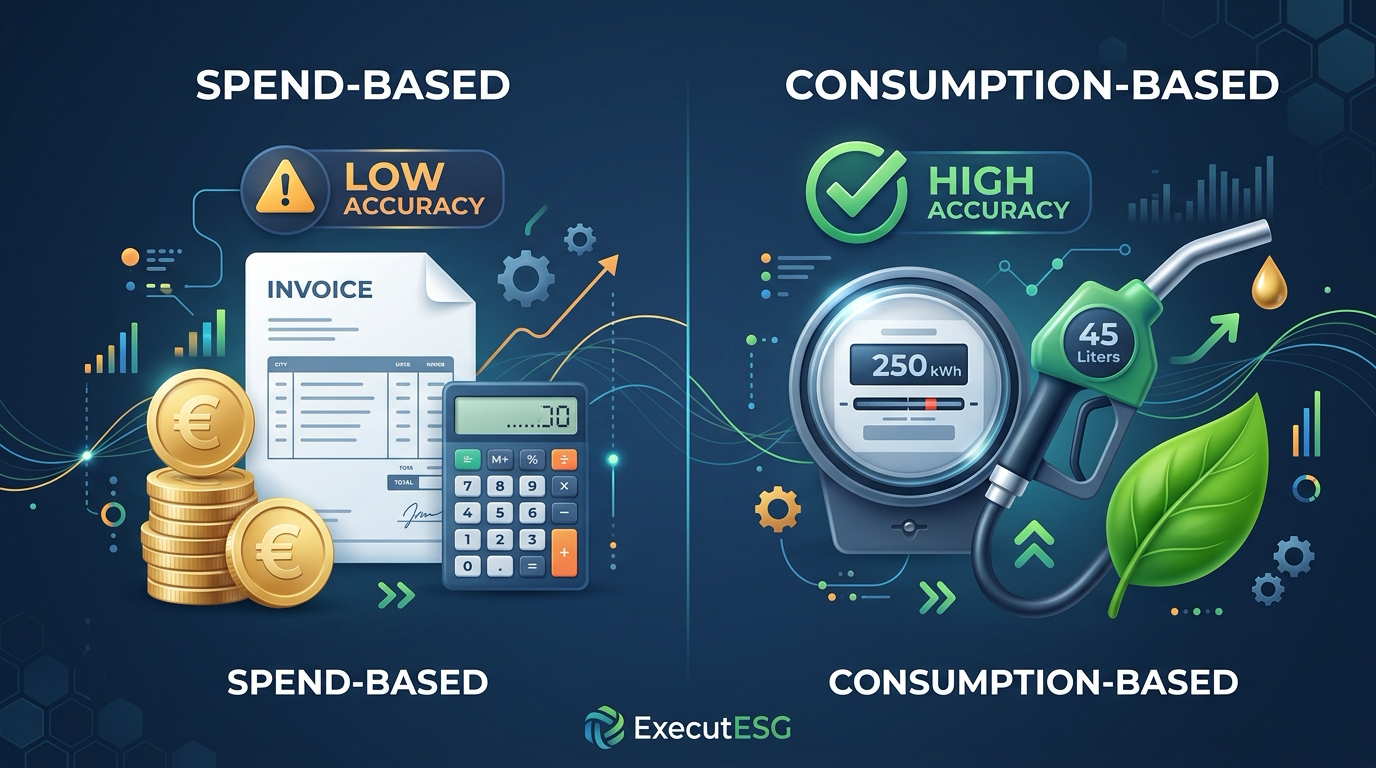
B3): Multiplying electricity or diesel ledger euros by generic industry averages failsVS (VSME)DisclosureB3, which requires physical energy inMWh(see how to replace spend estimates with invoice activity units). - Broken or Unversioned Spreadsheet Formulas: Copy-pasted Excel sheets where
kgCO2eandtCO2eare mixed (1,000xunit error), or where undocumented emission factors lack source authority and calendar year. - Incomplete Organizational Boundaries (
B1): Reporting headquarters electricity while omitting a leased warehouse, production hall, or 15-vehicle service fleet controlled by the same legal entity. - Unverified Renewable Electricity Claims: Claiming
0.0 tCO2emarket-based Scope 2 emissions without attaching the utility supplier's Guarantees of Origin (GoO) cancellation statement, or omitting the dual location-based grid figure. - Undocumented Materiality or "Not Applicable" Decisions: For CSRD-obligated companies, flat 1-to-5 stakeholder surveys with arbitrary cut-offs; for
VS (VSME)reporters, leaving disclosures blank without stating whether an item is Not Applicable (such asB4industrial air/water permits for an office firm).
Building a Voucher-Linked Evidence Vault in 4 Practical Steps
Controllers can make their sustainability file review-ready alongside regular monthly closing (detailed in our general ledger to XBRL lineage guide):
- Lock Boundary & Consolidation Rules (
B1): Record your legal entity Business ID (Y-tunnus/Organisationsnummer), NACE sector code, headcount, and operational sites in one place. - Tie Every Energy & Fuel Row to Accounting Vouchers: Connect Procountor, Netvisor, Fortnox, or a Universal CSV trial balance so every
kWh,MWh, andliterpoints back to a specific supplier invoice ID and PDF attachment. - Store HR & Governance Source Records (
B8–B11): Attach annual payroll FTE exports (B8), occupational accident logs (B9), collective bargaining / training summaries (B10), and board anti-corruption confirmations (B11). - Run Pre-Submission Arithmetic & XBRL Checks: Export a clean PDF + machine-readable XBRL package where renewable + fossil energy sums, unit codes, and base-year comparisons are validated automatically.
Bridging Self-Serve Software and External Scrutiny: The €299 Expert Review
Most European suppliers with 20 to 500 employees do not need a €20,000 consulting project, yet CFOs understandably want a second pair of eyes before sending their first VS (VSME) report to a Tier-1 customer or commercial bank.
ExecutESG pairs transparent self-service software (0 € Free entry, 49 €/mo Core, 129 €/mo Pro with ERP Scope 3 sync and XBRL) with an optional €299 Consultant-in-the-Loop Expert Review:
- Checks
B1–B11andC1–C9completeness against your NACE industry profile. - Verifies Scope 1 and Scope 2 unit conversions (
kWh,MWh,liters) and Nordic/EU residual-mix factors. - Flags missing Guarantees of Origin or voucher attachments before you share the report externally.
Frequently Asked Questions
Do non-listed SMEs need limited assurance on a VS (VSME) report?
No. Under EU law and the 2026 Omnibus package, voluntary VS (VSME) reports require zero statutory limited or reasonable assurance from external audit firms.
What is the difference between limited assurance and reasonable assurance in ESG?
Limited assurance relies on analytical reviews, process inquiries, and targeted sample checks to conclude that nothing came to the auditor's attention indicating material misstatement, whereas reasonable assurance performs deep substantive testing to issue a positive true and fair view opinion.
Which assurance standard applies to European CSRD audits?
European CSRD limited assurance engagements follow the International Standard on Sustainability Assurance (ISSA 5000, replacing earlier ISAE 3000 / ISAE 3410 practice) alongside CEAOB and EFRAG implementation guidance.
Why do enterprise customers ask SME suppliers for invoice-backed carbon figures?
Because CSRD-obligated buyers undergo external limited assurance on their Scope 3 value-chain disclosures, their auditors test whether key supplier figures come from verified physical activity data rather than rough macroeconomic estimates.
How can a CFO verify a VS (VSME) report before sending it to a bank or buyer without hiring a Big-4 firm?
Compile your report from voucher-linked utility, fuel, and payroll records in ExecutESG (0 € Free / 49 €/mo Core / 129 €/mo Pro) and add an optional one-time €299 Expert Review to check boundary completeness, emission factors, and source attachments prior to submission.
Check Your VS (VSME) & CSRD Readiness Score
Answer 6 quick questions under the EU Voluntary Standard VS (VSME) to discover your compliance gap score, estimated time savings, and generate your free starter report.
Stay Ahead of EU Sustainability Mandates
Get our weekly intelligence briefing on VS (VSME), CSRD compliance, buyer Scope 3 demands, and EcoVadis audits—distilled for European SMEs.