From Invoices to Audit Trails: Replacing Spend Estimates with Verified Activity Data
From Invoices to Audit Trails: Replacing Spend Estimates with Verified Activity Data
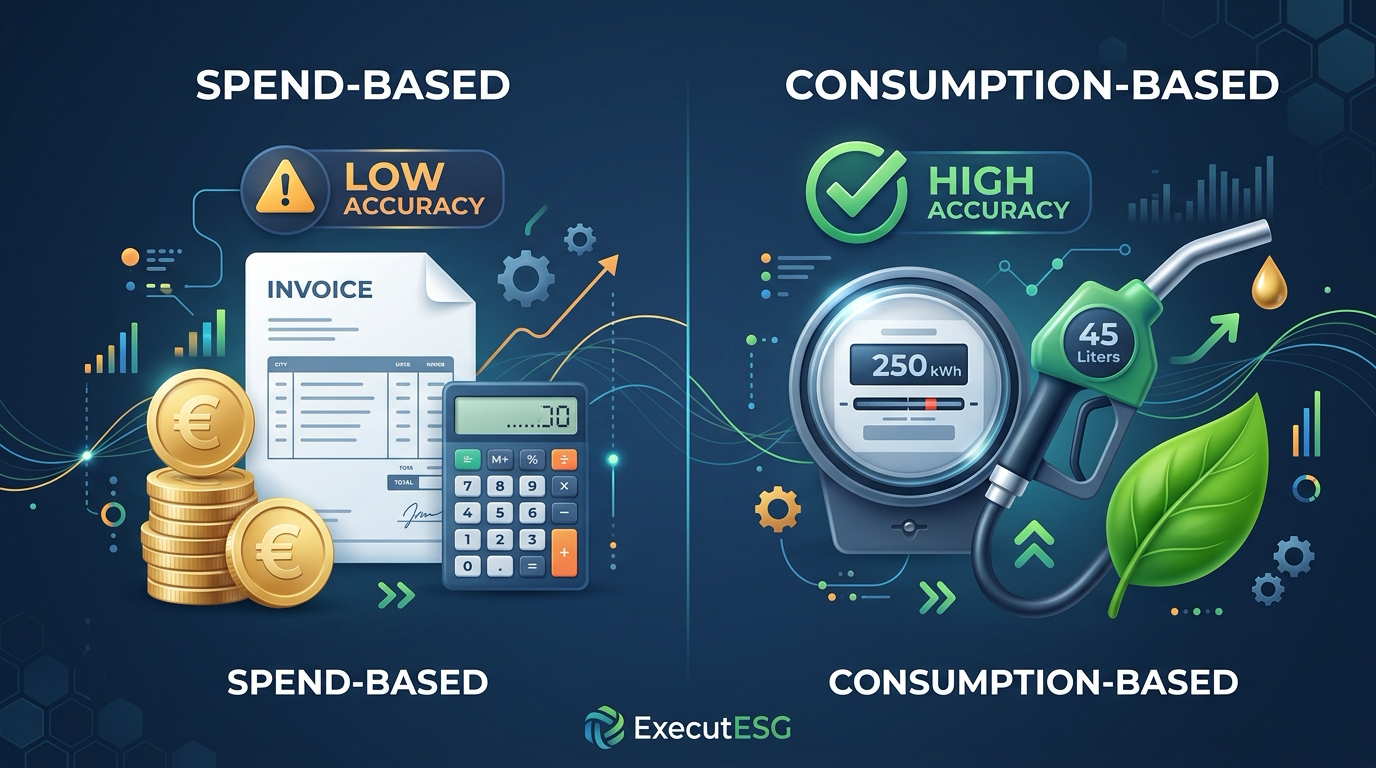
When mid-market controllers run their first greenhouse gas footprint using a basic spend-based carbon tool, the numbers often contradict operational reality. A logistics or manufacturing company optimizes delivery routes, replaces oil heating with heat pumps, and cuts physical diesel usage by 12%—yet its reported carbon footprint jumps 18% year-over-year simply because wholesale energy and fuel prices rose.
That distortion happens whenever software multiplies net general ledger euros by generic macroeconomic sector averages (kgCO2e / €). Price inflation masquerades as pollution, and paying a green price premium for renewable electricity or renewable diesel (HVO100) paradoxically increases your calculated emissions.
To publish a credible VS (VSME) disclosure for commercial banks and corporate buyers, finance teams need a practical middle ground between inaccurate euro estimates and months of manual spreadsheet entry: automated activity-based extraction for high-impact accounts paired with a documented general ledger audit trail.
Why Does Fuel and Energy Inflation Break Spend-Based Carbon Accounting?
Spend-based calculators apply Environmentally Extended Input-Output (EEIO) factors calibrated on historical national price levels. Whenever unit prices diverge from the base year, monetary spend decouples from physical combustion (see our line-item invoice walkthrough).
Consider an industrial subcontractor operating a 25-van service fleet across two fiscal years:
- FY2024 Baseline:
60,000 litersof fossil diesel at€1.55 / L=€93,000spend. Physical Scope 1 emissions (2.68 kgCO2e/L) =160.8 tCO2e. - FY2026 Operational Efficiency + Price Spike: Fleet consumption drops 15% to
51,000 liters, while pump prices rise to€2.05 / L(€104,550spend,+12.4%higher euro outlay).- Actual Activity-Based Scope 1:
51,000 L × 2.68 kgCO2e/L=136.7 tCO2e(-15.0%real reduction). - Unadjusted Spend-Based Estimate: Reports a
+12.4%artificial emissions increase, creating a27.4percentage-point reporting error on your bank and customer scorecards.
- Actual Activity-Based Scope 1:
Under EFRAG VS (VSME) Disclosure B3 (Energy and greenhouse gas emissions), reporting total energy consumption in physical megawatt-hours (MWh) is required—meaning pure euro spend cannot satisfy B3 compliance on its own.
Comparison: Spend-Based vs. Activity-Based vs. Hybrid Carbon Accounting
Finance leaders do not need physical weights for paperclips or legal retainers. The GHG Protocol and EFRAG both support a Hybrid Methodology that enforces physical activity units on the 5 to 8 accounts driving 85%+ of emissions while retaining spend-based screening on minor overhead accounts:
| Accounting Dimension | Spend-Based Only (EEIO) |
Pure Activity-Based (100% Physical) |
CFO Hybrid Model (Activity + Spend Fallback) |
|---|---|---|---|
| Primary Data Input | Net invoice euros (€) per GL account |
Physical units (L, kWh, MWh, kg, tkm) on every purchase |
Physical units on Scope 1–2 & top Scope 3; € fallback on minor OPEX |
| Inflation & Price-Shock Immunity | None (price rises inflate reported tCO2e) |
Full immunity across 100% of spend | Full immunity on 85–95% of total footprint |
| Green Material Recognition | Penalizes higher-priced HVO100 & green tariffs |
Recognizes exact supplier emission factors | Recognizes renewable tariffs, HVO100, and low-carbon metals |
EFRAG VS (VSME) B3 Compliance |
Fails B3 physical MWh requirement |
Compliant | 100% compliant (B3 MWh + C3 Scope 3 targets) |
| Controller Setup Time | 1–2 hours (unreliable output) | 80–150 hours if chased across all tiny vendors | Under 48 hours via ERP sync & Chart of Accounts mapping |
| Audit & Bank Defensibility | Weak (sector proxies only) | Very high | High (voucher-linked primary proof on all material accounts) |
How Do Controllers Extract Physical Units Directly from General Ledgers?
Every audited balance sheet and income statement in Finland, Sweden, and Germany already classifies energy, fuel, and freight transactions into dedicated general ledger accounts (see our Chart of Accounts to GHG mapping guide):
- Scope 1 Stationary & Fleet Fuels (Liikekirjuri
4410/7510, Swedish BAS4010/5611): Extract physical liters (L) of diesel, petrol, orHVO100and cubic meters (m³) orMWhof natural gas from structured e-invoice (Finvoice/Peppol BIS 3.0) quantity fields (DeliveredQuantity) or attached fuel-card CSV lines. - Scope 2 Electricity & District Heating (Liikekirjuri
4150/4420, BAS5020): Extract billedkWh/MWhfrom utility e-invoices alongside contract tariff metadata to calculate both Location-Based (national grid average) and Market-Based (0.0 kgCO2e/kWhwith Guarantees of Origin) Scope 2 totals. - Material Scope 3 Upstream Freight & Metals (Liikekirjuri
4000/4310, BAS4010/5710): Pull net shipment mass (kg/tonnes) and transport distance (tonne-km) from primary logistics carriers, leaving low-impact accounts (6800IT SaaS,7350accounting/legal fees) on documentedEEIOspend factors.
How Does Continuous Audit Lineage Connect the Balance Sheet to VS (VSME)?
When an enterprise buyer or assurance reviewer samples a reported metric in your VS (VSME) disclosure, your controller should never have to hunt through email attachments. A continuous audit trail links five records in a single chain (detailed in our GL-to-XBRL lineage architecture):
- Audited Trial Balance Account: Reconciles 100% of annual energy and fuel expenditure against your closed statutory general ledger so zero invoices are omitted.
- ERP Voucher ID & Posting Date: Preserves the immutable voucher reference (e.g., Netvisor
Voucher #2026-08412) and supplier VAT / Business ID. - Extracted Physical Quantity & Unit: Logs
2,450.0 L(HVO100) or18,400 kWhalongside the source e-invoice XML or PDF attachment. - Versioned Emission Factor: Records the exact authority and year (e.g.,
Statistics Finland / Fingrid 2026orDEFRA 2026) applied to that physical unit. - Digital Disclosure Tag: Outputs the verified sum directly into your machine-readable EFRAG VS (VSME) XBRL package and PDF report.
48-Hour Automated Sync with Visma Netvisor, Procountor, and Fortnox
Instead of exporting dozens of manual CSV sheets at year-end, Nordic finance teams connect their cloud accounting system using read-only OAuth2 credentials (see our Nordic ERP integration breakdown):
- Hour 0–2 (Read-Only Connection): Authorize Visma Netvisor, Fennoa, Accountor Procountor, Fortnox, or upload a Universal CSV general ledger export on ExecutESG.
- Hour 2–24 (Automated CoA Mapping & Line Parsing): ExecutESG maps Liikekirjuri, BAS, or DATEV account codes to
VS (VSME)categories, parses structuredFinvoice/Peppolphysical quantities, and flags any high-spend energy or fuel voucher missing a physical unit (kWh,L,kg). - Hour 24–48 (Controller Review & Export): Your controller confirms flagged exceptions in one screen and exports an audit-ready
VS (VSME)report on ExecutESG's transparent plans (0 €Free entry,49 €/moCore for Scope 1–2 PDF/CSV,129 €/moPro for ERP Scope 3 sync and XBRL).
Frequently Asked Questions
Why does spend-based carbon accounting overstate emissions during inflation?
Spend-based calculators multiply invoice euro totals by fixed kgCO2e/€ industry factors. Whenever electricity, district heating, or diesel prices rise faster than general inflation, higher euro bills produce an artificial spike in reported carbon emissions even when physical energy consumption falls.
What is hybrid carbon accounting for SMEs and mid-sized companies?
Hybrid carbon accounting uses verified physical activity units (liters, kWh, MWh, tonnes, tonne-km) for the 5 to 8 accounts that generate 85% to 95% of company emissions (Scope 1 fuels, Scope 2 utilities, key raw materials, and freight) while applying spend-based EEIO factors only to minor overhead expenses such as office supplies and software subscriptions.
Can Visma Netvisor, Procountor, and Fortnox provide physical quantities for ESG reporting?
Yes. Nordic e-invoices (Finvoice 3.0 and Peppol BIS Billing 3.0) stored inside Visma Netvisor, Accountor Procountor, Fennoa, and Fortnox carry structured line-item quantity (DeliveredQuantity) and unit codes (KWH, MWH, LTR, KGM) alongside PDF invoice images, allowing automated extraction without changing daily accounts-payable bookkeeping.
Does EFRAG VS (VSME) accept spend-based figures for Scope 1 and Scope 2?
No. Disclosure B3 of the EFRAG VS (VSME) Basic Module explicitly requires physical energy consumption in megawatt-hours (MWh) alongside gross Scope 1 and Scope 2 greenhouse gas emissions in tCO2e, which requires utility and fuel quantity data rather than euro totals alone.
How long does it take to move from spend estimates to verified activity data?
Because 85%+ of a typical company's footprint sits inside fewer than eight utility, fuel, and freight vendor accounts, controllers connecting Netvisor, Fortnox, or a Universal CSV trial balance typically complete physical unit verification within 48 hours.
Check Your VS (VSME) & CSRD Readiness Score
Answer 6 quick questions under the EU Voluntary Standard VS (VSME) to discover your compliance gap score, estimated time savings, and generate your free starter report.
Stay Ahead of EU Sustainability Mandates
Get our weekly intelligence briefing on VS (VSME), CSRD compliance, buyer Scope 3 demands, and EcoVadis audits—distilled for European SMEs.