EFRAG VS (VSME) Double Materiality Guidance for SMEs
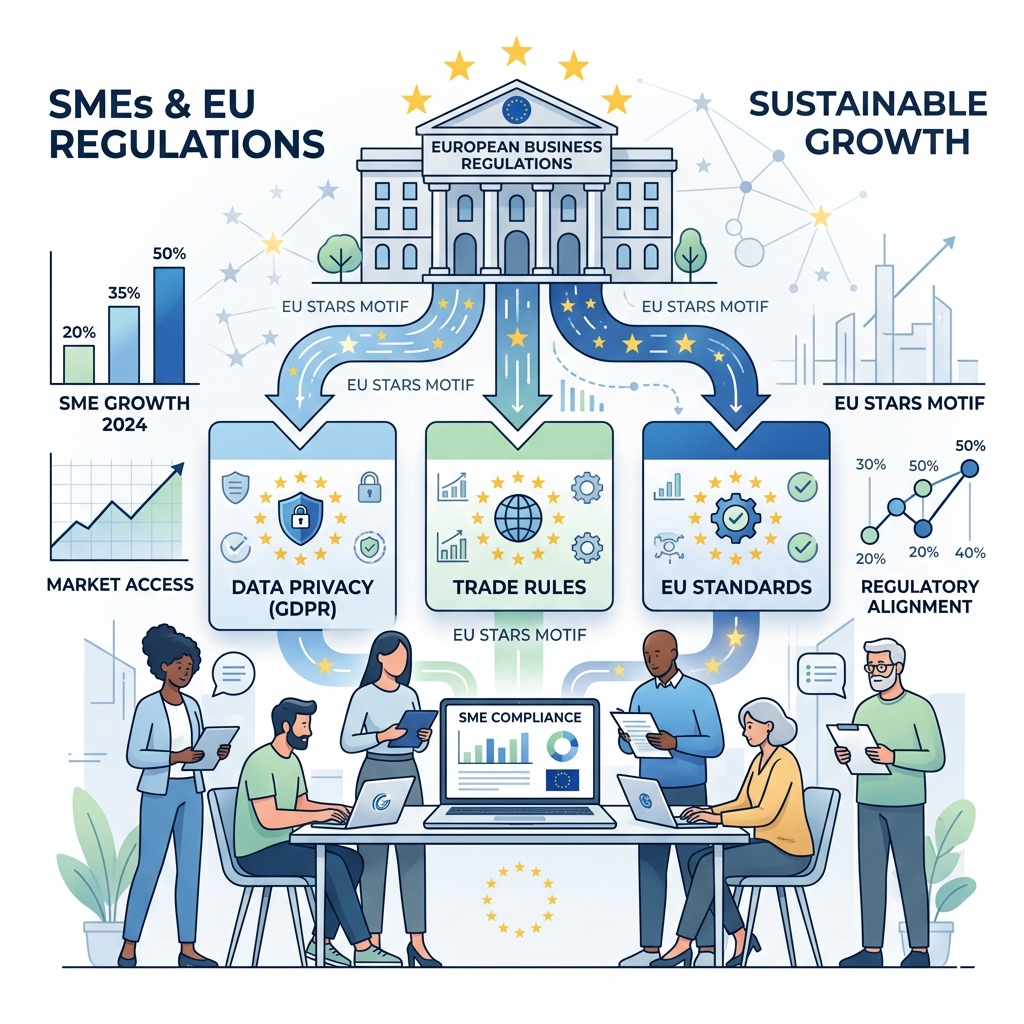
The Corporate Sustainability Reporting Directive (CSRD) has transformed the European business landscape. While its direct legal mandates target large listed enterprises, its operational effects are felt heavily by Small and Medium-sized Enterprises (SMEs).
If your business is a supplier to a large corporation, you are part of their value chain. Under the CSRD, your enterprise clients must report on their Scope 3 greenhouse gas emissions and environmental impacts. To satisfy this requirement, they will send you questionnaires requesting detailed sustainability data.
To prevent smaller businesses from being overwhelmed by these requests, the European Financial Reporting Advisory Group (EFRAG) developed the Voluntary SME (VSME) standard.
Within the VS (VSME) standard, the Business Partners Module introduces the Double Materiality Assessment (DMA). However, EFRAG has modified the guidance to make this assessment achievable and proportional for SMEs.
In this guide, we explain how EFRAG’s VS (VSME) double materiality guidance works, why it is essential for protecting your B2B contracts, and how to execute it efficiently.
1. Why Does a Voluntary Standard Include Double Materiality?
You might wonder: if the VS (VSME) standard is voluntary and designed for simplicity, why does it include a Double Materiality Assessment?
The answer lies in the value chain boundary. Large corporate buyers are legally mandated to report their Scope 3 emissions. If they buy materials or services from you, they cannot determine their own material topics without evaluating the impacts and risks associated with their suppliers.
┌─────────────────────────────────┐
│     LARGE ENTERPRISE CLIENT     ├─┐  (Mandated by CSRD to report
└─────────────────────────────────┘ │   on value chain impacts)
                 │                  │
                 ▼                  ▼
┌─────────────────────────────────┐
│       SME B2B SUPPLIER          ├─┐  (Feels supply chain pressure;
└─────────────────────────────────┘ │   must provide sustainability data)
                 │                  │
                 ▼                  ▼
┌─────────────────────────────────┐
│    VOLUNTARY VS (VSME) REPORTING     ├─┐  (Acts as a shield: reports only
└─────────────────────────────────┘    what is material via the DMA)
By conducting a simplified DMA under the VS (VSME) framework, you accomplish two strategic goals:
- Protect B2B Contracts: You provide corporate buyers with the structured, audit-ready ESG data they need, keeping you qualified as a preferred supplier.
- Shield Against Over-Reporting: Instead of answering every ad-hoc questionnaire sent by different clients, you publish a single, standard-aligned report. The DMA proves why certain topics are immaterial, shielding you from collecting unnecessary data.
2. Understanding the Modular Structure of VS (VSME)
The VS (VSME) standard is structured into three modules to match different business needs:
- The Basic Module: Designed for micro-enterprises and small businesses. It requires a simple set of metrics (such as direct energy consumption, water usage, and basic workforce indicators) and does not require a Double Materiality Assessment.
- The Business Partners Module: Designed for SMEs selling B2B to large corporate clients. This module mandates a Double Materiality Assessment to filter out advanced metrics that are not relevant, ensuring you only report on topics that actually affect your value chain.
- The Lenders Module: Designed for SMEs seeking loans or credit, focusing on key metrics requested by financial institutions.
If you are an SME selling services or goods to large enterprise accounts, you must utilize the Business Partners Module to remain competitive.
3. How EFRAG Proportionality Rules Simplify the DMA
EFRAG recognizes that an SME with 50 employees cannot execute the same quantitatively intensive DMA as a multinational corporation. The VS (VSME) double materiality guidance simplifies the assessment in three key ways:
1. Qualitative Over Quantitative Scoring
Under the mandatory ESRS rules for large enterprises, financial materiality requires quantitative modeling. Under VS (VSME), SMEs can use a qualitative scoring approach. You can rate the magnitude and likelihood of a risk using descriptive scales (e.g., Low, Medium, High) rather than precise monetary valuations.
2. A Pre-Defined Topic Library
SMEs do not need to research or construct an inventory of potential ESG topics. EFRAG provides a standardized, simplified list of candidate sustainability matters (covering Climate, Circular Economy, Own Workforce, and Business Conduct). This acts as a ready-made long-list, saving weeks of background research.
3. Pragmatic Stakeholder Engagement
Large corporations must conduct global surveys and formal workshops to gather stakeholder feedback. Under VS (VSME), a targeted survey sent to key employees, your primary suppliers, and your largest customers is sufficient to establish stakeholder alignment.
The Pairwise Efficiency Gain
Even with a simplified list, traditional surveys often suffer from uniform high scores. ExecutESG replaces these forms with a forced-choice pairwise consensus mechanism. By letting stakeholders select between options (A vs. B), the platform calculates priority vectors mathematically. This satisfies the stakeholder's need for Autonomy and gives you a defensible threshold, as shown in the Hanken School Case Study.
4. Key Materiality Focus Areas for B2B SMEs
When conducting your VS (VSME) Double Materiality Assessment, several topics are frequently flagged as material due to supply chain requirements:
- Climate Change (ESRS E1 / Scope 1-3): Enterprise clients require your carbon footprint data to calculate their own Scope 3 emissions. This makes greenhouse gas tracking a critical disclosure. Learn more in our Scope 1, 2, and 3 Greenhouse Gas Emissions Guide.
- Biodiversity & Ecosystems (ESRS E4): Corporate buyers are increasingly evaluating biodiversity risk. Our guide, Beyond Carbon: The Definitive Guide to Nature Footprint and Handprint, outlines how to measure your environmental footprint and build a nature-positive strategy.
- Own Workforce (ESRS S1): Large buyers require assurance that their suppliers maintain safe working conditions, pay adequate wages, and respect collective bargaining rights.
- Business Conduct (ESRS G1): Anti-corruption, data privacy, and supplier code-of-conduct policies represent low-hanging compliance fruit that enterprise clients expect.
5. How ExecutESG Digitizes EFRAG Guidance
Attempting to navigate EFRAG's PDF guidance documents and build a DMA in spreadsheets is slow and error-prone. ExecutESG is designed to automate the process:
- Guided Context Mapping: The system helps you define your reporting boundaries and map your value chain partners.
- Sector-Specific Shortlisting: Load candidate topics matching EFRAG standards, with optional AI suggestions based on your NACE industry code.
- Automated Survey Distribution: Send out pre-built, pairwise surveys to stakeholders, generating mathematically clear priority vectors and a consensus map.
- Assurance-Ready Audit Trails: Generate the Double Materiality Matrix and download the documentation required by your client's auditors.
By moving your sustainability data into a unified ESG database, you turn double materiality from a complex compliance hurdle into a clear commercial advantage.
Next Steps
If you want to satisfy your enterprise buyers and protect your contracts without excessive overhead, launch your assessment today.
Read How to Complete a Double Materiality Assessment in 5 Simple Steps to map out your execution timeline, or register for ExecutESG's free platform to use our guided double materiality wizard.
Recommended Articles
- The Ultimate Guide to Double Materiality Assessment (DMA)
- How to Complete a Double Materiality Assessment in 5 Simple Steps
- Double Materiality Assessment Methodology: How to Score Impacts and Risks
- Beyond Carbon: The Definitive Guide to Nature Footprint and Handprint
- VS (VSME) Standard Explained: The Complete Guide for European SMEs
- Understanding CSRD Double Materiality: A Practical Compliance Guide
Check Your VS (VSME) & CSRD Readiness Score
Answer 6 quick questions under the EU Voluntary Standard VS (VSME) to discover your compliance gap score, estimated time savings, and generate your free starter report.