The Ultimate Guide to Double Materiality Assessment (DMA)
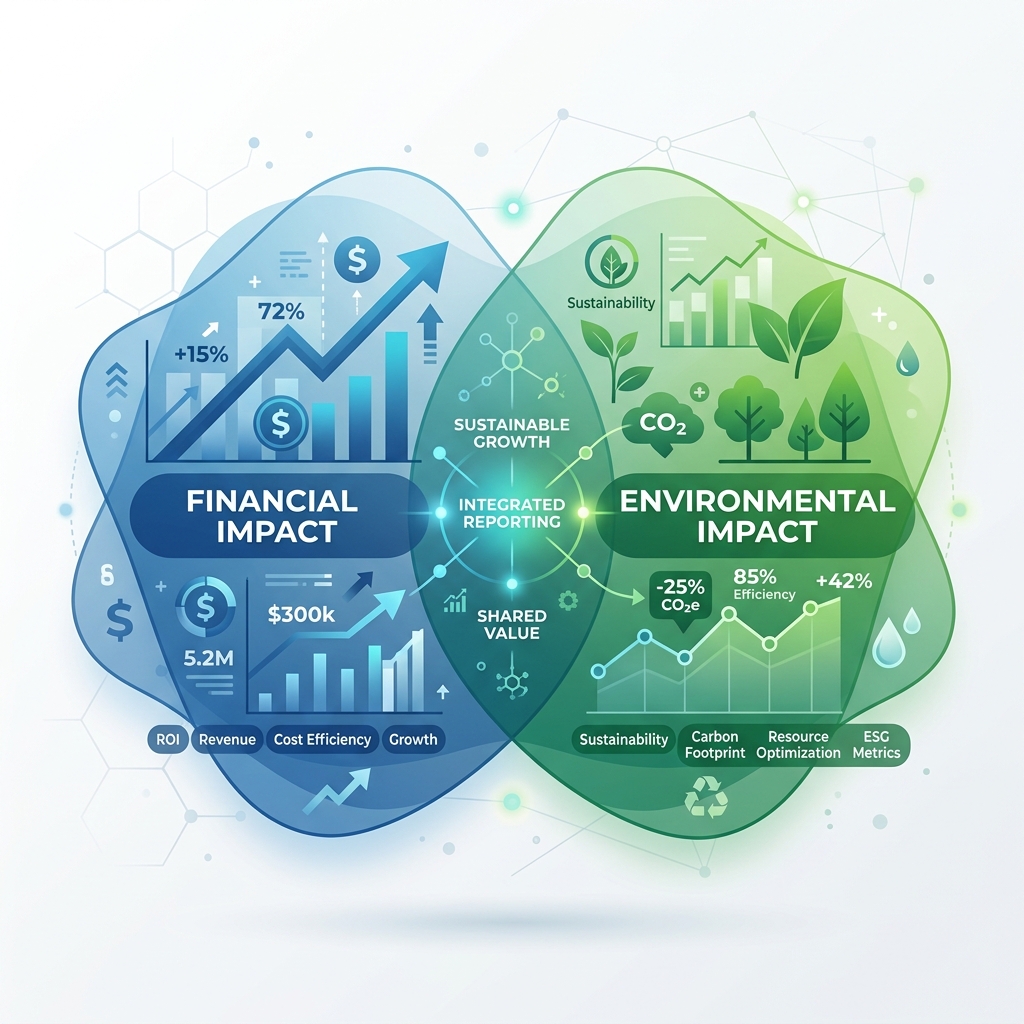
The Double Materiality Assessment (DMA) is the foundational exercise of modern sustainability reporting. It is not merely a compliance checkbox for the European Union's Corporate Sustainability Reporting Directive (CSRD) or the Voluntary SME (VSME) standard—it is a strategic operating system that determines what matters, why it matters, and how a company will act.
For years, corporate sustainability was treated as a public relations exercise or an academic tracking project. Companies could cherry-pick their environmental highlights, focusing on low-hanging fruit while ignoring systemic risks. The introduction of double materiality by the European Financial Reporting Advisory Group (EFRAG) fundamentally ended this practice.
Today, you cannot declare your own reporting boundaries based on what is easiest to measure. You must execute a structured, audit-ready DMA to identify which Environmental, Social, and Governance (ESG) topics are material to your business and your stakeholders.
In this definitive guide, we will break down the structural architecture of double materiality, outline EFRAG’s scoring rules, and introduce a psychologically intelligent, mathematically rigorous approach to stakeholder alignment.
1. What Is Double Materiality?
Double materiality means looking at your company’s relationship with the world through a two-way mirror. An ESG topic is considered material—and must therefore be disclosed in your public sustainability statement—if it crosses the threshold for either Impact Materiality or Financial Materiality.
                    ┌───────────────────────────────┐
                    │      SUSTAINABILITY TOPIC     │
                    └───────────────┬───────────────┘
                                    │
                  ┌─────────────────┴─────────────────┐
                  ▼                                   ▼
      [ Inside-Out Perspective ]          [ Outside-In Perspective ]
          IMPACT MATERIALITY                  FINANCIAL MATERIALITY
      How the company impacts the          How sustainability issues
       environment & society.              affect the company's value.
                  │                                   │
                  └─────────────────┬─────────────────┘
                                    ▼
                     CROSSES MATERIALITY THRESHOLD?
                                    │
                                  ✅ YES
                                    ▼
                         MUST DISCLOSE IN REPORT
Impact Materiality: The Inside-Out Perspective
Impact materiality captures your company’s positive and negative impacts on society and the environment. This includes your direct operations and your upstream and downstream value chain partners.
- Actual vs. Potential: An actual impact is happening right now (e.g., current carbon emissions or water discharge). A potential impact is a future risk (e.g., the likelihood of an industrial chemical spill).
- Positive vs. Negative: Positive impacts are actions that restore or benefit the environment (such as wetland remediation or purchasing local biodiversity credits). Negative impacts are pressures that degrade ecosystems or infringe on human rights.
- Temporal Boundaries: Impacts must be evaluated over the short-, medium-, and long-term horizons, forcing companies to look past immediate quarterly results.
For a deep dive into carbon tracking, read our Scope 1, 2, and 3 Greenhouse Gas Emissions Guide.
Financial Materiality: The Outside-In Perspective
Financial materiality captures how external sustainability factors create financial risks or opportunities that affect your development, financial performance, cash flows, and access to capital.
- Physical Risks: Risks that result directly from climate change, such as a coastal warehouse facing increased flooding or extreme weather patterns disrupting agricultural supply chains.
- Transition Risks: Risks that result from the societal, regulatory, and economic transition to a low-carbon economy, such as sudden carbon border taxes or soaring fossil fuel energy prices.
- Opportunities: Financial advantages created by sustainability, such as obtaining lower interest rates from banks via green credit facilities, or capturing new market share by offering certified carbon-neutral products.
The "OR" Function
A common misunderstanding is that a topic must be material on both axes to be reported.
Double materiality operates strictly as an OR function. If a software company has a negligible carbon footprint but rents servers from carbon-intensive data centers, its Scope 3 emissions are material from an environmental standpoint, even if no direct carbon tax is levied on the software company itself. The topic must be disclosed.
Failing to recognize value chain boundaries is one of the most common reasons third-party auditors reject a company's sustainability report. Learn more about this by reviewing Understanding CSRD Double Materiality: A Practical Compliance Guide.
2. The Commitment Cycle: Bridging Understand & Decide
At ExecutESG, we believe that compliance should be a byproduct of healthy organizational alignment, not the primary driver. If you treat the DMA as a technical data-collection chore, you build a compliance report that sits on a shelf, unused by leadership and ignored by employees.
We frame the DMA through The Commitment Cycle—an organizational operating system that pairs technical operations with leadership transformation. The DMA represents the bridge between the first paired pillars: Understand & Decide (Shared Clarity).
 ┌──────────────────────────────────────────────────────────────────┐
 │                     THE COMMITMENT CYCLE                         │
 │                                                                  │
 │   PILLAR 1: Understand & Decide   ──►   Shared Clarity           │
 │   PILLAR 2: Act & Deliver         ──►   Committed Execution      │
 │   PILLAR 3: Report & Celebrate    ──►   Shared Achievement       │
 │                                                                  │
 │           ♥ PAIRWISE COMPARISON — THE BEATING HEART ♥            │
 └──────────────────────────────────────────────────────────────────┘
- Understand (Operations): This is the data-collection phase. The sustainability manager gathers carbon baselines, maps value chain inputs, and analyzes NACE industry benchmarks.
- Decide (Leadership): This is the strategic alignment phase. The CEO, board, and key stakeholders evaluate the data and commit to a strategic direction, choosing where to invest resources and capital.
Without Decide, understanding is academic. Without Understand, deciding is gut instinct. The DMA is the mechanism that binds these two forces, ensuring strategic decisions are evidence-based AND collectively owned.
To explore the wider frameworks governing voluntary standards, see VS (VSME) Standard Explained: The Complete Guide for European SMEs.
3. The Beating Heart: Pairwise Comparison (AHP)
The traditional method of stakeholder engagement is broken. Typically, a company emails a spreadsheet or a survey containing a list of 50 ESG topics, asking participants to rate each topic from 1 (low) to 5 (high).
This approach consistently fails due to three psychological and statistical factors:
- Survey Fatigue: Stakeholders get overwhelmed by dozens of highly technical questions and start answering randomly just to finish the form.
- Uniform Scoring (The "Everything is Important" Problem): Because stakeholders care about the environment and social justice in the abstract, they rate almost every topic as a 4 or 5. A dataset where everything is important is useless for strategic decision-making.
- Loudest Voice Bias: In workshops, the final priorities are often dominated by the loudest voice in the room or the personal opinion of the CEO, eroding team alignment and trust.
How Pairwise forced-choice comparisons work
To resolve these issues, ExecutESG uses an Automated Pairwise Consensus Mechanism based on Thomas Saaty’s Analytic Hierarchy Process (AHP).
Instead of rating items in isolation, stakeholders are presented with a series of forced-choice, binary comparisons:
⚖️ Stakeholder Pairwise Judgment Screen
Which topic represents a more significant environmental impact for our organization's value chain?
The indirect greenhouse gas emissions associated with purchased raw materials and shipping logistics.
The direct emissions from burning fossil fuels in our owned and leased distribution vehicles.
The Math: Converting Subjective Judgments into Defensible Priorities
By breaking down 50 topics into a sequence of binary choices, we eliminate the complexity of rating abstract scales. Stakeholders compare one pair at a time. Behind the scenes, the system aggregates these choices into a pairwise comparison matrix.
Using AHP matrix algebra, the platform calculates:
- The Win Rate (Priority Vector): The mathematical weight of each topic, showing its relative importance compared to all others.
- The Inconsistency Index: A mathematical score indicating whether a stakeholder's inputs are logically coherent (e.g., if a stakeholder prefers A over B, and B over C, but then chooses C over A, the inconsistency index rises). If the index is too high, the system flags it for review.
- Consensus Mapping (Disagreement Map): A visual breakdown showing where stakeholders agree and where opinions diverge, allowing leadership to focus their alignment workshops on actual areas of disagreement.
The Psychology: Fulfilling Self-Determination Theory
By giving every stakeholder a structured platform where their choices mathematically impact the final priority ranking, the system satisfies the core psychological need for Autonomy and Relatedness.
Participants do not feel like passive subjects completing a checklist. They experience Inclusion ("My voice was heard"), which builds a shared mental model of ESG priorities. When the priorities that emerge from this consensus are converted into actions, it fosters Agency ("My input made a difference") and Pride ("We did this together").
For academic and statistical validation of this consensus mechanism, read the Hanken School of Economics Case Study on AI-Driven Double Materiality.
4. The ExecutESG 10-Task Workflow: A Step-by-Step Roadmap
Executing an audit-ready Double Materiality Assessment requires a clear operational sequence. The ExecutESG platform runs on the ExecutESG 10-Task Engine, which maps directly to the 9-Step Leadership Journey of our Core Doctrine.
Here is how the workflow is structured across five major steps:
┌────────────────────────────────────────────────────────┐
│             THE EXECUTESG 10-TASK WORKFLOW             │
├────────────────────────────────────────────────────────┤
│  STEP 1: SETUP & CONTEXT                               │
│  └─ Task 1: Project Setup                              │
│  └─ Task 2: Value Chain & Context Analysis             │
│                                                        │
│  STEP 2: IMPACT IDENTIFICATION                         │
│  └─ Task 3: Impact Identification (NACE Shortlisting)  │
│  └─ Task 4: Impact Validation Workshop                 │
│                                                        │
│  STEP 3: STAKEHOLDER PAIRWISE (THE BRIDGE)             │
│  └─ Task 5: Stakeholder Surveys & Pairwise Voting      │
│                                                        │
│  STEP 4: FINANCIAL RISK ASSESSMENT                     │
│  └─ Task 6: R&O Identification                         │
│  └─ Task 7: R&O Validation Workshop                 │
│  └─ Task 8: Financial Scoring (Magnitude × Likelihood) │
│                                                        │
│  STEP 5: STRATEGIC DECLARATION                         │
│  └─ Task 9: Consolidated Materiality Review            │
│  └─ Task 10: Final Declaration & Threshold Workshop    │
└────────────────────────────────────────────────────────┘
Step 1: Setup and Context (Tasks 1 & 2)
- Task 1: Project Setup: The sustainability manager defines the scope of the assessment, sets the reporting year, and invites team members to the ExecutESG workspace.
- Task 2: Context Analysis: The team maps the boundaries of the value chain, listing upstream suppliers, direct operations, and downstream customers.
Step 2: Impact Identification & Validation (Tasks 3 & 4)
- Task 3: Impact Identification: The platform scans standardized EFRAG database topics. To bypass "blank page syndrome," the sustainability manager uses the AI-Powered DMA Topic Suggestions tool to load industry-specific candidate topics based on NACE codes.
- Task 4: Impact Validation Workshop: The core leadership team reviews the candidate list, adding custom local impacts or removing topics that are irrelevant to their business model.
Step 3: Stakeholder Engagement & Pairwise Voting (Task 5)
- Task 5: Stakeholder Surveys & Pairwise Comparison: Stakeholders (board members, employees, key customers, and suppliers) complete structured pairwise comparison questionnaires. The AHP engine aggregates these responses into priority vectors and win-rates.
Step 4: Financial Risk & Opportunity Assessment (Tasks 6, 7 & 8)
- Task 6: R&O Identification: The team identifies potential outside-in risks and opportunities, mapping how environmental pressures and transition dynamics could impact cash flows.
- Task 7: R&O Validation Workshop: Leadership refines the financial risk inventory, linking risks directly to operational areas.
- Task 8: Financial Scoring: Evaluators score each risk and opportunity on its Financial Magnitude and Likelihood of Occurrence (Magnitude × Likelihood = Financial Score).
Step 5: Strategic Declaration (Tasks 9 & 10)
- Task 9: Consolidated Materiality Review: The platform combines the pairwise impact win-rates with the financial risk scores, creating a consolidated materiality draft.
- Task 10: Final Declaration Workshop: Leadership reviews the draft, determines the final materiality thresholds, and approves the Double Materiality Matrix. The system locks the results, generating a complete, time-stamped audit trail ready for assurance providers.
For details on the exact scoring formulas, scales, and threshold mathematics, see Double Materiality Assessment Methodology: How to Score Impacts and Risks.
5. Integrating Nature: Beyond Carbon
One of the most common pitfalls of traditional sustainability management is carbon tunnel vision. Companies focus exclusively on carbon footprint calculations while neglecting their wider ecological dependencies.
Under the ESRS topical standards (specifically ESRS E4: Biodiversity and Ecosystems), companies must evaluate their broader environmental footprints. ExecutESG is designed to address this by providing integrated assessment tools:
🌱 The Footprint vs. Handprint Paradigm
A company's environmental strategy cannot rely solely on carbon mitigation. In our guide, Beyond Carbon: The Definitive Guide to Nature Footprint and Handprint, we outline the transition from carbon neutrality to nature-positive operations. While you strive to shrink your Nature Footprint (negative impact on biodiversity), you must actively expand your Nature Handprint (the positive, restorative actions you take to support ecosystems). ExecutESG helps you baseline and measure both metrics.
During your DMA, if biodiversity is flagged as a material impact (Step 2), the system automatically integrates these biodiversity equivalents into your action roadmap (Act & Deliver), helping you transition from compliance reporting to real environmental stewardship.
6. How the DMA Applies to SMEs (The VS (VSME) Context)
If your business is a non-listed SME in Europe, you do not face immediate mandatory reporting under the CSRD. However, you will experience supply chain pressure. Your large enterprise customers, who are subject to the CSRD, must report on their Scope 3 value chains. They will request structured sustainability data from you to complete their own reporting.
To shield SMEs from overly complex data requests, EFRAG designed the Voluntary SME (VSME) standard. The VS (VSME) standard features three modules:
- The Basic Module: A simplified set of basic metrics (energy, water, basic workforce safety) that does not require a formal DMA.
- The Business Partners Module: Designed for SMEs selling B2B to large corporations. This module requires a Double Materiality Assessment to filter out advanced metrics that are not relevant, protecting the SME from reporting unnecessary data points.
- The Lenders Module: Designed for SMEs seeking capital from banks, focusing on basic risk metrics.
By conducting a simplified DMA under the VS (VSME) framework, SMEs can identify exactly which disclosures their corporate buyers need, shielding their commercial relationships without incurring massive consultant costs.
For a detailed review of this framework, see EFRAG VS (VSME) Double Materiality Guidance for SMEs.
7. Strategic Outcomes: Compliance is a Result
When executing a Double Materiality Assessment, compliance should never be positioned as your primary objective. Compliance is a natural byproduct of a healthy, aligned organization.
ExecutESG's methodology is built to deliver on a hierarchy of strategic outcomes:
| Priority Rank | Strategic Outcome | What It Means for Your Business |
|---|---|---|
| 1 | 🧠 Psychological Alignment | Your leadership team shares a common, aligned mental model of the company's ESG priorities. |
| 2 | 🤝 Relational Strengthening | Internal trust and stakeholder relationships are deepened through structured, democratic dialogue. |
| 3 | 🎯 Strategic Clarity | You make clear, mathematically defensible decisions about what matters, removing personal bias. |
| 4 | ✊ Ownership & Commitment | Your team feels personally invested in the outcomes because their voice mathematically counted in the process. |
| 5 | ⚡ Operative Action Planning | Your priorities translate directly into concrete action plans with clear owners, deadlines, and KPIs. |
| 6 | ✅ Regulatory Compliance | CSRD, ESRS, and VS (VSME) requirements are fulfilled as a natural byproduct of your alignment. |
By focusing on alignment, you convert the regulatory burden of double materiality into a strategic growth opportunity.
Conclusion: Start Your Journey
The era of manual, consultant-driven sustainability reporting is ending. The companies that navigate the low-carbon transition successfully are those that build an audit-proof, data-driven foundation.
With ExecutESG’s software-guided DMA wizard, powered by the ExecutESG engine, you can bypass spreadsheet chaos and complete a stakeholder-backed, mathematically defensible Double Materiality Assessment in under two weeks.
Ready to align your leadership team and generate your matrix? Register for ExecutESG's free platform and launch your first Pairwise Stakeholder Session today.
Recommended Articles
- How to Complete a Double Materiality Assessment in 5 Simple Steps
- Double Materiality Assessment Methodology: How to Score Impacts and Risks
- EFRAG VS (VSME) Double Materiality Guidance for SMEs
- Beyond Carbon: The Definitive Guide to Nature Footprint and Handprint
- AI-Driven Double Materiality: Benchmarking Autonomous Agents Against Human Experts
- New: AI-Powered DMA Topic Suggestions
- VS (VSME) Standard Explained: The Complete Guide for European SMEs
Check Your VS (VSME) & CSRD Readiness Score
Answer 6 quick questions under the EU Voluntary Standard VS (VSME) to discover your compliance gap score, estimated time savings, and generate your free starter report.
Stay Ahead of EU Sustainability Mandates
Get our weekly intelligence briefing on VS (VSME), CSRD compliance, buyer Scope 3 demands, and EcoVadis audits—distilled for European SMEs.