ExecutESG vs Greenly: Full ESG Reporting Tool vs Carbon Accounting (2026)
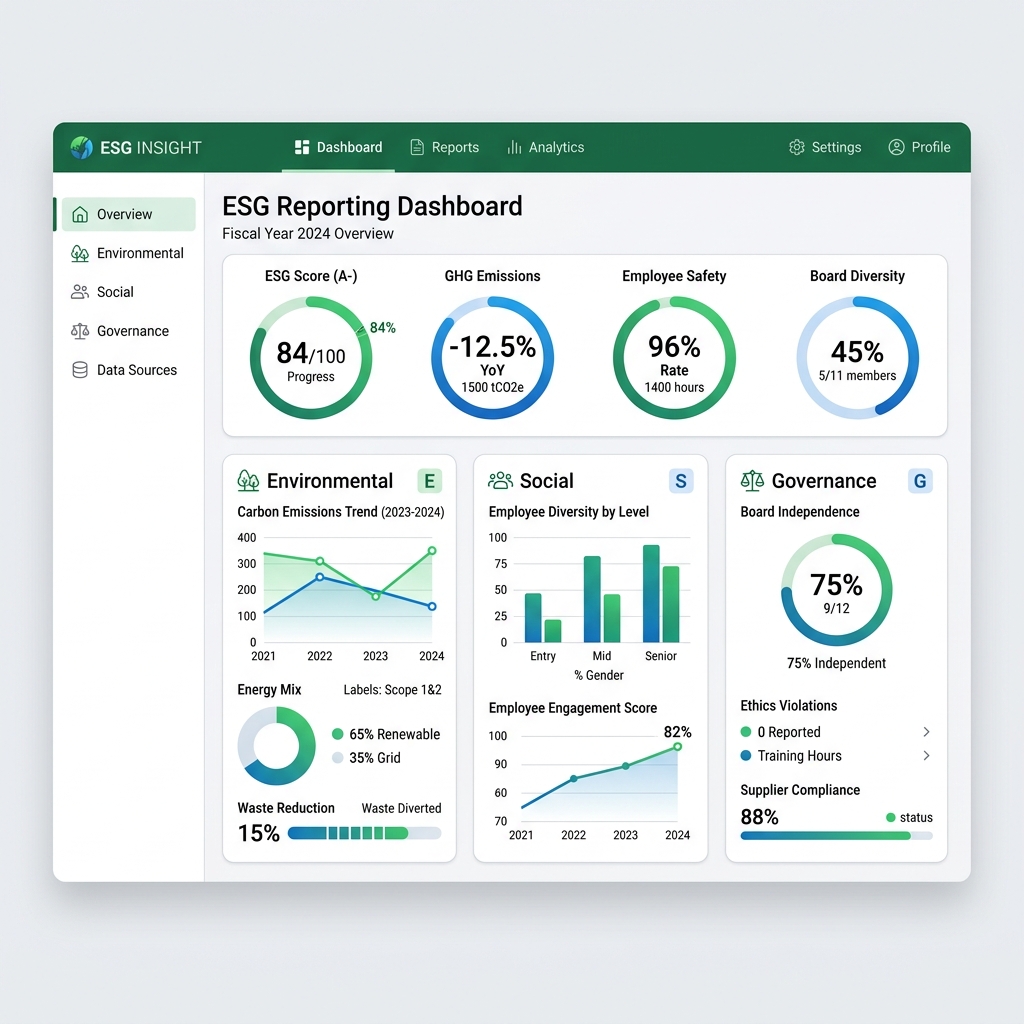
⚡ Need Complete EFRAG VS (VSME) Compliance, Not Just Carbon?
Corporate buyers and financial institutions demand social metrics, governance policies, and double materiality assessments in addition to greenhouse gas data. ExecutESG provides an end-to-end platform for European SMEs.
ExecutESG vs Greenly: Full ESG Reporting Tool vs Carbon Accounting (2026)
When businesses begin measuring their environmental footprint, Greenly frequently appears on buyer shortlists. Founded in France, Greenly built a strong reputation as an accessible carbon accounting platform that helps organizations calculate greenhouse gas emissions by analyzing bank transactions and utility data.
However, companies facing corporate buyer supplier audits, banking covenants, or European sustainability disclosure mandates soon discover a major operational gap:
Carbon accounting represents only one third of modern sustainability compliance.
Corporate buyers and lenders do not ask solely for carbon dioxide emissions. They require workforce health and safety figures, pay equality ratios, anti-corruption policies, and double materiality evaluations.
This guide benchmarks ExecutESG against Greenly, clarifying when a pure carbon accounting tool suffices and when your business requires a complete sustainability reporting tool.
Executive Summary: ExecutESG vs Greenly
| Feature / Metric | ExecutESG | Greenly |
|---|---|---|
| Primary Scope | Full ESG Reporting Tool (Environment, Social, Governance) | Focused Carbon Accounting Software |
| Official EFRAG VS (VSME) Modules | Native Support (Basic B1–B12, Narrative N1–N5, BP1–BP11) | Partial (requires manual custom fields) |
| Scope 1, 2, and 3 GHG Calculator | Built-in activity-based calculations | Core strength (bank spend + activity data) |
| Double Materiality Assessment (DMA) | Native algorithmic pairwise voting (AHP & Bradley-Terry) | Add-on survey service |
| Social & Workforce Disclosures | Full EFRAG S1 metrics (safety, gender pay ratio, training) | Limited out-of-the-box templates |
| Governance & Anti-Corruption | Documented policy tracking & whistleblower compliance | Basic governance questionnaire |
| Statutory Value Chain Cap Protection | Native 2026 EU Omnibus legal compliance | General carbon reporting |
| Pricing | Free Basic Module; Pro from €99/month | Annual subscriptions starting around €3,000–€8,000+/year |
| Core Product Tour | ExecutESG Platform Overview | Best ESG Reporting Tools Benchmark |
The Core Distinction: Carbon Accounting vs ESG Reporting
To make an informed software decision, leadership teams must distinguish between two different categories of software:
┌────────────────────────────────────────────────────────────────────────┐
│             CARBON ACCOUNTING vs FULL ESG REPORTING SUITE              │
├────────────────────────────────────────────────────────────────────────┤
│  GREENLY (Carbon Footprint Engine):                                    │
│  ├─ Scope 1: Direct fuel & gas combustion                              │
│  ├─ Scope 2: Purchased electricity & heating                           │
│  └─ Scope 3: Upstream supply chain & spend-based estimates             │
│                                                                        │
│  EXECUTESG (Comprehensive EFRAG VS (VSME) Suite):                      │
│  ├─ ENVIRONMENTAL: Scope 1, 2, 3 GHG, water consumption, circularity   │
│  ├─ SOCIAL: Workforce safety (LTIFR), collective bargaining, pay ratio │
│  ├─ GOVERNANCE: Anti-bribery, board oversight, whistleblowing policies │
│  └─ STRATEGY: Pairwise Double Materiality Assessment (AHP)             │
└────────────────────────────────────────────────────────────────────────┘
1. The Reporting Mandate: Why Carbon Alone Leaves You Stranded
Greenly focuses on carbon footprinting. It integrates with your accounting software, scans general ledger spend, and converts expense categories into estimated metric tons of carbon dioxide equivalent ($tCO_2e$).
While spend-based carbon footprinting provides a helpful initial estimate, it falls short when Tier-1 corporate buyers issue supplier disclosure audits. In Europe, enterprise buyers operating under CSRD must collect supplier data that matches the EFRAG Voluntary Standard VS (VSME).
Under EFRAG VS (VSME), carbon accounting constitutes only four disclosure points out of more than thirty required metrics:
- Workforce Profile (B8): Full-time vs part-time ratios, permanent vs temporary contracts.
- Health and Safety (B9): Lost Time Injury Frequency Rate (LTIFR) and workplace incidents.
- Remuneration & Pay Equity (B10): Unadjusted gender pay gaps and executive compensation ratios.
- Business Conduct (B11–B12): Documented policies against bribery, fraud, and human rights abuses.
If you purchase a tool dedicated strictly to carbon, your team must still construct manual spreadsheets to track social metrics, governance policies, and supply chain due diligence. ExecutESG collects all three ESG dimensions within a single unified workflow.
2. Spend-Based Estimates vs Activity-Based Precision
Greenly relies heavily on financial spend data to estimate carbon footprints. Spend-based accounting multiplies the euros spent on a vendor by an industry-average carbon intensity factor.
While fast, spend-based accounting exhibits major flaws:
- Inflation Distortion: If your energy utility raises electricity rates by 30% while your actual physical kilowatt-hour consumption stays identical, a spend-based tool records a 30% increase in your carbon footprint.
- Procurement Inaccuracy: Buying low-carbon recycled steel costs more per ton than high-carbon blast furnace steel, yet spend-based methods penalize the sustainable purchase with higher estimated emissions.
ExecutESG prioritizes physical activity data—actual kilowatt-hours, gas therms, vehicle fuel litres, and freight ton-kilometers. Read our deep dive on consumption-based vs spend-based carbon calculations to explore the auditor implications.
3. Double Materiality: Real Math vs Static Forms
Under European sustainability guidelines, companies must identify which ESG topics present severe real-world impacts or material financial risks.
Greenly primarily offers carbon footprinting, treating materiality as an optional, consultant-assisted exercise.
ExecutESG integrates an algorithmic Double Materiality Assessment (DMA) engine. Rather than asking employees to fill out subjective 1-to-5 surveys that result in clustered, uninformative rankings, ExecutESG deploys pairwise comparison voting based on the Bradley-Terry mathematical model. Stakeholders vote on pairs of topics, generating defensible priority matrices that withstand external assurance review.
When to Choose Greenly
Greenly represents an effective option under the following conditions:
- Your sole corporate objective is quantifying your carbon footprint ($tCO_2e$) for marketing or internal decarbonization targets.
- You operate primarily in France or require quick automated bank transaction scanning.
- You do not need to deliver structured social (workforce) and governance disclosures to enterprise buyers or commercial lenders.
When to Choose ExecutESG
ExecutESG stands out as the superior choice if:
- You are a European SME, mid-market manufacturer, or supply chain supplier required to provide comprehensive EFRAG VS (VSME) compliance disclosures.
- You need an all-in-one sustainability reporting tool covering carbon emissions, workforce metrics, and governance policies in a single dashboard.
- You want to complete a verified baseline report in under 30 minutes without committing to multi-thousand-euro annual contracts.
- You want to protect your business against excessive customer questionnaires using the 2026 EU Statutory Value Chain Cap.
Conclusion
Carbon accounting is vital, but carbon alone does not satisfy modern enterprise supply chain audits.
By choosing ExecutESG, organizations eliminate spreadsheet fragmentation, satisfy corporate customer questionnaires, and secure compliant EFRAG VS (VSME) disclosures through an affordable, self-service platform.
Explore our complete guide to the best ESG reporting tools in 2026, or start your free baseline report on the ExecutESG platform.
Frequently Asked Questions
Can Greenly generate an EFRAG VS (VSME) report?
Greenly focuses on greenhouse gas accounting under the GHG Protocol. While you can export carbon footprint metrics from Greenly, it lacks native guided modules for EFRAG VS (VSME) social metrics (workforce diversity, pay gaps, health and safety) and governance policies, requiring manual data compilation.
Does ExecutESG calculate Scope 1, 2, and 3 emissions?
Yes. ExecutESG includes an automated triple-scope greenhouse gas calculator. It converts physical operational data (utility bills, gas meters, vehicle fuel, and freight shipments) directly into metric tons of carbon dioxide equivalent ($tCO_2e$) using verified international emission factor datasets.
What is the primary advantage of ExecutESG over carbon-only tools?
ExecutESG unifies environmental metrics, social workforce data, governance disclosures, and double materiality assessments into a single EFRAG-compliant workflow. This ensures your company satisfies all customer questionnaire requests without managing multiple disjointed software subscriptions.
Check Your VS (VSME) & CSRD Readiness Score
Answer 6 quick questions under the EU Voluntary Standard VS (VSME) to discover your compliance gap score, estimated time savings, and generate your free starter report.
Stay Ahead of EU Sustainability Mandates
Get our weekly intelligence briefing on VS (VSME), CSRD compliance, buyer Scope 3 demands, and EcoVadis audits—distilled for European SMEs.