The SME Guide to Commercial Bank ESG Requirements & Sustainability-Linked Loans in the Nordics
The SME Guide to Commercial Bank ESG Requirements & Sustainability-Linked Loans in the Nordics
Across Finland, Sweden, Denmark, and Norway, corporate credit committees no longer judge mid-market loan renewals solely on EBITDA, collateral, and debt-service coverage. When a 50-to-500 employee manufacturer, logistics operator, or contractor applies for a revolving credit facility, equipment lease, or working-capital line in 2026, corporate relationship managers at Nordea, OP Financial Group, Danske Bank, and SEB attach a mandatory sustainability questionnaire to the credit file.
Borrowers who leave those sections blank or submit unverified spreadsheet estimates face slower underwriting and higher risk weights. Borrowers who submit a structured, machine-readable VS (VSME) disclosure package routinely clear ESG credit screening in days and can negotiate 15 to 50 basis points (0.15%–0.50%) in interest margin reductions on green or sustainability-linked loans.
Why Are Nordea, OP, Danske Bank, and SEB Asking SMEs for Emissions Data?
Nordic banks are not collecting borrower sustainability metrics as a public relations exercise. Three binding European banking rules require lenders to quantify the climate and transition risks inside their corporate loan books:
- EBA Loan Origination and Monitoring Guidelines: The European Banking Authority requires commercial banks to integrate environmental, social, and governance risk factors directly into borrower creditworthiness scoring and collateral valuation.
- Pillar 3 ESG Risks & Green Asset Ratio (GAR): Under Capital Requirements Regulation (CRR) Pillar 3 disclosures, European banks must publish their Green Asset Ratio and Banking Book Taxonomy Alignment Ratio. When a bank lacks verified emissions data from an SME borrower, it must rely on conservative sector proxies that penalize the bank's financed-emissions intensity.
- PCAF Financed Emissions Targets: Nordea, OP, Danske Bank, and SEB have committed to reducing financed emissions across heavy transport, commercial real estate, manufacturing, construction, and agriculture. Under the Partnership for Carbon Accounting Financials (PCAF) data quality hierarchy, a borrower's verified physical Scope 1 and Scope 2 figures upgrade a loan from low-grade sector estimates (Score 4–5) to primary reported data (Score 1–2).
What Do Major Nordic Banks Actually Check During SME Credit Reviews?
While each Nordic lender uses its own portal or relationship-manager intake sheet, over 85% of the requested quantitative data maps directly to EFRAG's voluntary VS (VSME) Basic (B1–B11) and Comprehensive (C1–C9) modules:
| Nordic Lender | Primary SME Credit & Green Loan Focus | Core Data Requested from Borrowers | Matching VS (VSME) Disclosures |
|---|---|---|---|
| OP Financial Group (Finland) | Corporate ESG questionnaire, green investment loans, and sustainability-linked working capital | Total energy (MWh), Scope 1 & 2 tCO2e, renewable share, occupational safety (LTIFR), and 3-year reduction targets | Basic B3, B9, B11 + Comprehensive C2 |
| Nordea (Nordics) | Sustainability-linked loans (SLL), green fleet/equipment financing, and transition plans | Location- vs. market-based Scope 2, fleet fuel transition plan, waste recycling split, and governance policies | Basic B3, B7, B11 + Comprehensive C1–C3 |
| Danske Bank (Denmark, Finland, Sweden, Norway) | Business transition loans and supply-chain resilience reviews | Activity-based carbon baseline, energy intensity per EUR revenue, and material climate physical/transition risks | Basic B2, B3 + Comprehensive C2, C4 |
| SEB (Sweden, Finland, Baltics) | Green corporate loans and mid-market KPI-linked revolving credit facilities | Audited annual KPI trajectory (2–3 measurable KPIs such as tCO2e/M€ or 100% renewable electricity) | Basic B3, B8–B10 + Comprehensive C2 |
Under the European Union's Omnibus value-chain cap, VS (VSME) serves as the standardized ceiling for sustainability data requests directed at non-listed undertakings under 1,000 employees. Submitting an official VS (VSME) report allows a CFO to answer OP, Nordea, Danske Bank, and enterprise customer audits from one verified dataset instead of filling out four incompatible spreadsheets.
How Do Sustainability-Linked Loan Margin Discounts Work for SMEs?
Unlike a traditional "green loan" (where 100% of proceeds must buy a specific solar array or electric truck), a Sustainability-Linked Loan (SLL) can fund general working capital, M&A, or credit lines. The interest margin steps down or up each year based on whether the borrower hits two or three pre-agreed Sustainability Performance Targets (SPTs).
Illustrative CFO Math on a €2,000,000 Credit Facility
Consider a Finnish industrial subcontractor renewing a €2,000,000 5-year credit facility priced at 3M Euribor + 2.10%:
| Credit Scenario | Annual ESG Evidence Provided | Margin Adjustment | Annual Interest Impact | 5-Year Cash Impact |
|---|---|---|---|---|
| Unverified Status Quo | None (bank applies sector default proxy) | +0 to +15 bps risk premium |
€0 to -€3,000/yr | Up to -€15,000 |
| Verified VS (VSME) SLL | Annual VS (VSME) XBRL + 2 KPI targets met |
-25 bps (-0.25%) discount |
+€5,000/yr saved | +€25,000 saved |
| Ambitious Transition SLL | VS (VSME) + verified Scope 1–3 intensity cut |
-40 bps (-0.40%) discount |
+€8,000/yr saved | +€40,000 saved |
Even a modest 25 bps margin ratchet on a €2M loan saves €5,000 per year—more than three times the annual cost of ExecutESG Pro (129 €/mo, or 1,296 €/yr billed annually on our transparent pricing tiers), while entry baseline reporting starts at 0 € on the Free tier.
How Can CFOs Prepare a Bank-Ready VS (VSME) Dossier in 5 Steps?
Prepare your sustainability credit appendix 30 to 45 days before your annual bank review meeting:
- Reconcile General Ledger Energy & Fuel Accounts: Map your Finnish Liikekirjuri, Swedish BAS, or German DATEV accounts to physical units (
kWh,MWh,liters) using our Chart of Accounts to GHG mapping guide so every emission number ties back to paid utility and fuel invoices. - Separate Location-Based and Market-Based Electricity (
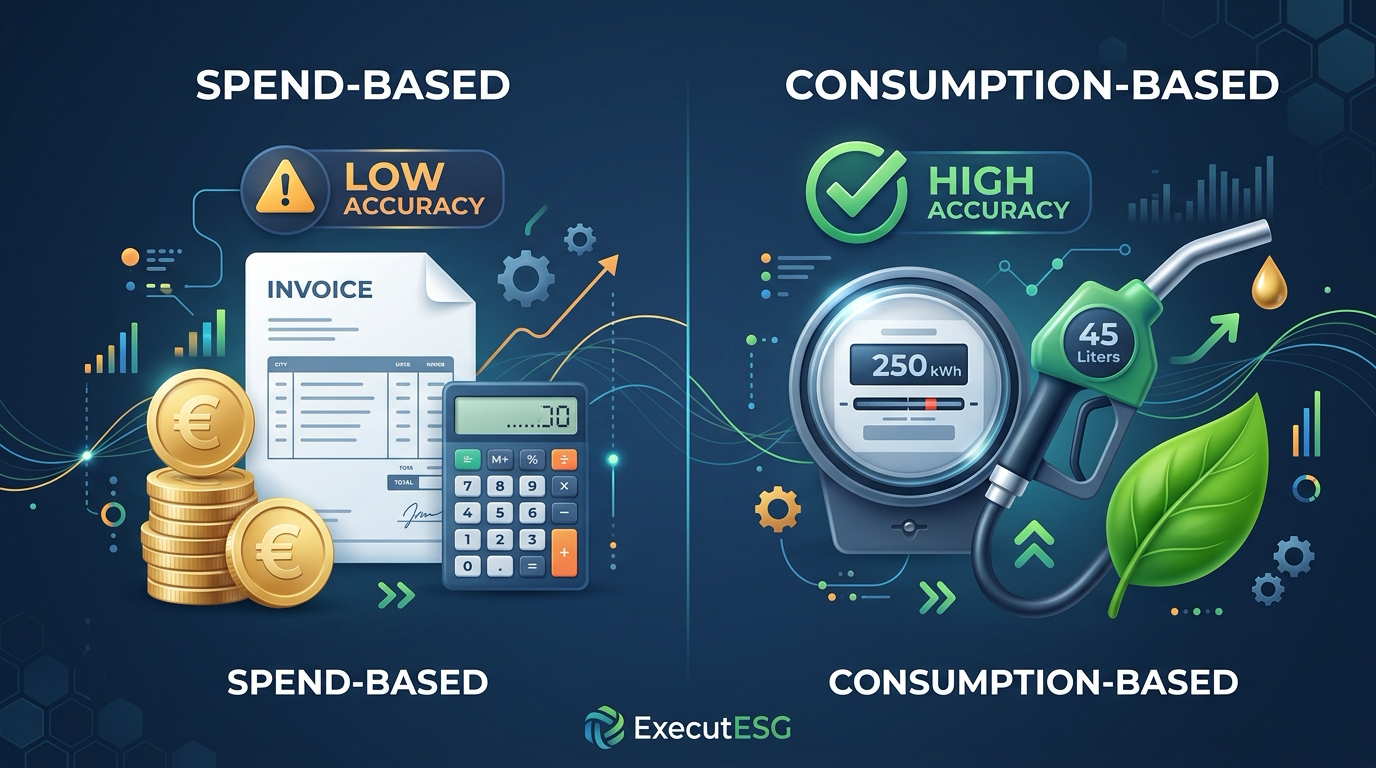
B3): Nordic grids already carry low location-based intensity (Nordic grid emission factors guide), and attaching Guarantees of Origin certificates proves0.0 tCO2emarket-based Scope 2 emissions to your lender. - Pull Automated Purchase Data from Netvisor, Procountor, or Fortnox: Connect your accounting ledger (Nordic ERP carbon accounting guide) to avoid crude spend-based inflation distortions when energy prices fluctuate.
- Document Two Measurable 3-Year KPIs (
C2): Banks favor clear, auditable ratios over vague pledges—for example, reducing Scope 1 fleet diesel liters per €1M revenue by8%annually, or cutting workplace lost-time injury frequency (B9) to zero. - Export Both Human PDF and Machine-Readable XBRL: Give your relationship manager a clean boardroom PDF summary alongside a digital XBRL file (
Pro 129 €/mo) that feeds directly into the bank's ESG risk engine. See our green financing accounting overview for internal control tips.
Frequently Asked Questions
Do Nordic banks require third-party assurance on SME VS (VSME) reports?
For most standard SME credit renewals and green equipment loans under €5M, banks accept a self-declared VS (VSME) report backed by reconcilable utility bills, fuel-card logs, and accounting vouchers. Formal limited assurance is typically requested only on larger mid-market Sustainability-Linked Loans where interest margin ratchets directly depend on annual KPI verification.
Which KPIs do OP and Nordea accept for SME sustainability-linked loans?
The most widely accepted SME loan KPIs in the Nordics are: (1) absolute or revenue-normalized Scope 1 and Scope 2 greenhouse gas intensity (B3), (2) share of renewable electricity and heating (B3), (3) workplace accident frequency rate (B9), and (4) operational waste recycling rate (B7).
Why does machine-readable XBRL matter to commercial banks?
Relationship managers and credit analysts process hundreds of annual renewals. Exporting your VS (VSME) disclosure in official EFRAG XBRL format lets the bank's risk software ingest standardized taxonomy tags automatically without manual PDF re-keying errors.
Check Your VS (VSME) & CSRD Readiness Score
Answer 6 quick questions under the EU Voluntary Standard VS (VSME) to discover your compliance gap score, estimated time savings, and generate your free starter report.
Stay Ahead of EU Sustainability Mandates
Get our weekly intelligence briefing on VS (VSME), CSRD compliance, buyer Scope 3 demands, and EcoVadis audits—distilled for European SMEs.