Calculating Scope 3 Category 1: Purchased Goods & Services from Supplier Invoices
Calculating Scope 3 Category 1: Purchased Goods and Services from Supplier Invoices
For most manufacturing, construction, wholesale, and retail companies, GHG Protocol Scope 3 Category 1 (Purchased Goods and Services) accounts for 60% to 80% of total corporate greenhouse gas emissions. Even in software and advisory firms, purchased cloud computing, external subcontractors, and office supplies make Category 1 one of the top two emission sources alongside travel.
Yet Category 1 is also where finance controllers waste the most time—either getting stuck chasing 400 minor vendors for questionnaires or relying purely on euro-spend estimates that penalize sustainable procurement. As part of our Master Guide to Scope 3 Decarbonization for European SMEs, this article walks through the exact boundaries, formulas, emission-factor sources (Exiobase, DEFRA, Ecoinvent, and supplier EPDs), and accounting-ledger shortcuts for Category 1.
What Belongs Inside Scope 3 Category 1 (and What Does Not)?
Category 1 captures cradle-to-gate upstream emissions (resource extraction, farming/mining, refining, and manufacturing up to the supplier's factory gate) of all tangible goods and intangible services purchased or acquired in the reporting year that are not capitalized as long-term fixed assets:
- Included in Category 1: Raw metals, plastics, timber, textiles, chemicals, electronic sub-assemblies, product packaging (pallets, cardboard, shrink wrap), maintenance consumables, SaaS/cloud hosting, legal/accounting services, and outsourced contract manufacturing.
- Excluded (Counted Elsewhere to Prevent Double-Counting):
- Capitalized machinery, vehicles, and buildings: Report in Category 2 (Capital Goods) in the year of purchase.
- Electricity, district heat, and fuels burned by your company: Report in Scope 1 & Scope 2 (
VS (VSME)DisclosureB3), with upstream Well-to-Tank losses in Category 3. - Separately invoiced inbound shipping paid by your company: Report in Category 4 (Upstream Transportation).
How Do the 4 GHG Protocol Calculation Methods Compare?
The GHG Protocol Technical Guidance for Category 1 ranks four calculation methods from fastest initial screening to highest audit precision:
| Method | Exact Mathematical Formula | Data Source in Finance | Typical Use Case & Limitation |
|---|---|---|---|
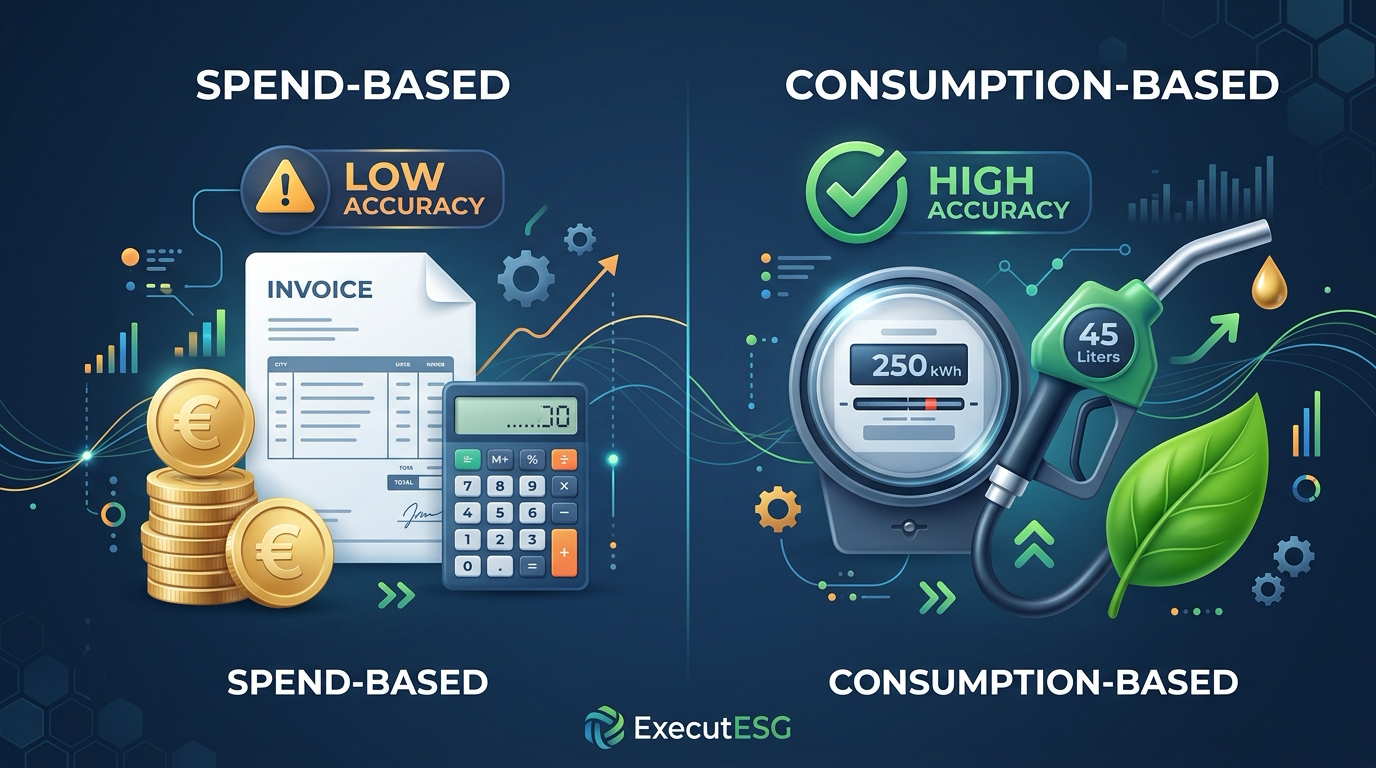
| 1. Spend-Based | Net Invoice Spend (€) × EEIO Factor (kg CO2e / €) |
Accounts payable general ledger (4000 & 6000 series) |
Fast Year-1 screening for minor OPEX (legal, IT, stationery). Distorted by price inflation and penalizes higher-cost green materials. |
| 2. Average-Data (Physical Mass) | Purchased Quantity (kg, tonnes, m3) × Cradle-to-Gate Factor (kg CO2e / unit) |
ERP purchase orders, packing slips, or material receipts | Best sweet spot for top raw materials (steel, aluminium, paper, plastics, chemicals) using DEFRA or Ecoinvent physical factors. |
| 3. Hybrid (CFO 80/20 Standard) | Supplier Scope 1–2 Allocation + Physical Material Mass + Spend Tail |
ERP vouchers + top-5 supplier data | Recommended audit standard (see our invoices-to-audit-trails guide): physical/supplier math on top 80% of mass, spend fallback on the 20% tail. |
| 4. Supplier-Specific | Purchased Units × Verified Supplier EPD or Product Carbon Factor (kg CO2e / unit) |
Certified ISO 14025 / EN 15804 EPD or supplier VS (VSME) B3 intensity |
Highest precision: Directly rewards switching to low-carbon steel, recycled aluminium, or renewable-powered contract manufacturers. |
Worked Numerical Example: Why Physical Weight Beats Spend Estimates
Suppose a 65-person Finnish metal fabricator buys 100 metric tonnes of structural steel sheet during FY2026. Compare what happens when the company switches half its volume from conventional blast-furnace steel (€950/tonne) to Nordic recycled electric-arc-furnace steel (€1,220/tonne) carrying a verified Environmental Product Declaration (EPD):
| Procurement Scenario | Invoice Spend (€) |
Naive Spend-Based Estimate (0.85 kg CO2e / €) |
Physical / EPD Calculation (kg × Verified Factor) |
Error in Spend Estimate |
|---|---|---|---|---|
Option A: 100 t Virgin Blast-Furnace Steel (~2,200 kg CO2e/t) |
€95,000 |
80.8 tCO2e |
220.0 tCO2e |
Understates real footprint by -63% |
Option B: 50 t Virgin + 50 t Recycled EAF Steel (~480 kg CO2e/t EPD) |
€108,500 |
92.2 tCO2e (looks 14% worse!) |
134.0 tCO2e (real -39% cut!) |
Falsely penalizes green steel! |
Notice the trap: under pure spend-based accounting, paying €13,500 more for low-carbon recycled steel makes your reported carbon footprint go up from 80.8 to 92.2 tCO2e. Recording physical tonnage (50 t × 2.20 + 50 t × 0.48 = 134.0 tCO2e) proves an auditable 86.0 tCO2e (-39%) reduction to bank credit officers and OEM buyers.
Where to Source Reliable Cradle-to-Gate Emission Factors
- UK DEFRA / DESNZ Conversion Factors (Free Annual Excel): Reliable physical weight factors (
kg CO2e per tonne) for metals, plastics, paper, cardboard, aggregates, glass, food, water, and electronics. - EXIOBASE (Multi-Regional Input-Output Database): Open European environmentally extended input-output (
EEIO) factors (kg CO2e per €) tailored by country and NACE industry code for screening service expenses. - Supplier Environmental Product Declarations (
EPDs): Third-party verifiedISO 14025/EN 15804declarations published on EPD International, RTS EPD (Finland), or IBU (Germany) for steel, concrete, timber, insulation, and chemicals. - Standardized Supplier VS (VSME)
B3Reports: For custom machined parts or contract assembly where no product EPD exists, ask your top 5 suppliers for their 1-page EFRAG VS (VSME) report (GHG intensity per €M turnover) and allocate by your share of purchases. Under the 2026 EU Omnibus Value-Chain Cap, asking SME suppliers for aVS (VSME)Basic report (0 €on ExecutESG) creates zero survey friction.
4-Step CFO Workflow Using Your Accounting Ledger
- Export Your Annual Purchase Ledger: Pull account series
4000–4999(Materials & Goods) and6000–6999(External Services & IT) from Netvisor, Procountor, Fennoa, Fortnox, or CSV (see our Chart of Accounts mapping guide and interactive CoA Crosswalk). - Isolate the Top 10 Material Vendors (
80/20Rule): Sort accounts payable by euro spend and physical mass. In 90% of SMEs, fewer than 12 raw-material and packaging vendors represent over 75% of Category 1 emissions. - Attach Physical Weights or EPDs to Top Inputs: Enter annual
tonnesorkgfrom purchase orders or supplier annual volume summaries for those top 10 inputs, and attach supplier EPD PDFs as audit evidence. - Keep the Service Tail on Documented Exiobase Factors: Leave low-impact legal, insurance, software, and office-supply accounts on Exiobase spend factors inside ExecutESG's carbon accounting workspace (
Pro 129 €/moincludes native Netvisor/Procountor/Fennoa sync and 1-click EFRAG XBRL export; check your readiness in 2 minutes or compare plans).
Frequently Asked Questions
1. Is Scope 3 Category 1 mandatory in EFRAG's VS (VSME) standard?
No. The VS (VSME) Basic Module (B1–B11, permanently 0 € on ExecutESG) requires only Scope 1 and Scope 2 operational emissions (B3). Quantifying Scope 3 Category 1 is an optional strategic disclosure under Comprehensive Module C3 when setting value-chain reduction targets or applying for sustainability-linked bank loans.
2. How do we avoid double-counting inbound shipping inside Category 1?
If a raw-material supplier sells goods on delivered terms (such as DDP or DAP) with transport bundled invisibly into the unit product price, cradle-to-gate plus standard transport factors in Category 1 cover it. If freight is billed on a separate carrier invoice (or itemized separately and paid by your company), exclude the freight fee from Category 1 spend and record that shipment in Category 4 (Upstream Transportation).
3. Should VAT be included when using spend-based emission factors?
No. Always strip Value Added Tax (VAT / ALV / Moms) and use net invoice amounts in euros, matched to the base year and currency calibration of your Exiobase emission factor table.
4. How many suppliers do we actually need to contact for primary data?
Start with just your top 5 to 10 raw-material or contract-manufacturing suppliers by physical mass. Requesting existing product EPDs (for metals, timber, plastics, Concrete) or a free 1-page EFRAG VS (VSME) B3 summary covers the majority of your footprint without spamming minor office vendors.
5. Can ExecutESG import Category 1 purchase invoices from Netvisor and Procountor?
Yes. On ExecutESG Pro (129 €/mo), Nordic companies connect Netvisor, Procountor, or Fennoa (or upload a universal CSV) to classify general-ledger purchase accounts automatically and override top material vendors with physical weights and EPD factors.
Check Your VS (VSME) & CSRD Readiness Score
Answer 6 quick questions under the EU Voluntary Standard VS (VSME) to discover your compliance gap score, estimated time savings, and generate your free starter report.
Stay Ahead of EU Sustainability Mandates
Get our weekly intelligence briefing on VS (VSME), CSRD compliance, buyer Scope 3 demands, and EcoVadis audits—distilled for European SMEs.