The Master Guide to Scope 3 Value Chain Decarbonization for European SMEs
The Master Guide to Scope 3 Value Chain Decarbonization for European SMEs
For most manufacturing, construction, wholesale, and logistics businesses, direct fuel combustion (Scope 1) and purchased facility electricity (Scope 2) represent only 10% to 25% of total corporate greenhouse gas emissions. The remaining 75% to 90% sits in Scope 3: raw materials, subcomponents, inbound and outbound freight, employee travel, waste treatment, and customer use of sold products.
Scope 3 affects small and mid-sized European companies from two directions at once:
- As an Upstream Supplier: Multinational buyers (such as Kone, Wärtsilä, Valmet, Kesko, or IKEA) need your verified Scope 1 and Scope 2 numbers because your direct operational emissions are their Scope 3 Category 1 (Purchased Goods and Services).
- As a Mid-Market Buyer & Borrower: When your company applies for sustainability-linked bank loans or reports the EFRAG VS (VSME) Comprehensive Module (
C3), measuring your top 2 to 3 material Scope 3 categories unlocks credible reduction targets without boiling the ocean across all 15 categories.
Visual Map: Upstream Scope 3, Own Operations, and Downstream Scope 3
All 15 GHG Protocol Scope 3 Categories Explained in Plain Business Language
The GHG Protocol Corporate Value Chain Standard divides Scope 1, 2, and 3 emissions so every indirect emission falls into one of 15 mutually exclusive categories (Categories 1–8 Upstream, Categories 9–15 Downstream):
| Category | Direction | Plain Commercial Meaning | Typical SME Relevance & Data Source |
|---|---|---|---|
| Category 1: Purchased Goods & Services | Upstream | Cradle-to-gate production of raw materials, components, packaging, and SaaS/services you buy | High (50–75% of footprint): Purchase invoices (kg/tonnes for metals, plastics, chemicals; € fallback on minor OPEX) |
| Category 2: Capital Goods | Upstream | Embodied carbon of new CNC machines, production lines, buildings, or IT hardware bought this year | Medium (spiky in CapEx years): Fixed-asset register additions (B1 / asset ledger) |
| Category 3: Fuel- & Energy-Related Activities | Upstream | Extraction, refining ("Well-to-Tank"), and grid transmission losses of fuels/electricity in Scope 1–2 | Auto-calculated: Computed automatically from your B3 fuel liters and electricity kWh |
| Category 4: Upstream Transportation & Distribution | Upstream | Third-party freight and courier bills paid by your company (inbound raw materials + outbound if you pay) | High for trade & manufacturing: Carrier statements (tonne-km or fuel surcharges) |
| Category 5: Waste Generated in Operations | Upstream | Third-party landfill, incineration, or recycling of factory and office waste | Directly aligned with VS (VSME) B7: Waste contractor annual weight summaries (tonnes) |
| Category 6: Business Travel | Upstream | Employee flights, rail, hotels, taxis, and mileage reimbursements in employee-owned cars | Medium (high for consultancies): Travel agency / expense ledger lines (km / flight legs) |
| Category 7: Employee Commuting | Upstream | Daily staff travel between home and workplace plus remote-work home heating/electricity | Low–Medium: Short anonymous annual staff commuting survey (km × transport mode) |
| Category 8: Upstream Leased Assets | Upstream | Energy of leased assets not already counted inside your Scope 1 & 2 operational control boundary | Usually N/A: Most SMEs include leased offices/vans directly in Scope 1–2 |
| Category 9: Downstream Transportation & Distribution | Downstream | Freight of sold goods paid by the customer after leaving your loading dock | Medium for FOB/EXW exporters: Shipment weight × average customer destination distance |
| Category 10: Processing of Sold Products | Downstream | Energy used by industrial customers turning your intermediate part (e.g., steel sheet) into final goods | Relevant only for intermediate component/material makers |
| Category 11: Use of Sold Products | Downstream | Lifetime electricity or fuel burned by powered products you manufacture and sell (pumps, machinery, luminaires) | Very High for equipment OEMs; N/A for services or passive parts |
| Category 12: End-of-Life Treatment of Sold Products | Downstream | Disposal or recycling of your sold products and packaging after customer use | Low–Medium: Product bill-of-materials mass × national recycling/disposal rates |
| Category 13: Downstream Leased Assets | Downstream | Energy used by tenants inside buildings or equipment you own and lease out | N/A unless you act as landlord or equipment lessor |
| Category 14: Franchises | Downstream | Operations of franchisees operating under your brand license | N/A unless you operate a franchise network |
| Category 15: Investments | Downstream | Financed emissions of equity stakes, project finance, and commercial loans | Primarily for banks & investors (why banks ask you for VS (VSME) B3!) |
Does the Official EFRAG VS (VSME) Standard Require Scope 3?
Understanding the modular split in VS (VSME) saves European SMEs hundreds of unnecessary consulting hours (see our supplier Scope 1 vs. Scope 3 breakdown):
- Basic Module (
B1–B11— Mandatory Entry Baseline): Requires only Scope 1 and Scope 2 greenhouse gas emissions (B3) plus physical operational waste weights (B7). Scope 3 is not mandatory in the Basic Module. Why? Because when 500 suppliers give an enterprise buyer accurate Scope 1 and Scope 2 figures (B3), that buyer already receives primary data for its own Scope 3 Category 1 without double-counting! - Comprehensive Module (
C1–C9— Optional Bank & Strategic Layer): Under DisclosureC3(GHG reduction targets and climate transition), EFRAG encourages companies with significant value-chain footprints to quantify and set targets on their material Scope 3 categories (typically Categories1,4,5,6, or11depending on NACE sector) rather than forcing all 15 categories.
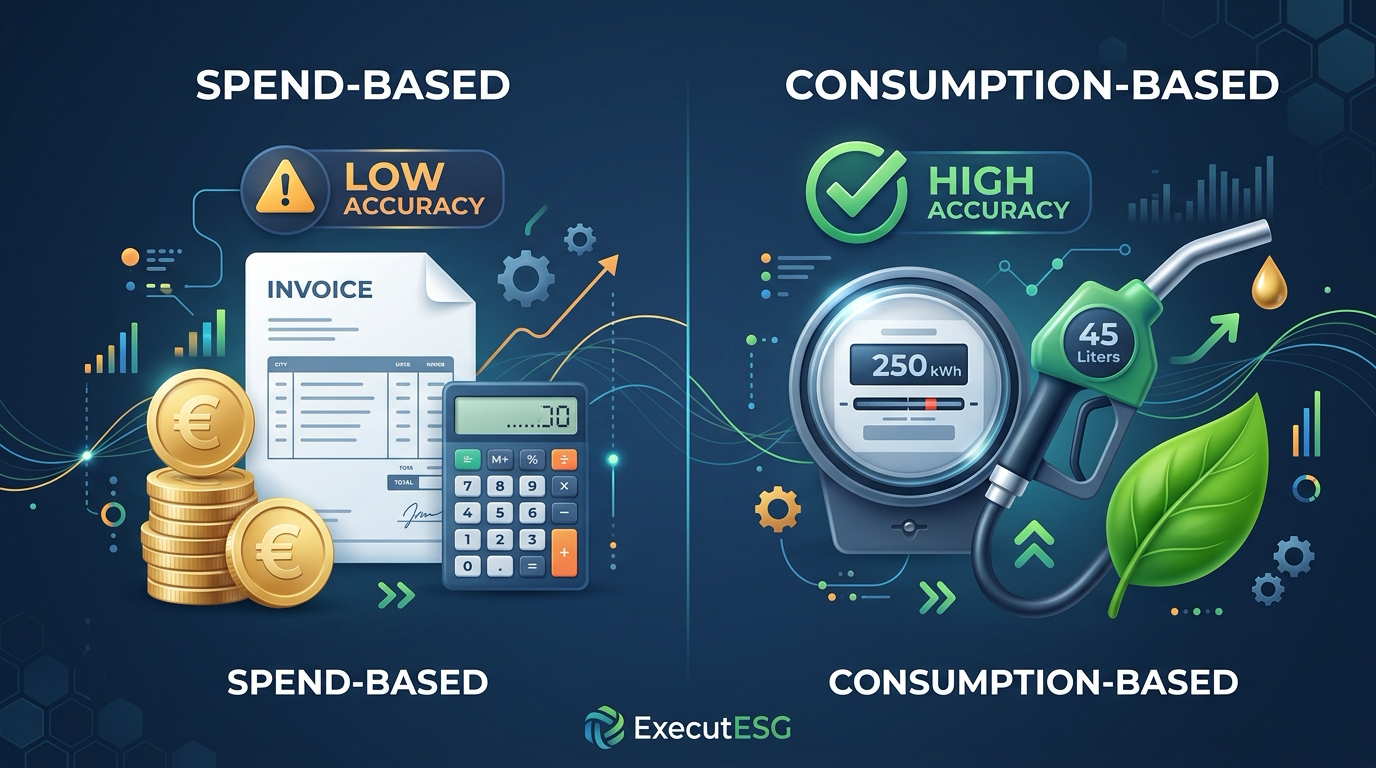
The 3-Step Progression: Spend-Based → CFO Hybrid → Primary Supplier Data
Controllers do not jump straight to surveying 300 suppliers on Day 1. Mature finance teams follow a three-stage progression (detailed in our invoices-to-audit-trails guide):
- Year 1 Screening (Chart of Accounts Mapping): Map your Finnish
Liikekirjuri, SwedishBAS, or GermanDATEVaccounts (see our Chart of Accounts mapping guide) to identify which 3 Scope 3 categories exceed 80% of indirect emissions. - CFO Hybrid Model (Physical Units on Top Vendors): Extract physical
tonnes,liters, andtonne-kmfrom Procountor, Netvisor, Fortnox, or Universal CSV invoices for your top 10 raw-material and freight vendors while keeping minor office expenses on documented spend factors. - Supplier
VS (VSME)Exchange (Primary Intensity Factors): Request standardized 1-pageVS (VSME)B3reports from your top 5 strategic suppliers so their real renewable electricity and efficiency gains directly lower your Category 1 footprint.
Explore our automated carbon accounting workspace and transparent pricing (0 € Free, 49 €/mo Core, 129 €/mo Pro with Scope 3 ERP integrations and XBRL export) to run this workflow without external consultants.
Frequently Asked Questions
Is Scope 3 mandatory under the EFRAG VS (VSME) standard?
No. In the EFRAG VS (VSME) Basic Module (B3), only Scope 1 direct emissions and Scope 2 purchased energy emissions are required. Quantifying material Scope 3 categories is an optional step under the Comprehensive Module (C3) for companies seeking green bank loans or setting value-chain targets.
Why do enterprise customers ask small suppliers about Scope 3?
When a CSRD-obligated enterprise asks a supplier for sustainability data, what the buyer primarily needs for its own Scope 3 Category 1 calculation is the supplier's Scope 1 and Scope 2 carbon intensity (VS (VSME) Disclosure B3), plus upstream raw-material origin if the supplier resells energy-intensive metals, chemicals, or electronics.
Do SMEs need to calculate all 15 GHG Protocol Scope 3 categories?
Never. Most categories (such as Category 14 Franchises, Category 13 Downstream Leased Assets, or Category 15 Investments) do not apply to typical SMEs. Focusing on the 2 to 4 material categories—usually Category 1 (Purchased Goods), Category 4 (Freight), Category 5 (Waste), and Category 6 (Business Travel)—captures over 85% of relevant indirect emissions.
How is Category 3 (Fuel- and Energy-Related Activities) calculated?
Category 3 is calculated automatically from the exact same electricity kWh and fuel liters you already enter for Scope 1 and Scope 2 (B3), applying official Well-to-Tank (WTT) and transmission-and-distribution (T&D) loss factors.
How can an SME reduce its Scope 3 emissions practically?
Three high-ROI levers move Scope 3 fastest: switching primary raw materials to certified recycled grades (such as low-carbon steel or aluminum in Category 1), consolidating parcel shipments and selecting HVO100/electric freight carriers (Category 4), and asking top-5 suppliers for their own VS (VSME) B3 baselines.
Check Your VS (VSME) & CSRD Readiness Score
Answer 6 quick questions under the EU Voluntary Standard VS (VSME) to discover your compliance gap score, estimated time savings, and generate your free starter report.
Stay Ahead of EU Sustainability Mandates
Get our weekly intelligence briefing on VS (VSME), CSRD compliance, buyer Scope 3 demands, and EcoVadis audits—distilled for European SMEs.