Scope 3 Category 4 & 9: Freight, Logistics & Tonne-Kilometre Carbon Accounting
Scope 3 Category 4 & 9: Freight, Logistics, and Upstream Transport Carbon Accounting
For wholesalers, e-commerce brands, food producers, and industrial manufacturers across Northern and Central Europe, third-party road haulage, Baltic short-sea ferries, rail freight, and air cargo regularly represent 10% to 35% of total value-chain emissions. Yet finance teams routinely misclassify outbound customer deliveries because the GHG Protocol names "Upstream Transportation (Category 4)" and "Downstream Transportation (Category 9)" follow who pays the freight invoice, not simply whether trucks drive toward or away from your warehouse!
Part of our Master Guide to Scope 3 Decarbonization for European SMEs, this operational guide explains the exact Incoterms boundary split, the ISO 14083 / GLEC Framework tonne-kilometre (tkm) formula, multimodal emission factors, and how to import carrier statements into VS (VSME) reporting.
Scope 1 vs Category 4 vs Category 9: The Incoterms Boundary Rule
Before running any emission math, separate your transport movements using one clear rule under the GHG Protocol: Did your company operate the vehicle, pay a third-party carrier, or hand goods over at your loading dock for the buyer to transport?
| Movement Scenario | Typical Incoterms (2020) | Correct GHG Bucket | Data Source |
|---|---|---|---|
| Vans or trucks owned or leased & operated by your company | Own fleet delivery | Scope 1 Direct (VS (VSME) B3) (or Scope 2 for EV vans) |
Commercial fuel cards (litres diesel/HVO) or charger kWh |
| Inbound freight of raw materials paid by your company | EXW / FCA (supplier dock) |
Scope 3 Category 4 (Upstream) | Freight forwarder invoice (DSV, DHL, DB Schenker, Posti) |
| Outbound delivery to customers paid by your company! | DAP / DDP / CIF / CPT |
Scope 3 Category 4 (Upstream) | Yes, Category 4! Any third-party freight paid for by the reporting company sits in Category 4, even outbound customer shipments. |
| Third-party warehousing & cold storage paid by your company | Outsourced 3PL hub | Scope 3 Category 4 (Upstream) | 3PL pallet-day energy summary or warehouse floor-area share |
| Outbound transport after sale paid by the customer | EXW / FOB (your dock/port) |
Scope 3 Category 9 (Downstream) | Dispatched shipment weight (tonnes) × customer city/port distance (km) |
[!NOTE] If your company is a road haulage or logistics carrier itself, diesel or HVO burned in your own trucks is your Scope 1 (
B3), which simultaneously supplies your shipper customer's Scope 3 Category 4 (see our dedicated freight & transport VS (VSME) guide).
How Does the Tonne-Kilometre (tkm) Calculation Work (ISO 14083 & GLEC)?
Both the GLEC Framework (Smart Freight Centre) and ISO 14083 rank three ways to calculate third-party freight emissions (always using Well-to-Wheel / WTW factors so fuel production and tailpipe exhaust are both captured):
- Fuel-Based Method (Highest Accuracy for Dedicated Loads): If your carrier reports exact litres of diesel,
HVO100, bio-LNG, or electrickWhallocated to your shipments, multiply fuel volume directly by itsWTWfactor. - Distance- & Mass-Based (
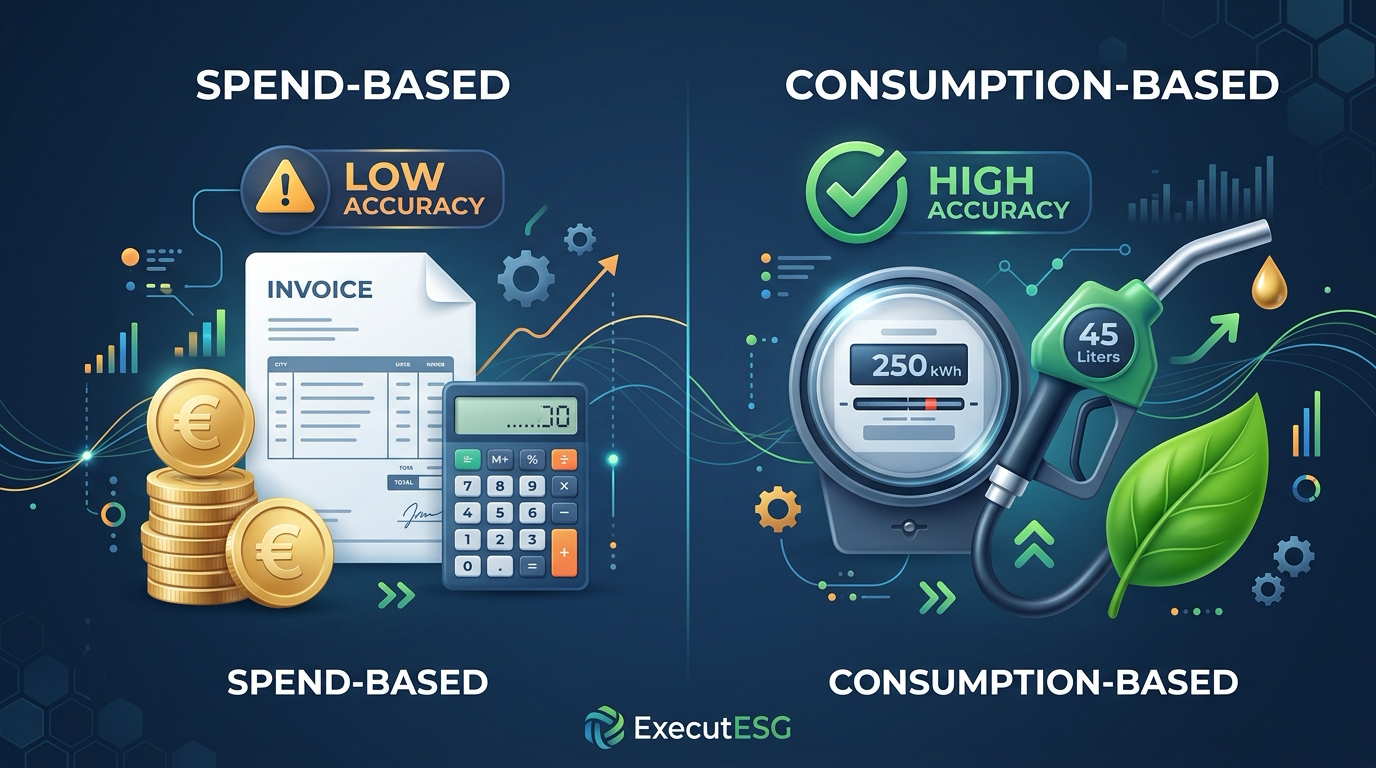
Tonne-Kilometre / tkm) Method (Standard Logistics Formula): $$\text{Emissions (kg CO}_2\text{e)} = \text{Shipment Mass (tonnes)} \times \text{Distance (km)} \times \text{Mode WTW Factor (kg CO}_2\text{e / tkm)}$$ Important: Sumtonnes × kmshipment by shipment (never multiply total annual tonnes by total annual kilometres, which mathematically inflates results by orders of magnitude!). Include gross shipment weight (product + pallet/packaging). - Spend-Based Fallback (Minor Parcel Couriers Only): Multiply net courier invoice spend (
€, excluding VAT) by an Exiobase road/postal freight factor when parcel weights are unavailable (just as in Category 1 purchased goods screening).
Multimodal Freight Emission Factor Reference (WTW Comparison)
Switching transport modes or contracting renewable HVO100 road lanes is one of the fastest Scope 3 reduction levers available to European exporters:
| Transport Mode & Vehicle Type | Indicative WTW Factor (g CO2e / tkm) |
Relative Carbon Intensity | Practical Example (10 tonnes shipped 800 km = 8,000 tkm) |
|---|---|---|---|
| Electric Rail Freight (Nordic / EU Grid) | ~15 – 28 g |
1x (Lowest) | 0.12 – 0.22 tCO2e |
| Container Vessel / Baltic Short-Sea Ro-Ro | ~16 – 45 g |
1.5x |
0.13 – 0.36 tCO2e |
Heavy Articulated Truck (HVO100 Renewable Diesel) |
~18 – 30 g |
1.3x |
0.14 – 0.24 tCO2e |
Heavy Articulated Truck (>32t Fossil Diesel, Avg Load) |
~85 – 115 g |
5x |
0.68 – 0.92 tCO2e |
Light Commercial Delivery Van (<3.5t Diesel) |
~450 – 650 g |
28x |
3.60 – 5.20 tCO2e |
| Long-Haul Air Cargo (Belly / Freighter) | ~600 – 1,100 g |
45x (Highest) | 4.80 – 8.80 tCO2e |
Takeaway for controllers: Replacing just two urgent 2-tonne air-freight shipments from Asia or Southern Europe with scheduled sea/rail freight often cuts more tCO2e than a full year of office electricity savings.
How to Import Carrier CSVs & Freight Accounts into ExecutESG
Major European forwarders (DHL, DSV, DB Schenker, Kuehne+Nagel, Posti, PostNord, Freja) provide free quarterly or annual ISO 14083 / EN 16258 CO2 customer reports in Excel/CSV upon request:
- Request Annual
WTWStatements from Your Top 3 Carriers: Ask your account manager for an annual shipment CSV listing totalshipments,gross weight (t),tkm, andWTW kg CO2eby mode. - Reconcile Against Your ERP Freight Ledger: Check ledger accounts
4150(Inbound Freight) and6150(Outbound Freight) in Netvisor, Procountor, or Fennoa using our CFO CoA Crosswalk so small courier invoices not covered by your top 3 forwarders are captured cleanly. - Generate Your Verified Report: Upload carrier figures into ExecutESG's carbon accounting module (
0 €Free for Scope 1 fleet ·49 €/moCore ·129 €/moPro with Scope 3C3targets, ERP sync, and 1-click EFRAG XBRL export; check readiness or compare plans).
Frequently Asked Questions
1. Why does outbound customer delivery paid by our company sit in Category 4 instead of Category 9?
Under the GHG Protocol Scope 3 Standard, Category 4 covers all third-party transportation and distribution services purchased and paid for by the reporting company in the reporting year—including both inbound raw materials and outbound DDP/DAP deliveries to customers. Category 9 covers only downstream transport after point of sale paid for by the customer (such as EXW or FOB orders).
2. What is the difference between ISO 14083 and EN 16258 in freight carbon accounting?
ISO 14083 (published in 2023 and aligned with the GLEC Framework) superseded EN 16258 as the global international standard for quantifying greenhouse gas emissions across multimodal transport chains and logistics hubs, mandating consistent Well-to-Wheel (WTW) emission accounting.
3. How do we prevent multiplying total tonnes by total kilometres by mistake?
Always calculate tkm per shipment or per route lane (Shipment_i Tonnes × Shipment_i km) and sum the resulting tkm rows. Multiplying annual summed weight by annual summed distance across 100 deliveries exaggerates tkm by roughly 100x.
4. Can we claim emission reductions from carrier "Book and Claim" HVO or Sustainable Aviation Fuel certificates?
Under ISO 14083 and EFRAG guidance, record physical network WTW emissions transparently first, and document audited carrier Book-and-Claim fuel insets (HVO100, SAF, electric fleet certificates) separately with retirement serial numbers so auditors can verify zero double-claiming.
5. Do non-listed SMEs have to report Category 4 and Category 9 in VS (VSME)?
In EFRAG's VS (VSME) Basic Module (B3, 0 € on ExecutESG), only your own operated vehicles (Scope 1) and facility energy (Scope 2) are mandatory. Quantifying Category 4 and Category 9 freight is recommended under Comprehensive Module C3 (129 €/mo Pro) for wholesalers, exporters, and manufacturers where third-party transport is a material emission driver.
Check Your VS (VSME) & CSRD Readiness Score
Answer 6 quick questions under the EU Voluntary Standard VS (VSME) to discover your compliance gap score, estimated time savings, and generate your free starter report.
Stay Ahead of EU Sustainability Mandates
Get our weekly intelligence briefing on VS (VSME), CSRD compliance, buyer Scope 3 demands, and EcoVadis audits—distilled for European SMEs.